
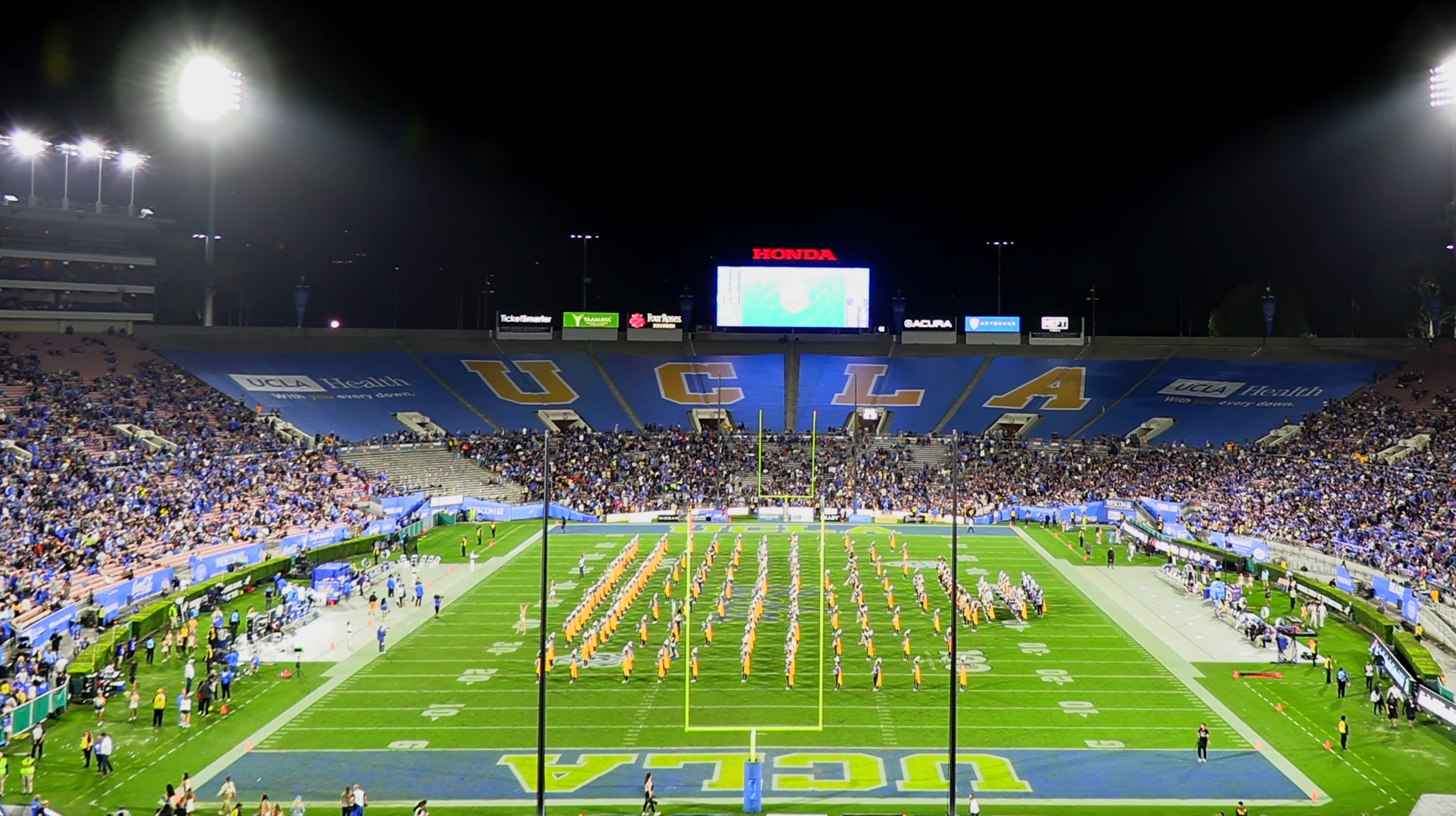
1928 to 1934 MAJOR STEPS FORWARD
With UCLA’s entrance into the Pacific Coast Conference in 1928, the University was compelled to assemble a Band comparable in size and quality to other Pacific Coast Conference schools. As the California Daily Bruin put it, “Every effort is being made to organize the rooting section and the band so that they will be on par with those of the other coast universities.”[1] As a further incentive to join the Band, the University approved 1.5 units of BA credit to all members, regardless of their current ROTC enrollment status, beginning in February 1928. In order to receive credit, students simply added the course “University Band” to their study lists.
Following the passage of University credit for band participation, the Band became the primary ensemble on campus, used to “serve all purposes when a band is needed.”[2] The ROTC Band, which had previously performed with the Pep Band at campus events, now primarily performed at military events.[3] Leroy Allen, who directed the Band from 1934-1947, differentiated the performing duties of the two ensembles by pointing out, “[The ROTC Band] furnished music for campus functions. The ‘Cub Band’ was organized to serve the extra-military needs of the student body.”[4] For instance, the ROTC band performed at events such as “drill formations, athletic contests, and University meetings,” while the Pep Band performed at less formal campus events such as student rallies.[5] Commenting on the direction and leadership of the Pep Band, Allen stated, “Under student control, there was a yearly change of leadership, resulting in direction by paid professional musicians, student directors and, occasionally, the ROTC band master, until 1935, when all bands of the University were placed under a faculty member of the Department of Music.”[6]
Describing the status of the Band in 1928, Richard Petrie ’29 told the California Daily Bruin, “A good band is the biggest advertisement a university can have, and nothing will get the name of an institution before the public better than a snappy band performance. No college activity demands a greater amount of time for preparation than does a band. In fact, two or three years of practice are necessary to produce a really good organization.”[7] The Band was likely present at the Southern California Olympic tryouts held in the Coliseum on June 16, 1928, which featured a combined band of 1000 performers.[8]
A New Director and New Uniforms
However, by the fall of 1928 the Band still had much to accomplish in order to favorably compare with other Pacific Coast bands. Students could not help but notice how the emerging ensemble paled in comparison to the established strength of the USC Band. In a letter to the editor of the California Daily Bruin, an unidentified student lamented, “[There are] two things the Band needs. One is instruction and the other is uniforms.” Nevertheless, the student noted the Band’s potential, stating, “There is sufficient musical talent among the men and sufficient will to put it over. If a means is found, a band may emerge from the chaos equal to anything on the coast.”[9]
In response to these concerns, Kenneth Piper ’29, ASUC President, immediately took action to ensure the purchase of uniforms and hiring of a full-time band director. Piper asserted, “I absolutely will not have a band on the field until I can put a Pacific Coast Conference band out there; consequently, we have planned a uniform that will add distinctiveness as well as dignity to the institution. We will hire a band leader of high caliber and I plan in that way to put the Band upon the same scale in reputation as our daily paper, annual, and athletic teams.”[10] Piper’s effusive support for the Band led to over 150 students appearing at the Armory to audition in October 1928, even though there were only 50 vacancies and 25 spots for alternates. [11] [12]
The ASUC Council appropriated $3000 for a uniform styled after West Point cadets, which John Vaughn ’31 demonstrated at the Arizona rally on September 28, 1928.[13] California Daily Bruin then published a photograph on October 1, showing Vaughn modeling the new uniform. The caption described the uniform in more detail: “The cap is of military style, and is white, with a gold band and patent leather visor. The waistcoat is made of flannel, being blue, with gold braid and buttons. The trousers, also flannel, are white, and very high waisted. Over the waistcoat is the cape, which is blue on one side and gold on the other, so that it may be worn on either side, or reversed for stunts on the field.” [14] Band members wore black shoes to complete the uniform.[15] To offset costs, the University directed the proceeds from the Frosh-Soph Brawl towards the purchase of the uniforms.[16] Additionally, the Association for Women Students (A.W.S.) pledged its support by selling bags of homemade candy, many of which contained prizes and donating proceeds to the Band. Groups that participated in the sale included social sororities, Phrateres, and the YWCA.[17]Observing that Band members were thrilled to receive the uniforms, the California Daily Bruin wrote, “Enthusiasm is running exceedingly high among members of the Bruin band this week.”[18]
The Band purchased its uniforms from C. L. Johnson of Desmond’s Department Store in downtown Los Angeles, who praised their aesthetic, stating, “We have made uniforms for some of the leading universities and colleges in the west, but I have never seen anything that could surpass those that you have chosen for your official band – they are undoubtedly the finest I have ever laid eyes on.”[19]
H. Monte Harrington, in his California Daily Bruin column “The Lantern,” wittily praised the uniforms, believing that they signaled the start of a new era for the Band. “Several years ago we had a band composed of a dented tuba, [and a] piccolo… It was no wonder that men wouldn’t turn out to join the band. But that’s over with. No university band on the coast will be more fittingly arrayed than ours. We have been howling about a decently dressed band for ten years and now we have the uniforms. Now we want fifty men.”[20] Meanwhile, “E.K.C.” proudly wrote to the paper declaring, “The improvement in the University Band this year is of great significance. It is one of the many outward signs that the University of California at Los Angeles has begun to ‘arrive.’”[21]

The Band on the Vermont Street campus in 1928
On October 4, the Band announced it had hired Benjamin Laietsky as director and Captain Ayres as drillmaster. Laietsky, a former member of John Philip Sousa’s band, had over twenty years of experience directing ensembles such as college bands, Firemen, and Shrine Policemen.[22] Kenneth Piper, President of the Associated Students, stated, “The consensus of opinion among the men of the band seems to be that they are extremely privileged to be allowed the tutelage of Mr. Laietsky, to whom they have taken a great liking.”[23] Likewise, Ayres had previously worked with the USC Band and Legion band, which won first place at the National Air Races and Pacific Southwest Exposition in 1928.[24] Frenchy Woodruff had the task of arranging music for the ensemble.[25] The Band scheduled weekly rehearsal on Mondays, Wednesdays, and Fridays from three to five in the Armory.[26]
The California Daily Bruin described Laietsky’s demeanor and the overall atmosphere at the Band’s first rehearsals. “Undaunted by the noise [at rehearsal], Benjamin Laietsky, director of the Band, presides over the distribution of the music. But all this veritable bedlam has the potentialities of an effective varsity band, for with one gesture from Mr. Laietsky, all the discord is concerted into the strains for the University’s fight songs and rousers as well as the better known marching songs. No temperamental tearing of hair and gnashing of teeth accompanies these rehearsals. With curt phrases the director doles out advice to the men, ranging all the way from the proper conduct of bandsmen in public to the technicalities of march music. While the Band proper rehearses in the Armory, out on the military field several aspiring drum majors receive instruction in the intricacies of wielding the silver baton. As is characteristic of new organizations, informality attends these rehearsals. Members straggle in one by one for a full hour after the practice has officially begun. The arrival of a new bass drum receives such a tremendous ovation that the practice has to be halted for a time.”
The Band unveiled its uniforms to the student body at the Pomona Rally on October 22, 1928.[27] At the Pomona game, the Band played “March Triumphant,” and “Fighting Bruin Bear,” while “marching in perfect rhythm from the east side of the field to the center.” [28] Recalling the Band’s highly anticipated performance at the Pomona football game, Southern Campus poignantly described the event. “As they marched out through the tunnel at the west end of the Coliseum that memorable Saturday, the marching musicians made an effective picture in their trim uniforms of blue and gold. In perfect step they marched the length of the field in orderly lines. With the shouts of the rooting sections barely heard above the sound of their playing, they returned to the middle of the field, executed a series of intricate maneuvers and drew up before the stands.”[29].
Southern Campus expanded on the greater significance of the Band’s new uniforms. In many ways, the uniforms symbolized the progress the band had made in becoming an organized ensemble. “The band was at last a reality,” wrote Southern Campus. “Against the green of playing field, the band made an effective picture in their trim uniforms of blue and gold. As they marched down the length of the Coliseum in perfect step to the martial swing of the blaring music the entire rooting section rose with a triumphant shout. For five years this moment had been awaited. It was more than a band that was playing; it was five years of effort capped with success… Within one short year the band has achieved an important achieved an important and dignified place in the life of the University and of the community.”[30]
First Marching Band Director Benjamin Laietsky [31]
Benjamin Laietsky was born on November 16, 1884, in St. Louis, Missouri, to Russian parents who had emigrated from Kiev just two years before. He became an accomplished violinist and began his career as a musician performing in theaters in the St. Louis area before moving to Southern California just before World War I. He continued his career as a violinist in theater orchestras including the one at the Superba Theatre on South Broadway in downtown Los Angeles. He was featured as a violin soloist with the John Philip Sousa Band as they toured the United States. By 1916, he was also a well-known orchestra leader and his ensemble was selected to perform at the opening of the cavernous Dome Dance Pavilion in Venice Beach on July 4th of that year.
Throughout the 1920’s, Ben Laietsky’s Orchestra was a summer fixture at the Crescent Avenue Pavilion on Catalina Island. In 1928, his parents, who were visiting during one of Laietsky’s performances on Catalina Island, were surprised to see some friends of theirs from Russia, the Levys, whom they had not seen in almost 40 years. While the two families were getting to know each other again, Benjamin Laietsky was introduced to the Levys’ daughter, Isabella, who was Benjamin’s dance partner later that evening (after Ben turned the baton over to another musician in the ensemble) and then his wife a few months later.
The Band’s welcoming of John Philip Sousa in downtown Los Angeles was widely publicized and a source of great pride for the newly formed band, as well as for Laietsky, who was reunited with his former bandleader. This turned out to be Sousa’s final visit to Los Angeles before his death in 1932.
While Benjamin served as Director the UCLA Marching Band, the Laietsky family had a son, Marvin (who was living in Hollywood as of 2011) and they moved from Beaudry Ave. in downtown L.A. to 140 S. Almont Drive in Beverly Hills, which placed him between his teaching position at UCLA and his professional work in downtown Los Angeles.
During his time as Director of the UCLA Marching Band, Laietsky maintained his career as a violinist and orchestra leader. After two years at UCLA, he left to focus on his growing opportunities to work as an orchestra contractor and manager for theaters, such as the opulent Orpheum Theatre, and for numerous radio shows, including those for Jimmy Durante, Cliff Arquette, Kenny Baker and Garry Moore. In the mid-1930’s, after suffering numerous misspellings of his last name for years, he officially changed it to Lasky.
Lasky’s career as an orchestra contractor and conductor continued through the 1940’s, and he would often be asked to assemble ensembles for events at the Shrine Auditorium, the Greek Theatre and for the Ice Capades. Lasky arranged for comedian Red Skelton to appear at one of the Shrine Auditorium shows, which Skelton did as a favor to Lasky for helping him become a member of the Masons – Lasky was very active in that organization and reached the 33rd Degree, the highest possible level.
When Beverly Hills Band Director George Wright was drafted into the Army at the beginning of World War II, Lasky filled in for him for a few years at the same time that his son Marvin attended that school. Lasky was used to working with the finest professional musicians in Los Angeles, so at times, the high school students’ shenanigans wore on his nerves. One day, he told the band members to sit down and be quiet, because they were going to take the full hour class and intently listen to one of their classmates named Andre play the piano for them. Andre, was Andre Previn, whose international career as a composer, conductor and pianist continued until his death in 2019 at the age of 89.
Benjamin Lasky died in Los Angeles in 1955 at the age of 70.
The Band Greets John Philip Sousa
A culmination of the University Band’s early success and revitalization occurred on November 8, 1928. The Band met on campus at the Armory for uniforms, leaving the campus in buses at 10 a.m. At 11:30 a.m., the entire University Band welcomed renowned conductor John Philip Sousa, “the world’s greatest ‘March King’,” on what was to be his last visit to Los Angeles. [32] In one of the many extraordinary occasions in the Band’s storied history, Lieutenant Commander Sousa conducted the Band in a performance of “The Stars and Stripes Forever.” As Sousa left for the Biltmore Hotel, the University Band, fully clad in its new uniforms, marched down the street behind Sousa’s car, playing “Men of Valor,” “Crosley March,” and “Typhoon March.”[33] Following the parade, Band members dined at the Biltmore Hotel and received tickets to Sousa’s upcoming concerts at the Philharmonic Auditorium.[34]
The California Daily Bruin column “The Lantern,” ran a headline that read “What Will Sousa Say?”; the column stated, “Our Bruin band gets quite a coup today when Sousa steps from the train and leads them in his best known march, ‘The Stars and Stripes Forever.’ The citizenry of Los Angeles will be treated when the band follows Sousa to his hotel, blaring away down the main drag in the blue and gold’s. Better publicity can’t be bought at any price.”[35]

John Philip Sousa with Director Benjamin Laietsky
Robert Keith Becomes Band Manager
The day after the Band greeted and performed for Sousa, the California Daily Bruin revealed that Robert Keith ’30 had been appointed the Band’s manager as part of “the first step in organizing a permanent managerial staff for the Bruin band”;[36] two juniors and two sophomores joined Keith as assistant managers. One of Keith’s first activities as Band manager consisted of securing gigs for the Band in San Francisco or San Diego during winter break 1928. Keith also negotiated with the Associated Students with hopes of allowing the Band to travel to Pacific Coast Conference games in 1929.[37]
Former manager Barry Bertram explained the duties and commitments required of him as Band manager. Essentially, managerial duties included overseeing the Band’s uniforms, planning gigs, arranging for transportation to performances, planning the Band’s meals, and managing regular and alternate members at scheduled events. “I made sure the fellas got their instruments there,” Bertram added. “The school provided instruments to some extent.”[38] To store the Band’s new uniforms, the University allocated two store rooms in the Mechanic Arts building.[39]
In December 1928 twenty-five members of the Band performed downtown at the Hillstreet Theatre, where the group marched onstage and performed a brief drill routine.[40] In the spring, the Band performed at basketball games, held at Olympic Auditorium, and planned “various check board formations” for its halftime show.[41] Meanwhile, Laietsky was busy making arrangements for the Band’s first film appearance in a Universal motion picture. Although details surrounding this film remain unknown, Laietsky announced the twelve members selected to appear in it at rehearsal during the second week of January.[42]
The Psi Chapter of Kappa Kappa Psi is Formed
The Band held a vote at rehearsal on February 20, 1929 whether to petition Kappa Kappa Psi, the national honorary band fraternity, with the goal of starting a chapter at UCLA. The Band continued to discuss the prospect of forming a fraternity at the first annual Band Banquet, held on February 23 at the downtown Mayfair Hotel and formed a fraternity on a University level, designated Kappa Theta Psi, with “ambitions towards a higher scholarship, better fellowship, and higher type of musical attainments for the members.” [43][44][45]
The members then petitioned Kappa Kappa Psi, the national organization. On May 7, 1929, the California Daily Bruin published an unofficial confirmation that the Band’s Kappa Theta Psi campus fraternity would become the Psi Chapter of Kappa Kappa Psi. The California Daily Bruin credited Robert Keith ’30, manager, for the success of the Kappa Kappa Psi petition.[46] [47] Nearly half of the Band members were initiated into the fraternity on May 4, 1929 at the Elk’s Club, electing Richard Petrie ’29 as president and Franklin Stoakes ’30 as vice-president.[48] Lacking its own fraternity house, the fraternity held its meetings at the Theta Delta Chi fraternity house in Westwood.
The Band inducted Herbert Clarke, renowned cornetist and former member of Sousa’s band, as an honorary member of Kappa Kappa Psi in November 1929 at the Breaker’s Hotel in Long Beach.[49]
On May 31, 1929, a day known as “Moving Day,” the Southern Branch began transitioning to its new campus in Westwood. Classes dismissed early at one in the afternoon, as the Bruin Band led the caravan from Hollywood to Westwood, where the ROTC Band performed in front of Royce Hall.[50][51] In the fall of 1929, Laietsky returned to direct the Bruin Band after a short absence during which he worked on recordings for Vitaphone films, as Fred Kienzle ’30 served as manager.[52] The Band held rehearsals on Wednesdays and Fridays at five in the afternoon, and Saturday mornings before games at ten in the morning.[53] At the Band’s first appearance of the season, which was at the USC game, the California Daily Bruin noted, “The Bruin band made an impressive appearance with the flashy blue and gold capes. Inasmuch as no performance was given by the Trojan band, the Bruin entertainers occupied the full limelight in the parade unit of the program.”[54] An editorial in the California Daily Bruin stated of the new campus, “It has a band which cannot be beaten.”[55]
In one of its first off campus engagements since moving to Westwood, the Band performed at the Beverly Hills Society Circus, held at the intersection of Wilshire and Santa Monica boulevards in October 1929. The Band, “chosen from among all the college bands in the Southwest,” performed at the opening ceremonies and for a national broadcast of the event, along with the Women’s Chorus.[56] The circus featured numerous celebrities present, including Sam Hardy as ringmaster and Fred Niblo as master of ceremonies, along with special guests Wallace Beery, Clara Bow, Charlie Chaplin, Chester Conklin, Hoot Gibson, Moran & Mack, Lois Wilson, and the Little Rascals.[57] After performing at the Beverly Hills Society, the Band made an appearance at the Masonic Clubhouse’s Halloween Party.[58]
Walter T. Bogart, editor of California Daily Bruin, effusively praised and congratulated the Band in an October 1929 editorial, highlighting the progress the organization had made since hiring Laietsky one year prior. Describing the Band as “one of the most alive of all our activities,” Bogart stated, “Of all the students’ musical organizations it is perhaps the one in the most satisfactory condition… They give programs and more programs. Their idea seems to demonstrate that their purpose in having instruments and uniforms is not to practice in them but to give the public music. And their music doesn’t seem to suffer for it.”[59]
The Band continued to fulfill off-campus engagements in 1929, performing at the Western Aircraft Show on November 14. Band members were served dinner on campus at the Co-op, and then rode in buses to the intersection of Wilshire and Fairfax avenues. The Band’s performance was broadcast on four radio stations.[60]
The Band’s performance at the St. Mary’s football game on November 16 illustrates the pictorial nature of the Band’s performances during the era. The Band marched in front of the St. Mary’s fans, forming the word “St.” and the letter “M”. The Band then marched toward the UCLA rooters, where it spelled out the letter “C”, “with a butterfly waving of capes.” Drum major Lewis Lowe and manager Fred Kienzle first introduced the idea of using these cape maneuvers to further accentuate drill sets on the field in 1929, known today to members as “Cape Tricks”.[61] Although still performing relatively simple maneuvers, the Band continued to develop its style for halftime shows.[62][63]
For the 1930-31 academic year, Martin Ruderman ’31 assumed the responsibilities of both director and manager, succeeding Benjamin Laietsky. The Band grew to sixty members, as Norman Hanwell ‘31, assistant manager, and Lewis Lowe ‘33, drum major, assisted Ruderman. To highlight its formations during night games, the Band began a tradition of fastening white lights to its instruments and batons. Ruderman pointed out that the Band was the “first collegiate organization in the United States to appear with lighted instruments at a night game.”[64] The 1930-31 season also marked the first time the Band’s drum majors, Lewis Lowe and Richard Dickerman ’34, twirled batons. As it had done in previous years, the Band continued to award letters to players based on attitude, playing ability, and attendance.[65] Ruderman told the campus newspaper that the Band hoped to travel to the Stanford game in 1931, and organized an intramural football team comprised of Band members that played against the Glee Club on December 19, 1930. Although students expressed concern about the Band’s lack of appearances at basketball games against USC, the California Daily Bruin revealed that the Band had made an agreement with the USC Band to alternate performances each year.[66] Additionally, Dean McHenry, ASUC’s newly elected student body president, pledged to further improve the Band.[67]
The following year, in which the Band embarked on its first trip to Stanford, featured Harley ‘Dick’ Dickerman ’34 as director, Lewis Lowe ’33 as manager, and Bart Sorge ’33 as assistant manager. As manager, Lowe’s duties included managing the Band’s finances and planning drill, while Dickerman handled conducting duties. The Band’s first appearance of the year occurred at the Fox Theater in Westwood, and the Band rehearsed on Monday, Wednesday, and Fridays.[68] 1931 marked the first time the Band held sectional rehearsals, scheduling separate brass and woodwind rehearsals.[69] The Band also began storing its uniforms in the then-recently dedicated Kerckhoff Hall.[70] Meanwhile, the Women’s Band re-organized in October 1931, seeking new members.[71]
“On To Stanford”: First Bay Area Trip in 1931
The Band began its tradition of annually traveling to the Bay Area in 1931 for the Stanford football game. Though the Band would later travel by train or plane to Palo Alto or Berkeley, the Band along with over 200 other loyal rooters boarded the H.F. Alexander boat, which the California Daily Bruin hailed as the “fastest liner along the coast,” in Wilmington on Friday, October 30. The event was a momentous occasion for the University, marking the first time that a large contingent of UCLA traveled outside Los Angeles to support their football team. The paper also noted that the football team was sure to put on an entertaining show for fans, stating, “It is rumored that old Father Spaulding has a few quick tricks himself, to be played in answer to manipulations of the Cards up north. The old hide-out play, with a player sent up in the bleachers disguised as a hot-dog vendor in the hope of receiving a long pass, may even be revived.”[72]
On October 16, the Band held a Sunday morning rehearsal, during which the Band finalized its roster of thirty-five for the ensemble’s first trip north.[73] Despite heavy rain and an early call time of 8 a.m., the rehearsal had an enormous turnout. Lewis Lowe stated, “This is the first year that our team has had a good chance to beat Stanford, and we don’t want to miss it.”[74] A.S.U.C. disbursed $100.00 to cover the Band’s expenses for the trip, and the Band paid for bus fare and one meal.[75] In the days leading up to the Stanford trip, the Band introduced a new fight song at the Pomona football game. The tune, “Bruin Fight,” was written by Bert Price ’27 and arranged by the Band’s own solo cornetist, Harry Bunton ’32. [76]
Former Band manager Barry Bertram ‘35, who came to UCLA in 1931, explained that the University chartered a boat to the San Francisco Bay Area annually for the Band and students. “They had ships here going daily for tourists from San Pedro to San Francisco and whenever we were playing [Cal or Stanford] in San Francisco, we took over the entire ship,” Bertram explained. “Not only the Band, but [also] the students [were onboard]. We’d leave in the morning, and get there in the afternoon on a Friday and then get a hotel in San Francisco. Then they’d bus us over to Berkeley.”
The H.F. Alexander departed Wilmington at 4 p.m., with many students taking a train to Wilmington.[77] The Band gave several performances on the liner, which featured nightly parties on Friday and Saturday. Buses were scheduled to meet the Band after docking in San Francisco; these transported the ensemble to parades held in San Francisco and at the Palo Alto campus.[78] Detailing the route of the parade in San Francisco, the California Daily Bruin wrote, “The Band will head the parade up Market Street, playing all the university airs en route to the farm.”[79] On Saturday, the Band performed at the football game, which started at 2:30 p.m. The Band was featured on radio station KPO after the game, performing six selections during a thirty-minute program at 9:30, and then boarded the boat at 1 a.m. for the journey to Los Angeles, on which the travelers ate a midnight dinner. [80][81] [82]
Recalling the Band’s seafaring trips, Bertram stated, “We were able to get the entire ship, and at that time, it cost us $8.00 roundtrip. UCLA paid for the hotels and the buses, and getting our instruments there, and our uniforms.” During the lengthy voyages, which often did not reach Northern California until 9:30 a.m. the following day, the Band and students had a spirited time, dancing throughout the night. “It was not a sleeping boat,” Bertram reminded. “When we got on at midnight, you know, [we were] just sitting on the decks, sitting on the chairs, and [we’d] walk around, have a [drink], or talk.” As Southern Campus wrote, “The participants had a better time, if possible, on the return trip than on the voyage up.” The travelers celebrated through the night, despite the night though some “crawled away to get a little sleep.”[83]
Not every Bay Area trip was smooth sailing for Bertram, however, who recounted his experience of nearly missing the boat. “I recall a couple of times that we were a little bit late [to the ship], and it was pulling out and we jumped on. I was with somebody else, and we had to jump. [The boat] was just pulling off right when we did it.”[84]

On the boat to Palo Alto in 1931
As the Band expanded to 60 members in 1931, members wished to continue playing their instruments outside of athletic events. As a result, the co-ed UCLA Concert Band was formed, which sought to achieve a high standard of musicianship by playing challenging pieces of music during the spring semester. [85][86]

On the field at the Coliseum in 1931
The Band presented an innovative show at the Idaho game in October 1932. The California Daily Bruin noted, “The Bruin Band proved its worth by putting up one of its most amusing shows to date.”[87] Directed by Dr. Edward M. Hiner and Lewis Lowe, the Band dressed as divers while three students in swimsuits performed various antics on the field. [88] The Band then revealed a new set of uniforms at the freshman football game against Stanford on October 15.[89] On October 17 the Band performed at a crew rally, at which Hollywood stars Jackie Cooper and Jimmie Durante were present. The Band also had a number of radio performances during the 1931-32 season, performing on stations such as KHJ, KFI, and KMTR.[90] At the KFI broadcast, the Band performed “Song of the Field,” and “The NC-4 March.”[91]
In January 1933 the Band began rehearsing for its upcoming performance at the Junior Chamber of Commerce Winter Sports Carnival at Lake Arrowhead. Participants included the UCLA ski and hockey teams, which competed against USC, Cal Tech, and Whittier. The Band performed at all sporting events at the carnival and gave daily concerts in Lake Arrowhead, which experienced an unexpected blizzard over the weekend.[92] The Band held an informal dance, open only to officers and members of the Band, at the Delta Sigma Phi house on May 12.[93] In the fall of 1933, the Band, managed by Lawrence Everett, increased to 80 members.[94] Forty members of the Band traveled to Palo Alto for the Stanford game, as the Band again boarded the H.F. Alexander on September 29.[95] ASUC further defrayed the Band’s cost for the trip, as each Band member paid $6.00 in out of pocket expenses.[96]
As the Cal Band threatened to strike in October over the possibility of Berkeley cancelling its trip to Los Angeles for the UCLA game, a UCLA student wrote a letter to the California Daily Bruin calling for more support for the UCLA Band. “When questioned as to why they do not support the band, students are quick to point out that it is really too small an organization to merit much attention. It is this very lack of interest which causes the membership in the band to decrease materially each semester… School spirit is all right when one feels that the student body is backing him, but this cannot be considered in this case. The trip to Stanford was financed for the most part by band members themselves, the ASUC assuming only a fraction of the expense…If UCLA desires a band truly representative of its increasing importance, it would behoove the student body to remedy the evident lack of interest and advantages relative to the band which his found on this campus.”[97]
In the spring of 1934, UCLA and USC featured exchange assemblies to “further friendly relations between the two major universities” at which the Band performed.[98] USC hosted its assembly in Royce Hall, while UCLA held a return assembly at USC on May 23.[99] The Band also performed at the opening of the Beverly Hills Post Office. Wearing dark suits instead of uniforms, the Band arrived at the post office after dining at Anderson’s Café, located at the intersection of Santa Monica Boulevard and Canon Drive.[100] In May 1934, Barry Bertram ’35 was elected manager of the Band, with Clark Lewis ’35 serving as assistant manager for the 1934-35 year.
1932 Director Dr. Edward M. Hiner
Dr. Edward M. Hiner was born on January 26, 1871 in Paola, Kansas. Though Hiner was a practicing dentist, he picked up the cornet in his spare time, and was influenced and inspired by John Philip Sousa to become a bandleader.[101] At the insistence of local musicians during the Spanish-American War, Hiner became the Director of the 3rd Regiment Band of Kansas City in 1889, a position he held for 27 years.[102] Hiner’s Band gained such national recognition that the group performed for President McKinley in 1898. Hiner directed the 7th Infantry Band to perform for soldiers headed overseas during World War I. The International Musician of St. Louis praised Hiner as being, “long ranked at the very top of his profession. He is noted for the seriousness with which he takes his art and one is always assured that the utmost of each selection will be brought out with the finesse and skill that always distinguishes a great artist.”[103]
Hiner had also opened a music school in Kansas City before moving to Los Angeles in 1919, where he remained until his death in 1948. In Los Angeles, Hiner served as Bandleader at the Egan School of Music, and later was in charge of the Hiner Band School, the largest private band school in the country, from 1921 until his death.[104] Several of Hiner’s students went on to perform with the Los Angeles Philharmonic Orchestra. Hiner also founded the music department at the Los Angeles Normal School, as it was known before it became the Southern Branch. [105]
John Philip Sousa was a frequent guest at the Hiners’ home in Highland Park, and Hiner had developed such a close relationship with John Philip Sousa that the March King dedicated one of his pieces to Hiner’s wife, Anna.[106]
[1] Ibid.
[2] Ibid., February 14, 1928.
[3] Ibid.
[4] Leroy W. Allen, The Origin and Development of the Department of Music at The University of California at Los Angeles, 1882-1956, 52
[5] 1922 yearbook [need citation]
[6] Allen, 18.
[7] Daily Bruin March 5, 1928
[8] Ibid., May 9, 1928.
[9] Ibid., September 27, 1928.
[10] Ibid., September 28, 1928.
[11]Ibid., October 1, 1928.
[12] Ibid., October 2, 1928.
[13] Daily Bruin, September 28, 1928; October 1, 1928.
[14] Daily Bruin, October 1, 1928.
[15] Combined Southern Alumnus Newsletter, 1928.
[16] Ibid.
[17] Daily Bruin, October 10, 1928.
[18] Ibid., October 11, 1928.
[19] Ibid., October 2, 1928.
[20] Ibid.
[21] Ibid.
[22] Ibid., October 4, 1928.
[23] Ibid., October 8, 1928.
[24] Ibid.
[25] Southern Campus 1929. 134.
[26] Daily Bruin, October 9, 1928.
[27] Ibid., October 22, 1928.
[28] Ibid.
[29] 1929 Yearbook, page 134
[30] Southern Campus 1929, 132-134.
[31] Text by Gordon Henderson, Solid Gold Sound Club Newsletter, Summer 2011. Special thanks to Marvin Lasky for photographs and information about his father.
[32] Daily Bruin November 7, 1928.
[33] Southern Campus 1929, 134.
[34] Daily Bruin, November 6, 1928.
[35] Ibid., November 8, 1928.
[36] Ibid., November 9, 1928.
[37] Ibid., November 14, 1928.
[38] Interview, Barry Bertram.
[39] Ibid.
[40] Daily Bruin, November 4, 1928. For roster of show, see ibid., December 5, 1928.
[41] Ibid., January 3, 1929.
[42] Daily Bruin, January 4, 1929.
[43] See ibid.,February 14, 1929; February 15, 1929.
[44] Ibid., February 25, 1929; February 19, 1929; February 21, 1929.
[45] Ibid., May 27, 1929.
[46] Ibid., May 7, 1929.
[47] Southern Campus 1929, 134.
[48] Daily Bruin, May 7, 1929; ibid., May 27, 1929.
[49] Ibid., November 5, 1929.
[50] Ibid., May 31, 1929.
[51] Jackson, 63.
[52] Daily Bruin, September 21, 1929.
[53] Ibid., October 9, 1929.
[54] Ibid., September 30, 1929.
[55] Ibid., October 14, 1929.
[56] Ibid., October 25, 1929.
[57] Ibid.
[58] Ibid., October 30, 1929.
[59] Ibid., October 29, 1929.
[60] Ibid., November 13, 1929.
[61] Southern Campus 1930, 229.
[62] Daily Bruin, November 18, 1929.
[63] Southern Campus 1929, 229.
[64] Daily Bruin December 4, 1930.
[65] Ibid.
[66] Ibid., February 24, 1931.
[67] Ibid., April 29, 1931.
[68] Ibid., Registration Issue, September 1931.
[69] Ibid., September 16, 1931.
[70] Ibid., September 24, 1931.
[71] Ibid., October 7, 1931. For photograph of Band forming “M” at Montana game, see Southern Campus 1932, 237. For Kappa Kappa Psi, see Southern Campus 1932, 405.
[72] Daily Bruin, October 14, 1931.
[73] Ibid., October 19, 1931.
[74] Ibid.
[75] Daily Bruin, November 2, 1931.
[76] See Southern Campus 1932, 404; Daily Bruin, October 23, 1931.
[77] Daily Bruin, October 23, 1931.
[78] Ibid., October 19, 1931.
[79] Ibid., October 23, 1931.
[80] Ibid., October 29, 1931.
[81] Ibid., October 19, 1931; October 14, 1931. For game time, see ibid., October 30, 1931.
[82] Ibid., October 23, 1931.
[83] For photograph, see Southern Campus 1932, ucla standford trip 1 & 2.jpg
[84] Bertram interview.
[85] For photograph, see Southern Campus 1932, 237.
[86] Daily Bruin, April 13, 1931.
[87] Ibid., October 3, 1932.
[88] Ibid., November 7, 1932.
[89] Ibid., October 12, 1932.
[90] For details on radio performances, see Daily Bruin, October 21, 1932; November 7, 1932; November 8, 1932.
[91] Ibid., November 7, 1932.
[92] Ibid., February 1, 1933.
[93] Ibid., May 11, 1933.
[94] Ibid., September19, 1933.
[95] Ibid., September 26, 1933.
[96] Ibid., September 29, 1933.
[97] Ibid., October 23, 1933.
[98] Ibid., April 17, 1934.
[99] Ibid., May 10, 1934.
[100] Ibid., April 27, 1934.
[101] Dory DeAngelo, “Edward M. Hiner: Bandmaster and music teacher, 1872-1948.”
http://www.kchistory.org/u?/Biographies,191
[102] Walter Barlow Stevens, Centennial History of Missouri, volume 4, 912.
[103] Ibid., 914.
[104] Ibid., 913.
[105] R. Dale Olson, “Chronology of Innovation: The Trumpet Mouthpiece – Part 1 of 2,” International Trumpet Guild Journal (January 2010), 66.
[106] “Reyes, Community Dedicate Sousa-Hiner Bandshell at Sycamore Grove Park,” News from the First Council District, Ed P. Reyes, November 12, 2005, http://web.archive.org/web/20060629162831/http://www.lacity.org/council/cd1/cd1press/cd1cd1press11433581_11142005.pdf.
1934 to 1941 – STRIKE UP THE BAND
Depression Causes Band Strike in 1934
By 1934 the effects of the Great Depression began to take their toll on the Band, as the ensemble encountered a lack of moral support from the student body and financial support from ASUC. Initially, Barry Bertram, the Band’s manager, spokesman, and chairman of the Music Organizations Board, called for the formation of an 80 piece Band, which at the time would have comprised the largest band in the organization’s history.[1] However, Bertram quickly realized that such a large organization was not possible under the Band’s current conditions. Fed up with the status quo, Bertram took far-reaching action. On September 19, the headline ofthe California Daily Bruin spelled it out plainly for all to see: “The University band is on strike!” Bertram, no longer willing to abide low membership and mediocrity, boldly stated that the Band would cease to exist unless “drastic changes” were made.
After he was elected Band manager, Bertram strove to increase the size of the band. “At that time, it was quite small. And when I was made Band manager, and I thought, ‘Gee, we just have to have a bigger organization.’ I felt a group like that, going into the Coliseum, you probably wouldn’t hear us very well over the 10th or 15th row.”
Convinced that the Band was too small, Bertram began brainstorming ways of increasing membership. “I was talking to some of the fellows and I said, ‘Either we gotta get this band bigger or make the Coliseum smaller,’” Bertram joked. The Band typically recruited members by printing notices in the campus newspaper, but Bertram had other plans in mind. “I was thinking about it, and I thought you know, putting a little notice in the Daily Bruin, ‘Come join the band!’ or something, it would be meaningless. So I thought of this idea of going on strike. And I was on the student council because I believe, as Band manager, you became Director of Musical Organizations.”
“And so I talked to [the student council] and told them what I was going to do. And they thought it’d be fine. So we just didn’t show up for about two or three Saturdays. They were all playing at the Coliseum at that time. And pretty soon, I started to get phone calls, you know… [asking] why we were striking. We wanted more people,” Bertram explained. “So I’d get people call and say, ‘Well, I’d like to audition.’”
And I said, ‘Audition? You don’t need an audition. Do you have a horn?’
‘Yeah.’
‘Can you play loud? Can you run? Come get a uniform.’”
Bertram himself explained the reasoning behind the strike to the California Daily Bruin in 1934. “A university of UCLA’s caliber cannot be represented by a small, poorly organized band. We will not have a band at all unless we can build a snappy, well-drilled marching band of eighty pieces as a minimum. If the Band is to fill its vital place in the University program, it must receive the sincere support of the Associated Students. Every Bruin man who can play a band instrument and has had any experience at all is expected to report for the try-out today.”[2] The strike’s sole purpose was to increase the Band’s membership, Bertram explained. “I don’t recall anything about money. To get more people, that was the idea.”
Student Body President John Burnside ’35 remained convinced that the strike would be short-lived, stating, “The advantages of band work should attract any eligible man.”[3] Despite Burnside’s optimism, negotiations continued. Although the strike quickly attracted 30 new members, Bertram continued to hold out, refusing to perform at the football games against Pomona and San Diego State unless more members joined. The Faculty and Curricula Committee then convened to discuss the idea of Band members receiving academic credit for their membership in the Band, in order to provide an added incentive to prospective members.[4]
Negotiations were also underway to hire a director, to allocate funds to provide for the transportation of 50 band members to Berkeley for the 1934 football game, and to grant an extra football ticket to everyone who had been in the Band for at least a year. Though the campus began to buzz with interest as more members joined, Bertram held his ground and continued the strike, insisting that the Band be an “eighty-piece group.”[5] “It grew quite significantly. As I recall it was up around 80 or 85 by the time [the strike] got through. And then we went back and started playing again,” Bertram stated. “From that time on, the Band stayed that large. It didn’t drop out.”
Leroy Allen Becomes Director; The Strike Ends
In the midst of the Band’s strike, the University hired Leroy Allen as the Band’s director in September 1934. Allen had previously served as the bandleader at Los Angeles Junior College and as the student band director for the Cal Band. Theodore Stearns, chair of the Music Department, hailed Allen as, “The finest band director in southern California.”[6]
Barry Bertram recalled meeting Allen for the first time and being present at his initial interview in Pasadena. “Well, there were several people they told me had applied, and I interviewed him out in Pasadena. He was very, very good, strict, and very well liked. I remember him being very personable.” Likewise, Band alumnus Jack Straus ’39 fondly remembered Allen as a pleasant, professional man distinguished by his calm demeanor.[7]
As of September 24, the Band had reached 68 members, which was still short of Bertram’s goal of having 80 members. Finally, with over 70 members in the band, Bertram called off the strike on the following day. The California Daily Bruin headline read, “Band men gain victory in strike as ends gained.”[8] Commenting on the progress the Band had made, Bertram stated, “Enthusiasm is running sky high, and only through the efforts and cooperation of the ASUC and Daily Bruin have we have been able to put the band on a status which it deserves. The student body this year has taken an entirely different attitude toward our organization.” Bertram’s gutsy move paid off, and the UCLA Band was stronger than ever.[9] [10] [11] Regarding academic credit for band members, the curricula committee established that such a measure was feasible in the future, ultimately receiving approval in 1935. [12][13]
One of the Band’s first events after the strike was to meet the football team at the Glendale station on September 28, 1934. After meeting at Janss Steps at 7:15 a.m. and being transported to Glendale, the Band led a parade in a rally around the train station’s quad. As an added incentive, members who attended this event received credit toward the upcoming Berkeley trip in October.[14]
Students wholeheartedly embraced the new Band, showing appreciation, pride, and support for the organization. An editorial in the campus newspaper stated, “UCLA has a BAND. It took a lot of time and energy on the part of students, administration, and ASUC officials, but the thing finally materialized…The Band [is] just the sort of band an institution like UCLA should have.”[15]
Leroy W. Allen’s prolific career in music began 1910. As a student at the University of California in Berkeley, he directed the ROTC Band and organized various dance orchestras. After earning his B.S. in 1913 from the University of California, he returned to his alma mater the following year, becoming Berkeley’s band director.
Allen left Berkeley in 1915 to further his studies at the Institute of Musical Art in New York. Upon graduating, Allen served as a director of bands for the U.S. War Department during World War I, but returned to Berkeley as an Associate in Music and Band Instructor after the war.
In 1925, Allen left Berkeley once again to earn his master’s degree at Columbia University. He remained in New York until 1927, where he offered private lessons. In 1927, Allen was elected to the Board of Education in Springfield, Massachusetts and was given the task of coordinating high school music departments. From 1929-1930, Allen continued his graduate education at Columbia.
From 1930-1935, Allen served as a music instructor at Los Angeles Junior College. He was elected President of the Southern California Jr. College Music Association in 1933, Vice-President of the Southern District of the California Western School Music Conference the following year, and President of the Southern District of the California Western School Music Conference in 1935.
Allen was hired as a summer music instructor at UCLA beginning in 1931. In 1934, he became director of the Band at UCLA, a position which he held for 12 years until 1946.
The First Bay Area Trip by Train in 1934
Originally, only 50 spots were available for the Band’s inaugural locomotive trip to Berkeley.[16] However, the University Board of Control was so impressed with the Band’s performance at the game the previous week against Montana that it voted to send all 67 members on the trip. The Band left at 8 p.m. on Friday, October 19, and had two private cars for the trip.[17] After boarding the station at Glendale, the Band arrived in Oakland on Saturday morning. The Band performed at the football game following a rehearsal and then had free time until the train left for Glendale at midnight.[18] Oliver Nees recalled the frantic pace of the trip, stating “[It was an] overnight train, up the coast, [which lasted] 10 hours. They took us up to San Francisco, and we would walk around on Market Street… and the train left at midnight on Saturday night, and we got back here Sunday morning.”
On October 1, 1935, the Bruin Band and ROTC Band welcomed President Franklin Roosevelt, whose motorcade passed through Westwood after visiting the Sawtelle Veterans Home. Though President Roosevelt did not stop on campus, the bands and campus community gathered on Westwood Boulevard to greet him. As the California Daily Bruin pointed out, Roosevelt was the “first President ever to pass through UCLA grounds.”[19]
As the Band continued to improve under the direction of Leroy Allen, students voiced their opinions of the Band in the California Daily Bruin. In November 1935 an anonymous student wrote a letter to the papercomplaining, “The UCLA Band is more like symphonic orchestra than anything else.” In response, a student argued that the reason for the Band’s lack of playing time rested squarely on the shoulders of the yell leaders. “Whenever the Band attempts to play a number, [the yell leaders] ‘ask’ the director to allow them to lead another yell.” In response to the comment comparing the Band to a symphonic organization, the student wrote, “the Bruin Band plays only marches at the football games.”[20] A letter from another student stated, “Director Allen is all right and so is the Band. For goodness sakes, give the boys a break. No one says they aren’t improving.”[21] Indeed, with the goal of improving the group, manager J.D. Gillespie had recently announced that the Band had plans to begin a drum major training program. Following the football game against Southern Methodist University, which brought its band to the Coliseum, a student was especially impressed with the SMU Band’s swing music. “Instead of playing the many times rehashed marches they play the modern swing tunes that have snap in them and please the crowd. Let this be a lesson to our band.”[22]
Although women did not march with the Band during this period, the Women’s Orchestra continued to have a presence on campus, performing in November 1935.[23] The Cal Band, however, started admitting women in to its band in May 1936, though women were required to march in separate formations during field shows.[24]
The Gershwins Bring A ‘Strike’ Of Their Own
As early as 1931, students complained that UCLA did not have a signature fight song; a student wrote to the California Daily Bruin in November 1931 declaring, “It is annoying to UCLA students to hear everything from “Come Join the Band” to “Bow Down to Washington” [on the radio] without mention of our own rally songs.”[25]
In 1936, UCLA had a tremendous meeting with two celebrated American composers as George and Ira Gershwin composed and dedicated a new rally song for UCLA entitled “Strike up the Band for U.C.L.A.” A writer for thecampus newspaper asked why the Gershwins would write such a song for a university with which they had no affiliation, and proudly reported, “They like us.”[26]
Maxson F. Judell, who worked in the music industry and knew the Gershwins, approached the brothers about writing a tune for UCLA as early as spring 1936. Judell had previously convinced John Philip Sousa to dedicate “Wisconsin Forward Forever” to the University of Wisconsin in 1917.[27] Lyricist Gus Kahn also desired to write a rally song for the University after he discovered UCLA lacked a signature rally tune.[28] After Kahn communicated this fact to the Gershwins, who were in Los Angeles working on the Fred Astaire film Shall We Dance and happened to have a fondness for the University, the brothers decided to write new lyrics for the eponymous song from their 1927 musical. The student body excitedly welcomed the Gershwins’ contribution. “From more than one standpoint, that makes UCLA their university,” wrote the California Daily Bruin in September 1936.[29] The Gershwins chose “Strike Up The Band” from the musical Strike Up the Band because of its “liveliness, catchiness and personality to qualify as a topnotch collegiate pep number.” After Ira Gershwin wrote a new set of lyrics for the song, the Gershwins transferred all rights to the tune to the Associated Students of UCLA. [30] In response, the California Daily Bruin printed a thank you letter with the headline “Thanks a million, a million thanks to you…”[31]
The Debut of “Strike Up The Band for UCLA”
The Gershwins presented a copy of the tune to the head of Associated Students in Kerckhoff Hall on September 23, 1936. Following the dedication of “Strike Up The Band for UCLA,” George Gershwin planned to conduct the Band at a Saturday morning rehearsal on September 26, with a performance of the tune planned for September 28.[32] The California Daily Bruin reported that George and Ira presented the song and introduced Maxson F. Judell in Royce Hall at the All-University Sing event on September 28, dubbed “Gershwin Nite.”[33] [34] George Gershwin also planned to perform “Rhapsody in Blue,” and “Variations on ‘I Got Rhythm’” at this concert.[35] A nationwide radio broadcast of the song occurred on October 2 at 8:30 p.m., performed by the orchestra of Andre Kostelanetz over KHJ Radio, and on the same night the song was played over the public address system at the football game against Montana.[36]
Not all students were pleased with “Strike Up The Band For UCLA” as a rally tune, however. A student wrote to the California Daily Bruin expressing disappointment, stating, “I have never seen anything particularly attractive about the melody of ‘Strike Up the Band.’ It has never been a catchy tune, it has never caught the musical fancy of the public. The Gershwins received a lot of publicity over rewriting the lyrics of the old song – but what has UCLA to show for it after all? Simply new lyrics set to a second-hand tune that never was so hit anyhow.”[37]
However, Maxson F. Judell wrote to California Daily Bruin columnist Hal Levy the following week with news of the tune’s national success. “You can say, as a feature touch to story, that as the orchestras and their sponsors have gotten the information on the song, they are all rushing to schedule it. That in radio, orchestral, and all circles, it is UNANIMOUS (not even one dissenting voice) that in STRIKE UP THE BAND FOR UCLA the school has one of the nation’s first two great college songs.”[38]
Further criticism from the student body emerged in the California Daily Bruin at the end of October. “This ‘rum-ta-tum-tum’ ditty that we laughingly call our new fight song is my idea of nothing on a hot day. It is bad enough to use a second hand score for our fight song, but golly Moses and Saint Elijah, when we use a worn out has-been like ‘Strike Up the Band.’”[39]
Whether students enjoyed or scorned the song, the song did not immediately emerge as UCLA’s signature pep tune as intended; in 1937 a letter in the campus newspaper revealed that a student had to visit Follies, a downtown burlesque theater, to hear “Strike Up the Band for UCLA.”[40]

First All-U Weekend, Feature Mascot Drum Major, The End of the Thirties
On October 16, 1936, UCLA joined Berkeley in the “first combined gathering in campus history,” held in the Greek Theatre on Cal’s campus. The event, which eventually became known as the “All-U Weekend,” became an annual tradition for the University of California campuses. The 80 members of the UCLA Band performed a joint concert with the 152 members of the Cal Band, directed by Charles C. Cushing, “to form one of the largest college band combinations ever to join for concert numbers on any Pacific Coast campus.” The bands started the concert by performing their respective fight songs. Each band then played two solo pieces, closing the concert with a joint performance of “Hail to California.”[41]
Stressing the importance of the occasion, President Sproul stated, “The University meeting has a triple significance. It will provide a long-merited recognition of the excellence of our University bands; it will provide an opportunity for California students north and south to meet together; and it will also enable the Berkeley campus to demonstrate the quality of its hospitality to its sister campus at Los Angeles.”[42]
The bands held a similar concert in November, as the Cal band visited Los Angeles for the USC game. The bands combined for “Our Sturdy Golden Bear,” and “By the Old Pacific,” and each band performed two solo numbers. The UCLA Band performed Goldman’s “Builders of America,” and two selections from C.C. White’s “Bandana Sketches,” before ending the concert with a combined performance of “Hail Blue and Gold,” UCLA’s alma mater.[43]
As it had done in 1936, the Band marched in the annual Tournament of Roses Parade on January 1, receiving the Silver Cup in the parade competition, an awarded presented to the best college band in the parade.[44][45] Students voiced concerns to the California Daily Bruin regarding the fact that the Band had a substantially smaller membership than the Cal or USC bands. In response, a student replied, “It is a well known fact that SC and many other large universities have subsidized their bands, drawing for their memberships from high schools and professional musicians.”[46] A further letter reiterated that the size of the Band depended on the interest of students. “It reflects whatever interest the students have in band music. If most of the boys who play instruments do not want to go out for band, one should not blame the band for being weak.”[47]
In 1937, however, students flocked to the Band seeking to join the organization. Band manager Dave Thompson stated, “An unexpected record turn-out for places in the organization makes it imperative for all men to attend the tryouts.”[48] This resulted in the Band growing to 80 members, the original target of Barry Bertram when he led the strike in 1934.[49]In 1937 the Band featured its first mascot drum major, Jimmy Casebear ’51, who was California state baton champion.[50] [51] At the Oregon game, the Band performed a special tribute show to the late George Gershwin, who died in July 1937. At this performance, the Band also worked with Walt Disney Studios sound technicians, who added halftime sound effects.[52]
In October 1937, the Band purchased new uniforms, which drum major Ed Petross displayed on the front page of the California Daily Bruin on October 22. Providing details on the new uniform, the newspaper explained, “The [jackets] are bright blue, with gold trimming around the pockets, gold braid epaulets, and gold buttons. The cap is made of white gabardine trimmed with blue. With the uniforms, the men will wear white cowhide Sam Brown belts and blue gabardine ties over white shirts. The trousers are blue, with gold stripes down the sides. Shoes will be white.”[53]
On October 22, the Band was scheduled to perform on KFI radio, as it had done in previous years. However, hours before the broadcast, the American Federation of Musicians prevented the Band from performing on the radio, since the Bruin Band was a non-union organization. As the California Daily Bruin put it, “The KFI-AFM dispute is a phase of the union’s move to require all radio stations to employ a union house orchestra.”[54] Other student representatives scheduled to appear on KFI, including student leaders and football officials, declined to go on-air without the Band, since such a program “would not have been representative of the University.” A student wrote to the California Daily Bruin in November 1937, expressing appreciation for the Band. “The stunts at the last two games have been swell, and the hard work has been appreciated. In the three years I’ve been in school, I have never seen any college band put on such a fine exhibition. Its pep and enthusiasm has influenced the entire school spirit which is the best it has ever been. Keep it up! We’ll be looking for something next game.”[55]
Eager to innovate its shows and hear ideas from students, the Band held a contest, judged by Leroy Allen in October 1938.[56] The contest invited students to drop their suggestions for field shows in a box located in Kerckhoff Hall. Band manager Kenneth Duse ’40, hoped to find “lettering or designs, as well as clever field acts” in the submissions.[57] The prize, an all-inclusive trip to the Cal game, was awarded to Charles Lesher ’39.[58] Lesher’s show idea, likely influenced by the cartoons of Max Fleischer, included characters such as “Joe Bruin,” “Van Vandal,” and the Oregon “Webfoot Duck,” and featured the tunes “You Rascal You,” and “Small Fry”. The Band performed Lesher’s show, along with its annual tribute to George Gershwin at the Idaho game on October 22.
Throughout the late 1930’s, the Band continually encountered difficulties in coordinating performances with yell leaders in the stands at football games. Roy Swanfeldt, commenting on the Band’s performance at the 1938 Cal game in his California Daily Bruin column “Mulligan,” complained, “What about our band?…[Why] did they do a sit-down strike during the [Cal] game and play no music?”[59] In a heated response, a student replied to Swanfeldt, blaming the yell leader for the lack of band music. “[Swanfeldt] better see the yell leader. The band only plays when the yell leader wants them to. Why doesn’t he know these things?”[60] Another student blamed the absence of student enthusiasm, stating, “Thickstun led the songs and the Band played them, but there wasn’t much cooperation from the rooting section.”[61] Finally, on October 28, a representative from the Band, “A. Agnue,” wrote to Swanfeldt, stating “We of the Bruin Band…spend years to build up this outfit and get a little campus recognition and you think we don’t want to be seen or heard…This year we get eighty members and try to cooperate with the rooters and Thickstun (who is a great guy) and luck goes against us. If you students aren’t cheering, the other band is playing and we’re in the hole…Why don’t you stick with us, Mr. Mulligan and see our band through, so that some day it will be the outstanding feature of our campus?” [62] The debate over coordination with yell leaders led to a freshman stating, “It would be a good idea to have song and yell practice with the band.”[63]
The Band performed a tribute to the University of Wisconsin on November 17. Featuring its mascot drum major, Jimmy Casebear ’51, the show featured the Band performing a serpentine “W”, and a performance of Wisconsin’s fight song, “On Wisconsin”.[64]
In 1938, the Band started receiving requests from spectators to include majorettes in its performances. A letter to California Daily Bruin stated, “It gets sort of tiresome watching the same old stuff and learning how to spell. The only one who really does anything is that junior drum major- and he isn’t even in college…Who am I to quibble – I’ll even take some pretty majorettes for a breather.”[65] However, the Band did not feature majorettes until the 1940’s, partly because they were perceived as being too provocative or having no place in an all-male organization. It was during this period, for example, that the Stanford Band’s majorette, who was still in high school, had received staunch disapproval from female students at the university. A newspaper article stated the protesting female students considered the majorette “undignified and an insult to Stanford womanhood.”[66] The following year, Stanford president Ray Lyman barred the Stanford band from featuring any majorettes. Meanwhile, Cal students overwhelmingly rejected the idea of drum majorettes, and members of the Cal Band itself unanimously refused the idea, citing their band was “the last stronghold of masculinity on the coast.”[67]
At the Oregon State game, the Band performed a tribute to football coach Bill Spaulding, who retired following the 1938 season. The Band spelled out “Bill” on the field, and also welcomed Oregon State to the Coliseum, forming a revolving “O,” and spelling “Aloha,” in reference to UCLA’s upcoming bowl game against Hawaii. The Band performed “Auld Lang Syne,” and Oregon State tunes.[68] On December 12, columnist Roy Swanfeldt wrote, “Brother Dick ‘Earmarks’ Pryne, returning from a Thanksgiving vacation fraternity regional conference at Stanford, reported that a member of the Stanford band lauded our outfit as the ‘best precision marching unit on the Pacific Coast’.”[69]
The Band sustained its growth into the 1939-40 year, which, according to manager Dave Wilson, featured “the largest trombone section in its history and a clarinet section of thirty-two pieces.”[70] Additionally, the music department experienced remarkable growth in 1939, as the music program included both music majors and music education majors for the first time. Leroy Allen, chair of the department, also noted, “For the first time, graduate work in music is being offered toward general secondary credentials.”[71]
With the emergence and rising popularity of swing music, speculation swirled on campus as to whether the Band would begin performing swing music, as Texas Christian University’s band had done during its performance in the Coliseum on September 29, 1939. Bruce Cassidy wrote in the California Daily Bruin, “Controversy rages. Will they swing? Five percent say yes; ninety-five percent say no. The rest are going to do something about it.”[72] In response, an anonymous UCLA band member, dissatisfied with the Band’s “conservative” style, denied any rumors of the Band performing swing music. The student wrote, “[I] have never been in any band as conservative as the Bruin Band. Every game sees the same old routine of coming out on the field and going into the same military type stunts (either a letter or a design) without any degree of informality whatsoever. It’s TIME FOR THE BRUIN BAND TO LET DOWN ITS HAIR!” Offering ideas for change, the Band member suggested the Band “come out on the field and perform some sound effects and clever narration.”[73] The following day, drum major Vincent Dagort pointed out that the Band only drilled an hour and a half per week, preventing the organization from performing more intricate maneuvers. Inviting students to offer their ideas for improving halftime shows, Dagort stated, “We have always made it known that we are open to suggestions from anyone interested. We give all suggestions a fair consideration, picking that which we can do best.”[74]
Prior to the Band’s trip to Stanford, director Leroy Allen offered insight into the organization of the Band during the late 1930s. Allen noted that band applicants were judged on both their musical and marching abilities, and the California Daily Bruin proclaimed, “The qualifications for the 1939 Bruin band members are the highest in the history of the band.” Allen went on to explain that the Stunt Committee especially considered “surprise” and “directness” in planning the Band’s field shows, and that the Band had a broad repertoire of music, ranging from marches to college songs to novelty tunes.[75]
The California Daily Bruin explained the secrets behind the planning and execution of the Band’s field shows in 1939. During the Allen era, each member received a number, which corresponded with a position on the field. The Stunt Committee drew the planned formations on a blackboard in the band room, which enabled Band members to locate their positions; for more complicated stunts, Band staff members placed numbered cards on the field.[76]
During its pre-game show at the Stanford game, the Band preformed “The Star-Spangled Banner,” and started the tradition of accompanying students in the singing of “Hail To The Hills of Westwood.” When the Band filed onto the field at halftime, it performed Stanford’s fight song, “Come Join the Band,” with members playing tom-toms. While performing this song, the Band formed the letters “LSJU,” representing Leland Stanford Junior University. The Band then morphed the letters “LS” and “JU” into two “C”’s, which merged to form an “S”. To end the show, the Band performed the UCLA fight song and formed a block “UCLA.”[77]
Instead of heading directly back to Los Angeles via train after the game, the Band stayed in San Francisco Sunday afternoon to perform at the Golden Gate International Exposition, the 1939 World’s Fair, located on Treasure Island. The Band performed a concert for an hour at one o’clock in the afternoon, where Jimmy Casebear presented his enormously popular twirling routine.[78]
Leroy Allen and alumnus Don Levy wrote a new fight song entitled “Bruin Powerhouse” in November 1939.[79] The Band won top honors in the 1939 Armistice Parade, and drum major Jimmy Casebear won top honors in the drum major category, despite facing stiff competition from over 100 entrants.
Sixty-two members of the Band traveled to Cal in 1940, where the Band joined the Cal and Davis bands for a combined halftime show, which featured all three bands “for the first time in University history.”[80]
Video of the 1940 Homecoming Parade
Video of the 1941 Homecoming Parade
In October 1941, the Band featured majorettes for the first time. Selected on the basis of a field tryout, the Band’s inaugural majorettes were Kay Christopher ‘44, Virginia “Jean” Harwood ‘45, and Louise Johnson ‘42. [81] A letter printed in the California Daily Bruin praised the Band’s majorettes in November 1942, proclaiming, “We think we have the best looking band on earth. Hooray for the Bruin Band!!” [82]
Renowned bandleader Glenn Miller honored UCLA on his radio program, performing rally tunes and dedicating the show to the University.[83] The Band marched in the 1942 Rose Parade, rehearsing on New Year’s Eve at two in the afternoon, and leaving the Men’s Gym on New Year’s Day at six a.m.
[1] Ibid., September 17, 1934.
[2] Ibid., September 9, 1934.
[3] Ibid.
[4] Interview, Jack Straus.
[5] Daily Bruin, September 20, 1934.
[6] Ibid., September 24, 1934.
[7] Interview, Jack Straus.
[8] Daily Bruin, September 25, 1934.
[9] Ibid.
[10] See picture of Leroy Allen, Southern Campus 1937, 195.
[11] Southern Campus 1939, 28.
[12] Daily Bruin, September 25, 1934.
[13] For academic credit, see Daily Bruin, September 18, 1935.
[14] Ibid., September 28, 1934.
[15] Ibid., October 22, 1934.
[16] Ibid., October 12, 1934.
[17] Ibid., October 17, 1934.
[18] Interview, Jack Straus.
[19] Daily Bruin, October 1, 1935.
[20] Ibid., November 7, 1935.
[21] Ibid., November 13, 1935.
[22] Ibid., November 20, 1935.
[23] Ibid., November 21, 1935.
[24] Ibid., May 4, 1936.
[25] Ibid., November 30, 1931.
[26] Ibid., September 24, 1936.
[27] For Sousa’s authorship of “Wisconsin Forward Forever,” see www.badgerband.com/music/wff.php.
[28] Daily Bruin, September 24, 1936.
[29] Ibid.
[30] For more on Gerhswins, see Larry Gordon, “Bruin tune rooted in music history,” March 20, 2008, http://articles.latimes.com/2008/mar/20/local/me-gershwin20.
[31] Daily Bruin, September 24, 1936.
[32] Ibid.
[33] Ibid., September 29, 1936.
[34] Ibid., September 28, 1936
[35] Ibid., September 28, 1936.
[36] Ibid., October 2, 1936.
[37] Ibid., October 15, 1936.
[38] Daily Bruin, October 22, 1936.
[39] Ibid., October 27, 1936.
[40] Ibid., November 18, 1937.
[41] Ibid. October 14, 1936.
[42] Ibid.
[43] Ibid., November 6, 1936. For “Hail Blue and Gold,” http://alumni.ucla.edu/share/ucla-history/songs.aspx.
[44] Daily Bruin, February 18, 1937. See also cartoon of Bruin Bear playing Tuba in ibid., January 3, 1937.
[45] [1/3/37 – cartoon – Bruin playing tuba]
[46] Ibid., March 3, 1937.
[47] Ibid.
[48] Ibid., September 14, 1937.
[49] Ibid., October 22, 1937.
[50] Ibid., September 28, 1937. 9/28/37
[51] For pictures of Kasbeer, see Southern Campus 1939, 145; Southern Campus 1940, 145.
[52] Daily Bruin, September 15, 1937.
[53] Ibid., October 22, 1937.
[54] Ibid., October 25, 1937
[55] Ibid., November 16, 1937.
[56] Ibid., October 13, 1938.
[57] Ibid., October 6, 1938.
[58] Ibid., October 13, 1938.
[59] Ibid., October 24, 1938.
[60] Ibid., October 25, 1938.
[61] Ibid., October 27, 1938.
[62] Ibid., October 28, 1938.
[63] Ibid., November 1, 1938.
[64] Ibid., November 10, 1938.
[65] DB 11/17/38
[66] DB 11/16/38
[67] DB 10/13/39
[68] db 12/7/38
[69] DB 12/12/38
[70] DB 9/20/39
[71] DB 10/6/39
[72] DB 10/3/39
[73] Daily Bruin, October 3, 1939.
[74] Ibid., October 4, 1939.
[75] Ibid., October 13, 1939. Also see cartoon in this issue.
[76] Ibid.
[77] Ibid.
[78] Ibid.
[79] Ibid., November 1, 1939.
[80] Ibid., October 17, 1940; October 18, 1940.
[81] Daily Bruin, October 31, 1941; ibid., December 9, 1941; Southern Campus 1942, 30.
[82] Daily Bruin, November 11, 1942.
[83] Ibid., October 31, 1940.
1947 to 1952 – REBUILDING THE PROGRAM
A story in the Los Angeles Times [?] extensively covered the drum majorette auditions of 1947. Referring to the Band’s decline during the Depression, the paper pointed out, “There was a time when anyone with a piccolo or perhaps even a comb and tissue paper, who wanted to be in the band needed merely to nod yes.” However, as the paper noted, this was no longer the case following the end of the war. “Things have tightened up, and this year especially, as the new postwar program gets under way.”[1]
The majorettes of 1947-48 had extensive twirling experience before joining the Band. Martha Jackson ’48 began twirling at the age of 13, Jo Spaulding ’48 at 12, and Jany and Joey Pope at 8. The Pope Twins initially intended to attend USC, but were delighted that they chose UCLA, as the USC band did not feature drum majorettes at the time. [2]
Majorettes’ Absence
The Band refrained from featuring majorettes after the 1947-48 season, much to the bewilderment of spectators. As the Westwood Hills Press noted, some believed the majorettes did not “add anything to the ‘musical’ success of the organization,” which may have influenced the Band’s decision.[3] The Westwood Hills Press reported the Band received only one complaint for its decision to omit majorettes.[4]. However, a student wrote to the Daily Bruin calling for their return. “Rumor has it that someone who has the say-so thought the [Pope] twins distracted the spectators’ attention from the band. It seems to me that they helped to keep everyone’s attention on it. The twins are identical, they are good looking, and they are good majorettes. What more could we ask? I would like to see a little campaign started to get our majorettes back.”[5]
Another letter from November 1948 stated, “An overwhelming number of Bruins feel that the Great Bruin Band is still sadly lacking…Ware referring, of course, to the absence of last year’s quartette of charming majorettes. No one, to our knowledge, has satisfactorily explained why the majorettes were dropped from the Great Bruin Band.” [6] Despite these passionate pleas, the majorettes failed to reappear.
UCLA and USC Perform Together at the 1947 and 1948 Rose Bowls
Alumnus Oliver Nees ’48 remembers the 1947 Rose Bowl Parade as a time when both the UCLA and USC bands struggled to recruit members. To alleviate these hardships, the bands combined in the 1947 and 1948 Rose Parades and Rose Bowl performances. Nees recalled that the Band only rehearsed for its 1947 performance for two hours. The next year, when UCLA performed with USC, the Band had slightly more practice time. “Our total practice [in 1948] was a Saturday afternoon. They had this little stack of uniforms. They picked one out that fit, they handed it to you, and then you went out and ran through practice.”
The Band’s New Co-Directors: C.B. Hunt and Patton McNaughton
A pair of new co-directors joined the Band in 1947, as C.B. Hunt and Patton McNaughton succeeded Leroy Allen. Hunt and McNaughton shared directing duties over the course of the year; McNaughton directed the marching band in the fall, and Hunt conducted the symphonic band in the spring.[7] Prior to serving as Technical Assistant to the University of Michigan Band, McNaughton had formerly been a school music teacher in Nebraska. McNaughton also worked in the radio and motion picture industry, and served as an assistant to Leroy Allen in the fall of 1946. Before joining Allen, McNaughton toured with jazz legend Artie Shaw from 1943-46, and was featured on a selection of Shaw’s recordings.[8]
After attending the Eastman School of Music and Northwestern University, Charles Brownlow (C.B.) Hunt left Vanderbilt’s Peabody College in Nashville, Tennessee as assistant professor of music to direct the Concert Band at UCLA while working on his Ph.D.
C.B. Hunt stayed at UCLA until 1949, when he received the first Ph.D. in Music from UCLA and then returned to teach at Peabody College. Hunt served as Chair while at Peabody before retiring in 1974. He also served as the principal clarinetist of the Nashville Symphony from 1946 to 1961. After retiring from Peadody, Hunt served as the dean of the College of Communications and Fine Arts at Southern Illinois University from 1974-83, and interim dean of the College of Fine Arts at Murray State University from 1986-88.
Alumnus Ralph Shaffer warmly recalled the personalities of McNaughton and Hunt. “McNaughton was a [very] personable individual. He was very friendly. We liked them both very much.”
McNaughton utilized local high schools as a valuable resource for recruiting members. “We were trying like the Devil to get the band up over 100 [members], and it was only about a 60 or 70 piece band until then,” McNaughton explained. “C.B. and I just worked our tails off…the goal being a hundred piece band. We contacted just about every high school graduation of bandsmen, and invited them to join us. And then we did some programs at [high schools]. Some of our programs we invited seniors from high schools to join our rehearsals and to join us [at practice]…by that time I knew most of the band directors in the area.”[9]
Ralph Shaffer: 1940’s Practice
Ralph Shaffer recalled the Band holding music rehearsals in the late 1940’s in Kerckhoff Hall and in a temporary bungalow on the northern edge of campus near the present-day location of the Young Research Library. “In ’47 when we started, we were practicing in Kerckhoff Hall in the [Grand Salon]. That was band rehearsal Tuesdays and Thursdays [at] 4:00 in ’47,” Shaffer recalled. “The next year, we moved to one of the temporary buildings. We were in 3K7 – that was the band room…The building, though temporary, offered the Band more space to store music and instruments and also featured an office.”[10]
McNaughton Expands Pre-Game Performances “The Great Bruin Band”
In 1947, the Band’s co-directors built the largest band the school had ever seen, as Band membership totaled an impressive 128 members.[11] Referred to as “The Great Bruin Band” or often “The Greater Bruin Band,” the ensemble had nearly doubled in size over the course of a year; the post-war years arrived with a promising future and signaled a reversal of fortune from the doldrums that plagued the Band in the 1930s and early 1940s.
The Band’s sudden increase in members meant that the group had outgrown its practice space in the Men’s Gymnasium and needed to relocate its practices. Gloria Olen wrote to the California Daily Bruin to raise awareness of the Band’s lack of rehearsal space. “What’s the reason that they have to stand out on the field and practice in the dark? The members tell me that they were assigned a room too small for half their number. In order to do a good job for us, they were forced to trot out to the field where seating and lighting are non-existent…Why must we deny them adequate practice conditions? … Not even Superman could learn music which he had to read in the dark…Let’s show a little cooperation and interest in one of the best things we have on the campus…Let’s give them some support and send out a top band to win honors for UCLA. Rehearsal rooms like other good things don’t just happen. Flood the Bruin with letters in behalf of your Great Bruin Band.”[12] In response, the Student Executive Council provided the band with a circus tent in October 1947 until a permanent solution could be arranged.[13]
The sudden influx of members into the Band posed equipment problems, as well. At the beginning of the school year, the Band lacked 40 uniforms to outfit the entire ensemble. Though ASUCLA granted the group $1578 for additional uniforms, they did not arrive until the USC game which forced the Band to improvise, substituting suit-coats, pants, and cardigans in place of uniforms. Vincent Brown, publicity director of the band, wrote in 1947 that the band had “outgrown its britches,” and called for amenities such as practice rooms, an equipment room, lockers for the Band.[14]
Leroy Allen commented on the lack of accommodations for the Great Bruin Band. “The lack of adequate rehearsal quarters and storage space soon became a serious problem,” Allen explained. “Various classrooms in the men’s gymnasium were assigned from semester to semester for each of the three bands, but these were not satisfactory from the standpoints of acoustics [or] seating arrangements.”[15] Largely due to the efforts of Bill Ackerman and ASUCLA, the University built the Band a temporary bungalow on the northern end of campus, which as Ralph Shaffer recalled, was called building 3K7. The Band moved into the building on March 4, 1948.

1947 The Great Bruin Band
Band Shows Under McNaughton – 1947
The Greater Bruin Band, bolstered by an unprecedented number of members, introduced more complex halftime shows and expanded its pre-game show during the postwar years under McNaughton. As the California Daily Bruin noted, “The new band directors have outlined extensive plans for modernizing the Bruin organization.”[16] The Band’s new pre-game show included its famous “Script UCLA” formation, as well as a shortened performance of the national anthem. [17] Instead of merely forming pictures at halftime, the Band started performing thematic shows that often saluted the visiting team and featured more complex, animated drill.
To provide an example of the Band’s innovative halftime shows, at the Iowa game, the Band performed a show entitled “School Days,” in which it sang “School Days,” formed three letter R’s which signified reading, writing, and arithmetic, played “In A Little Red School House” while forming a schoolhouse, and enacted a teacher receiving an apple, while performing “In A Little Red School House.”[18]
Likewise, the Band performed a show with the theme “Under Water” on October 11 at the Oregon game. During this show, drum major Gordon Wheatley used his baton to trace a cursive formation on the field, using Band members as “ink”. The Band then performed a sequence in which the Oregon duck became trapped by a letter “C,” followed by the appearance of Joe Bruin.[19] The Band performed a similar show at the Washington game in November, during which the Band formed a rotating “W,” before forming the word “Dog” while playing “Oh Where, oh Where Has My Little Dog Gone”.[20]
A student praised the revamped Band in May, stating, “Granted they are the best marching band in the land, but they are more, too. A ‘grin’ and hearty congratulations to one of UCLA’s most up and coming organizations.”[21]

1947 First High School Band Day

The Varsity Band in the 1940’s
Alumnus Ralph Shaffer recalled the details of Band performances at UCLA basketball games in the late 1940’s. “The first time I remember the Band was I went to a basketball game at the gym in’47 in the spring. The basketball games in those years were played in the Men’s Gym. We were sitting up at one corner in a very small platform. We were there every time there was a game; a different group would show up. There weren’t many of us, but enough to play.”
Instrumentation and Uniforms of “The Great Bruin Band”
Band manager Cliff Cole wrote to Will Connolly of the San Francisco Chronicle, detailing the instrumentation of the 1948 band. “The personnel is composed of 3 flutes and piccolos, 1 oboe, 18 clarinets, 11 saxophones, 14 cornets, 9 trumpets, 8 horns, 11 trombones, 5 baritones, 4 sousaphones, 2 glockenspiels, 1 cymbal, 4 snare drums, 1 bass drum, 2 co-directors, 1 drum major, 1 twirler, 2 band photographers, and 5 general assistants—a total of 103”[22] The 1948 Band was also the first year the Band featured assistant drum majors.[23]
Cole also described how the Band used two sets of uniforms; the Band primarily wore its standard military uniform, reserving a second cardigan-jacket uniform for casual affairs.
In the late 1940’s, UCLA concentrated on forming its own identity with the goal of distinguishing itself from Cal, its northern counterpart; the school’s newspaper removed the word “California” from its masthead in 1947, and the Band also discontinued the practice of playing Cal fight songs. In 1948 a student inquired as to why the Band no longer played Cal’s fight song “Fight for California,” a song also known by the title of “Our Sturdy Golden Bear.” Cole responded, “It was felt that UCLA is big enough to fight for itself now…[and] suggested by [Bill] Ackerman that we concentrate on our own schools.”[24] Instead, the Band routinely performed tunes such as “Blues in the Night,” and Glenn Miller’s arrangement of “St. Louis Blues.”[25]
The Band’s First Recruiting Film
In February 1948, the Band announced plans to film its first recruiting film. The Daily Bruin stated, “While nothing definite has been arranged, plans for a moving picture of the band to be used as an educational aid to schools throughout the country are being formulated. The picture, if done, will use the members of the band for the cast and will show the manifold activities of the band from academic to social life.”[26]

UCLA Band at the WSU game 9/19/48
A Comparison of Big Ten and Pacific Coast Bands
Following the halftime performances of the Cal and Northwestern bands at the 1949 Rose Bowl, Pete Matz ’50 remarked in the Daily Bruin on the differences between bands from the Big-Ten Conference and those from the Pacific Coast Conference.[27] Although Matz contended, “The Great Bruin Band has established a place for itself among the best of the football bands in the West,” he admitted, “nothing like the [Northwestern] Wildcat band was seen or heard at coast football games this year.” Tempo marked one of the most significant differences between the Midwest and Pacific Coast ensembles; the Northwestern Band marched at 192 beats per minute, while bands on the West Coast marched at around 68 beats per minute. Additionally, Matz noted that the Northwestern Band “executed all its movements from an unusual spread formation,” while the Cal Band “did its fancy steps from the standard block line up, with the result that [the] last few ranks had to break into a run.” Matz also noted that the Northwestern Band was louder, stating, “The Northwestern outfit gets a bigger sound than the Cal band.” Matz’s observations serve to highlight the stylistic differences of the period between Midwest and Pacific Coast bands.
Ralph Shaffer: Buses Fail to Arrive For First Game of 1949 Football Season
During Shaffer’s tenure as manager from 1949-50, he experienced an unfortunate transportation difficulty on game day, as the Band’s Greyhound Buses failed to arrive after a Saturday pre-game practice. “I was ordering the buses and no one ever explained to me the situation. I turned in the requisitions and so forth to Stan down at the [Associated Students] office. I assumed that they then called Greyhound but they didn’t; they said that it was supposed to be my job.” Shaffer lamented. “So here we got through with our rehearsal and there were no buses out there in Westwood to take us to the game.”
Luckily, band member Cliff Cole had an idea. “Cliff Cole was still in the band that year, and he organized a carpool from Fraternity Row,” explained Shaffer. “He called all the fraternities. They came over and everyone got to the game.”
The Unrivaled Spirit of “The Great Bruin Band”
Daily Bruin writer Stan Bachrack praised the Band’s demonstration of indomitable school spirit at Berkeley in 1948, despite the football team’s loss in the contest. Prior to the game’s kickoff, the Band crowded outside the team’s locker room, cheering and playing for fifteen minutes. The Band did the same after its halftime performance, playing “By the Old Pacific’s Rolling Waters” for the team. Most remarkable to Bachrack, however, was the Band’s unconditional support and spirit for its university. “Has a Bruin Band ever played ‘By’ while standing between the goal and 20 yard line within speaking distance of the players? Has a Bruin rooting section ever mobbed the bench after a lost game and carried off as many members of the squad as they could get on their shoulders? … And how long has it been since a Bruin coach, whose team has lost five games, been cheered and assured that he will have their support?”[28]
 “6 Rahs ” Cartoon – 11/23/49
In April 1950 the eighty-five piece Symphonic Band began a tour of local high schools during the campus’ spring break. The Band visited Beverly Hills High School, John Adams High School, Compton Junior College, and Lynwood High School. Concluding its tour on April 29, the Band performed at the Pomona fairgrounds along with the All Southern California High School Band. Under McNaughton, the Concert Band focused on performing contemporary musical works, and renowned trombonist Lloyd Ulyate, who had achieved fame with Ray McKinley and Jimmy Dorsey’s bands, performed with the Band.[32]
Ralph Shaffer recalled the tour stating, “Everyone went in their own private cars. Normally we played regular concert music. But mostly it was much lighter music. Pat [McNaughton] tried to make it an educational kind of thing. He would give a very brief lecture of sorts before something was played.”[33]
The Concert Band Premieres Five Compositions in 1949
In May of 1949, the UCLA Concert Band premiered five compositions in Royce Hall. All five pieces were written for and dedicated to the UCLA Concert Band. Composer Roy Harris’ “The Fruit of Gold” made its debut, which commemorated the 100th anniversary of the California Gold Rush. Other pieces premiered included Healey Willan’s “Royce Hall Suite,” Boris Kremenliev’s “Three Village Sketches,” Harold Kidder’s “Capitol Sketches,” and Kendall Capps’ “Symphony for Band.”[29]
The Band welcomed head football coach Henry Russell “Red” Sanders to UCLA by performing a show dedicated to Sanders during his coaching debut against Washington State. The Band formed the word “Coach,” while performing “California, Here I Come,” and the Band also played “You Gotta Be a Football Hero,” while forming an inflating football.[30] The Band performed at a rally held at Coach Sanders’ house in December 1949. The 2,500 students present hoped that the rally would dissuade Sanders from reportedly considering a job offer from the University of Florida. Sanders told the crowd outside his apartment, “Who ever said I was leaving?”[31] Sanders remained UCLA’s head coach until his death in 1958.
Alfred E. Newman Conducts the Concert Band in 1950
On May 29, 1950 at its annual spring concert, the UCLA Symphonic Band welcomed renowned composer Alfred E. Newman to Royce Hall as a guest conductor. The concert, organized by band member Hebert ‘Herb’ Wise ’50, featured Newman conducting selections from the film score, “Captain from Castile.” The Symphonic Band also invited six high school seniors to play with the group at its last concert, recognizing them for their extraordinary musicianship.[34] Ralph Shaffer recalled the event stating, “Royce Hall was full. Frankly, the name Alfred Newman did it, the fact that we were playing ‘Conquest’.”[35]
For the 1950-51 season, the Band introduced a number of innovations. Most notably, the Band adopted the high step marching style. Additionally, for its pre-game routine, the Band marched in a block “UCLA” formation across the field. Altering its appearance, the Band added gold gloves and shoes to its military uniforms. [36]
The Band’s shift to high stepping provoked a response from students; one student wrote to the Daily Bruin stating, “I here lift my voice of criticism to the new way in which the band pranced on the field last Saturday at the Coliseum.”[37] Another student, citing the military nature of the high step jokingly wrote to the paper stating, “Now we will have a highly skilled mobile unit to protect the school from invasion.”[38]
The Band performed an extensive Disney themed halftime show on September 30. While performing “Heigh Ho,” Band members spelled “Disney” using their plumes, which remained on the field for the duration of the show. The Band subsequently formed a pig, playing “Who’s Afraid of the Big Bad Wolf,” and then a slipper while performing Cinderella’s “The Work Song”. The Band followed these tunes with “When You Wish Upon a Star,” “Dead Man’s Chest,” and Dukas’ “The Sorcerer’s Apprentice,” before closing the show by performing “By the Old Pacific’s Rolling Waters” in a block “UCLA” formation.[39]
The Band Flies to Berkeley
For its 1950 trip to Berkeley, the Band sought an alternative form of transportation: flight. McNaughton chartered two DC-4 airplanes from Western Airlines, with each plane holding 66 passengers. The Band left at 6:00 a.m. on Friday, November 10, and arrived in Oakland two hours later. On Sunday, the band flew back to Los Angeles from San Francisco, arriving at 5:30 A.M.[40]
The Band held its annual High School Band Day, in which the Band invites local high school bands to perform with the Band, on November 3, 1950. Seven high schools and two junior colleges joined the Band in performing an Armed Forces themed halftime show. The combined ensemble performed songs including “Columbia, the Gem of the Ocean,” “U.S. Field Artillery March,” “Anchors Aweigh,” “Marine’s Hymn,” “Army Air Corps March,” and “America, The Beautiful,” while assembling formations such as a cannon, anchor, and outline of the United States.[41]
Gilbert ‘Gil’ Robbins led the Band as drum major in 1949 and 1950, serving as the head of the Band’s Stunt Committee before joining the Air Force in 1951. [42] [43] [44] Robbins, father of actor Tim Robbins, later achieved fame as a musician in the folk band The Highwaymen and as an actor.[45]
Ralph Shaffer’s Jeep Mishap – 1951
While the Symphonic Band was rehearsing in Royce Hall for its upcoming concert in the spring of 1951, members of the Band played a prank on manager Ralph Shaffer. On a Sunday morning, Shaffer parked his Jeep near the loading dock behind Royce Hall before attending the rehearsal. Following the rehearsal, Shaffer returned only to find his Jeep missing. Upon asking where his Jeep went, members of the Band told him, “Why don’t you look in the foyer of the auditorium?” Shaffer, shocked at what he found, stated, “So I went down the hallway into the foyer out there toward the quad. There’s my red Jeep in the lobby of Royce Hall. They had pushed it quietly down [there]. I remember starting the engine, and I don’t know whether I drove it out, but I’m sure it was the first time any Jeep was in the lobby. They were always doing things to my Jeep, removing all the spark plugs, moving the wires around.”[46]
In the spring of 1951, the Bureau of Student Opinion polled students to determine their attitudes towards the Band. Specifically, the survey sought to determine students’ opinions of the Band’s gold shoes, the Band’s name, and Band arrangements.[47] The poll found that the majority of students liked the Band’s uniforms, but disliked its gold shoes and gold pants. Regarding the Band’s name, 49% of students polled found the “Greater Bruin Band” moniker “to be too egotistical;” instead, students favored the name “Bruin Band.” 43% of students polled expressed satisfaction with the Band’s arrangements, though students complained about the intro of the alma mater and “By the Old Pacific.” [48]
Robert Fleury Replaces Patton McNaughton / ‘Aloha’ Shirts
As Patton McNaughton retired in 1951, the University hired Robert M. Fleury, who had previously held the position of Assistant Band Director at the University of Wisconsin.[49] During the transitional period, the Band’s student staff oversaw the Band’s day-to-day operations and prepared the group for its first performance of the season at the Texas A&M game. The Daily Bruin noted, “[Fleury] found, upon his arrival to campus, that students had assumed the initiative in readying the band for its fall season.”[50]
When the University announced Patton McNaughton’s retirement, Band members became immensely upset, according to Ralph Shaffer; the Band even considered going on strike once more, but relented after receiving a warning from University officials. “I do remember someone in administration told us, ‘Do not strike. We’re not gonna stand for that.’ And we did not,” Shaffer recalled. “There was somewhat of a nation-wide search for a band director and there was an organized student effort to keep McNaughton.” Shaffer recalled one of the Band’s saxophone players established a movement to retain McNaughton as the Band’s director. “We sent out letters all over the country to people to write to the UCLA administration about how good McNaughton was, how good the Band was, and so forth. We got all kinds of letters–dozens, maybe hundred letters–from directors and other people around, and it had no effect unfortunately,” Shaffer pointed out. “[Band members] resented the fact that McNaughton was [not] rehired. There was nothing really against [Fleury] that came in.”
Many Band members expressed their loyalty to McNaughton by not returning for the 1951-52 season. In an October 1951 Daily Bruin editorial, Bob Myers pointed out that “UCLA band membership [has] dwindled to but thirty people, hardly a sufficient number to put even a ‘pep’ group into operation…The situation has been so bad this fall that Robert Fleury, the new bandmaster, has had to rely upon band alumni and high school recruits to fill out the ranks.”[51]
Notable gigs for the 1951-1952 season included performances at the Westwood Village Theatre’s grand reopening, a Memorial Day ceremony at Twentieth-Century Fox, and the dedication of the UCLA Medical School.[52] The Band wore new uniforms, which consisted of “gold Eisenhower jackets with blue trousers and gold stripe, blue and gold cap, and shoulder patch resembling a helmeted Bruin.”[53] [54] At the Homecoming parade, the Band wore Hawaiian shirts, a precursor to the Varsity Band’s ‘Aloha’ shirts.[55]
Prior to the 1951 USC game, a Daily Bruin reporter traded barbs with a Daily Trojan reporter. UCLA student Shelley Lowenkopf wrote, “The badly outclassed SC band will stand little chance against the Great Bruin Band in the halftime game. Most of the SC band was forced to pawn their instruments to hire professional football players for the ‘Biggest Game’. As a result most of their music will come from combs and tissue paper. Also be sure to notice that the tubas and other remaining brass instruments are turning green.”
In response, Bob English of the Daily Trojan wrote, “The pitiful Bruins will attempt to equal this unequaled display by unashamedly exposing to public view a disorganized group of disharmonic clowns which is satirically called The Great Bruin Band. It is this reporter’s opinion that they look more like a group of taxicab drivers on strike—and sound worse.”[56]
Maxson F. Judell’s Campaign For “Strike”
Beginning in the late 1940’s, Maxson F. Judell wrote a series of lengthy letters to UCLA officials, including Bill Ackerman, Director of Associated Students, and Patton McNaughton, UCLA Band Director, begging the Band to play “Strike Up The Band for UCLA” more often.
In one of his first letters to Bill Ackerman, Judell expressed his discontent regarding UCLA’s failure to play “Strike Up The Band for UCLA.” Pointing out that the USC band had played a Gershwin medley, he urged Ackerman to take action. “It’s all up to you, Bill. If the Trojans can, in the face of UCLA having STRIKE UP THE BAND FOR UCLA, go all out for Gershwin it’s high time that UCLA did. Right? Strike her up, Bill!”[57] Judell then pleaded with McNaughton to play the tune more frequently. “[I] hope that you’ll sink your teeth into the STRIKE tune more than ever and get a deserved sensational reaction.”[58]
In order to demonstrate the song’s significance, Judell took the entire band to MGM Studios for a screening of the film Strike Up the Band. “The several playings of the tune should indicate what can be done with the tune,” Judell wrote.[59] He then asked McNaughton and Hunt to meet with him and consider “all possibilities of the tune.”
Judell praised the Band for playing the tune in October 1949. “Your brasses and horns sounded most effectively. The playing of the number came, too, when after a short yell you had the Stadium quiet – and thus giving you a good play.”[60] However, Judell was not satisfied with one performance of the tune at a football game. “Why not consider the thought of playing it about 3 times during entire first and second halves?…STRIKE is a grand march – and also possesses a heluva lot of color and seamanship as a tune.”
When Robert Fleury succeeded McNaughton in 1951, Judell resumed his correspondence, informing Fleury that he had secured the talents of William Lava to write a new arrangement of “Strike Up the Band for UCLA.”[61] Months later, Judell told Fleury that he spoke with a “top New York Times executive” who thought it was “a disgrace that a Bruin band should…not play [Strike] even once; not once; not even once.”[62]
In 1952, Judell expressed concern about the Band being overshadowed by the USC band, then under the direction of Clarence Sawhill. “There is no question that the SC band is the one to beat out here–and they conduct themselves with good show and they always get good write-ups from the sports press. So – musically and public relationship and press-ly – you have one asset that’s tops. Such an asset, may I say, that SC in the years here, has approached me several times as to getting STRIKE away from UCLA and giving it to them. They stressed they’d play it better, use it more often, etc…When [Lucien Cailliet] headed the SC band 5-6 years ago, he played STRIKE UP THE BAND FOR UCLA twice at the UCLA-USC football game, and made monkeys out of the Bruin Band!”[63]
A week later, Judell informed Fleury that he had contacted Ed Sullivan, columnist for the New York Daily News and future television host. “I wrote Ed this week saying you were having a noon concert March 21, will premiere the new arrangement [of “Strike”] as such and the specially-written introduction, etc. and to give the event an item in his syndicated column.”[64] In one of his final letters to Fleury, Judell mentioned that Sullivan had featured the blurb about the Band in his column. “Who else but Maxson Judell would have thought of the item for Sullivan and, one out of one, get it in his column? It shows you the power of the tune.”[65] [Find this article]
When Dr. Clarence Sawhill arrived at UCLA in the following months, Judell’s pleas for the Band to perform “Strike Up the Band” more often would finally be heard; under Sawhill’s direction, the Band regularly incorporated the tune into its pre-game performances.
Video of 1947 UCLA Homecoming (various glimpses of the Band)
Video of 1948 UCLA Homecoming (various glimpses of the Band)
Video of 1951 UCLA Homecoming (various glimpses of the Band)
[1] 1947 11:11 majorettes article p. 1, p.2.
[2] 1947 11:11 majorettes article p. 1, p.2.
[3] Westwood Hills Press, December 2, 1948.
[4] Ibid.
[5] Daily Bruin, October 6, 1948.
[6] Ibid., November 15, 1948.
[7] 1947 here comes the band 12:47 article [newspaper?]
[8] Daily Bruin, October 10, 1947.
[9] Interview, Patton McNaughton.
[10] Interview, Ralph Shaffer.
[11] Southern Campus 1948, 42.
[12] Daily Bruin, September 25, 1947.
[13] Ibid., October 8, 1947.
[14] 1947 here comes band 12:47 p.2.
[15] Allen, 53.
[16] Daily Bruin, September 15, 1947.
[17] Ibid.
[18] Ibid., September 26, 1947.
[19] Ibid., October 10, 1947.
[20] Ibid., November 14, 1947.
[21] Ibid., May 4, 1948.
[22] 1948 11:2 connolly praises band article
[23] Daily Bruin, September 13, 1948.
[24] Ibid., October 6, 1948.
[25] Ibid., September 22, 1947; September 13, 1948, September 22, 1948. [check this citation]
[26] Ibid., February 16, 1948.
[27] Ibid., January 6, 1949.
[28] 1948 11:8 Back cracks article
[29] LA Times Part 3 5/12/1949, 1949 5:12.jpg
[30] See Daily Bruin, September 13, 1947 to September 17, 1949.
[31] Ibid., December 6, 1949.
[32] Ibid., April 21, 1950.
[33] Interview, Ralph Shaffer.
[34] 1950 05:29 Symphonic Band Concert Program 3
[35] Daily Bruin, May 25, 1950.
[36] Ibid., September 13, 1950. For high stepping, see ibid., September 22, 1950.
[37] Ibid., September 26, 1950.
[38] Ibid., September 28, 1950.
[39] Ibid., September 29, 1950.
[40] 1950 ItineraryTentativeBerkeley 11:10-12:50, 1950 EstimateBerkeleyExpenses 11:11:50,1950 PoCharterPlanes 10:20:50
[41] Daily Bruin, November 3, 1950.
[42] Southern Campus 1950, 70.
[43] Southern Campus 1951, 224.
[44] For mention of Gil Robbins as drum major, see Daily Bruin, September 22, 1950.
[45] Gil Robbins obituary, Los Angeles Times, April 11, 2011. http://articles.latimes.com/2011/apr/11/local/la-me-gil-robbins-20110410
[46] Interview, Ralph Shaffer.
[47] Daily Bruin, March 5, 1951.
[48] Ibid., April 5, 1951; ibid., April 6, 1951.
[49] For Robert Fleury’s position at the University of Wisconsin, see University of Wisconsin Yearbook 1949, 553.
[50] Daily Bruin, October 1, 1951.
[51] Ibid., October 26, 1951.
[52] Ibid., October 18, 1951.
[53] Ibid., November 2, 1951.
[54] 1952.jpg 1952 2.jpg – YB [find citation]
[55] Group picture – 1952 2.jpg
[56] Daily Bruin, November 23, 1951.
[57] 1940s LetterJudell 1:12 1.jpg
[58] 1940s LetterJudell 1:22
[59] 11:27:47 1,2
[60] 10:30:49
[61] 2:14
[62] 9:18
[63] 3:4:52 1]
[64] 3:11:52
[65] 3:18:52
1967 to 1972 – THE BAND REACHES MATURITY
The “Sportswriters’ Show”
In 1967, the Band circulated a survey to numerous sportswriters in Southern California with the intent of designing a halftime show that would please members of the press. Sousaphone player Bill Eadie recalled the purpose of the show, stating, “As head of the band’s publicity crew from 1965-1968, I had the job of promoting the band at a time when many thought that halftime shows were at best passé. Charles Maker had even written an opinion piece calling for the elimination of band shows. Over the summer the publicity crew sent a questionnaire to area sports writers asking what kind of halftime shows they would like to see.” The questionnaire was well received by writers in the area; some even included their responses in their columns. Chuck Thomas of the Ventura County Star Free Press wrote, “The UCLA Band must figure if they can get a halftime show us jaded, old, sportswriters will watch, ANYbody will watch it, and I wouldn’t argue with that.”[1]
As writers completed the surveys, the Band studied the replies and designed a halftime show around their recommendations. The show consisted of “experimentation in style, sound, and sight,” and Band members formed a Dixieland band and group of singers for the show, which was performed at the Cal game on October 14, 1967. Musically, the show consisted of Band music that was popular at the time, featuring “The Circus On Parade,” “Thoroughly Modern Millie,” “Mairzy Doats and Dozy Doats and Liddle Lamzy Divey,” “Three Little Fishes,” “The Girl From Ipanema,” and “Up, Up and Away.”[2]
The show was such a success that TV Guide referenced the performance. More importantly, as Eadie noted, “The calls for the elimination of the band stopped after that.”[3]
Parts of this show appear in this 1967-68 promotional film
Andy Williams Performs With Band, “Discover America” Show – 1967
At the USC game in November 1967, the Band performed a show entitled “Discover America.” Acclaimed singer Andy Williams was present to sing “America, the Beautiful” during the pregame show.[4] Featuring formations such as the Liberty Bell, a riverboat, cacti, and an outline of the United States, the Band performed “Yankee Doodle,” “Way Down Yonder in New Orleans,” “Daybreak” by Ferde Grofe, “The Stars Stripes Forever,” and “Discover America,” by John Cacavas. By 1968, the Band began using props such as flags, balloons, smoke bombs, and bright cloth to supplement halftime shows, as evident in the Band’s “Discover America” show.[5]
 Andy Williams performing with the UCLA Bruin Marching Band at the LA Coliseum on November 18, 1967
The Band’s Academy Awards Appearance in 1969
On April 14, 1969, the Band performed at the 41st Academy Awards, becoming the first college band to do so.[6] While the Varsity Band had just made a nationally televised appearance at the NCAA Men’s Basketball Tournament Championship game in Louisville, the Solid Gold Sound was about to reach another massive audience at its performance at 41st Academy Awards, as it was the first Academy Awards program broadcast internationally.
In early 1969, the director of the 41st Academy Awards, Gower Champion, called Kelly James with the idea of having a marching band accompany a dancer while marching to “Chitty Chitty Bang Bang,” which was nominated for Best Original Song. James agreed to the idea, and met with Champion several times over the next few weeks to discuss the logistics of the performance, which also featured dancer Paula Kelly. After Lar Best drew up an arrangement of “Chitty Chitty Bang Bang,” the Band began rehearsing for the upcoming performance.
As the Band scheduled rehearsals in early March, the majority of Band members were away from campus. Not only had spring break just begun, but the Varsity Band was also away traveling with the basketball team for the NCAA Tournament. Kelly James had been in an automobile accident shortly after the Varsity Band returned, and Clarence Sawhill was ill as well. With only three weeks left until the performance, John Hayes, assistant to the director of bands, did his best to ensure the Band would be ready for one of its most important performances. Rehearsals consisted of learning the drill and music for the show; to ensure the Band was prepared for its performance, the Band replicated the pillars through which it would march during the routine at Dorothy Chandler Pavilion.
On the day before the Academy Awards, a Sunday afternoon, the Band had a final dress rehearsal at Dorothy Chandler Pavilion. After the Band performed a solo run-through of the performance for Gower Champion and Paula Kelly, Paula Kelly joined the Band, adding her own dance routine. Afterwards, Champion and Paula Kelly discussed the performance; the Band’s hard work and discipline in its rehearsals had paid off. John Hayes recalled Gower Champion being particularly impressed with the Band. “The part that I always found interesting was [Champion] had allotted two hours there, and he also thought that he may not like the sound of our band playing the thing, so he had it all arranged for the pit orchestra to play it. And at the end of two times through, which was about twenty minutes, he was kind of laughing, saying, ‘It was just perfect. You have no idea how much money we’re wasting over here the next hour and a half, with all the camera crews and the musicians there.’ Everybody was just on a free break because they didn’t have to rehearse anymore.”
The Band again arrived at Dorothy Chandler Pavilion the following night for the awards show. After performing, the Band left immediately. John Hayes was overjoyed at the Band’s performance. “I was just happy it went so well that’s all. Because it could have, you know…they get really nervous at these big shows.” [7][8][9][10]
Bandmember Carl Johnson wrote the following recollection of this event.
“I entered UCLA as a freshman in the fall of 1968. I played baritone horn in the marching band and was fortunate enough to get into the Wind Ensemble, sitting first chair. We were informed that the marching band had been invited to perform one of the Oscar nominated songs at the 41s Annual Academy Awards Presentation. That was the good news; the bad news was that due to limited stage space, the band would have to be reduced in size.
The reduction was based on some combination of seniority, musicianship, dedication, and instrumental balance. The band members allowed to participate was posted and I, although was overjoyed to see I had been selected, I was disappointed to see one of my best friends, Dennis Beringer, who also played baritone horn, was not.
Due to circumstances I do not dearly recall, the band was one sousaphone short, needing an even number for symmetry, I imagine. I volunteered to play the part, as this freed up a baritone horn opening allowing Dennis to fill the spot. The result was that we were both able to have the thrill of a lifetime.
The legendary Gower Champion was producer-director-choreographer for the show. We rehearsed in the gym, where the floor was marked to the size of the stage at the Dorothy Chandler Pavilion. I can still picture Champion during breaks, doing stretches and toe touches; the dancer in him always staying limber. His unexpected death in 1980 at the age of 61 was a shock I still remember.
Paula Kelly, an African-American dancer who had debuted on Broadway five years earlier, but who was making her first television appearance with us, joined the band. Of course, it might be more accurate to say we joined her; it was listed as ‘PAULA KELLY AND FRIENDS’ in the program. We were named at the end of the “Acknowledgments” on the last page of the program and “F. Kelly James” was named under ‘Arrangers and Orchestrators.’ The segment consisted of our marching on stage, playing the Kelly James-arrangement of the title song to the film Chitty Chitty Bang Bang, and having Paula Kelly dance among us. It was a delight to work with her and to see her career blossom in film and on television over the next several years.
April 14th, 1969, the day of the program, finally arrived and we set off on our bus to downtown Los Angeles for a dress rehearsal before the live show that evening. Henry Mancini was the music director and there were multiple presenters. We were fortunate enough to have Sidney Poitier introduce us. While we were waiting backstage, he came up to “us sousaphones” and jokingly asked if we didn’t get hernias carrying them. He helped many of us get over being ‘star struck’ by revealing his engaging personality and showing a genuine interest in why we were there.
The rehearsal went well, as some of the band (sousaphones and bass drum, in particular) had to negotiate their way on, off, and around the stage gingerly to avoid doing damage to the mirrors lining the set and at the stage entrances. We then settled into our area in the depths of the Dorothy Chandler Pavilion to wait for the show to begin. We were told, while waiting, that they had taped the dress rehearsal and would air that while we performed for the live performance. There was some disappointment even as we breathed a collective sigh of relief at knowing we now only had to worry about doing our best for the live audience and not for the millions watching on television.
The broadcast began, but we were not scheduled to appear until fairly late in the show; this allowed us plenty of time to get nervous. We had no delusions about the chances “our song” had for winning the Academy Award. After all, it was from a less-than-memorable Disney film, starring Dick Van Dyke, about a flying car! One of our ‘competitors,’ Jose Feliciano, was waiting in the same area. He was to sing ‘The Windmills of Your Mind’ composed by Michel Legrand for The Thomas Crown Affair. It dearly deserved to win, and it did.
The moment arrived, we were called to the stage, and the routine went perfectly. It was not until we returned to the basement waiting area that we were told the show had in fact, been aired live; we had been told earlier they would play the tape so we wouldn’t get too nervous. Thrilled we had acquitted ourselves so well, we put our instruments back under the bus and climbed on board for the trip home. Traffic after the show was terrible of course, so we had to sit, waiting for a chance to pull away from the curb. As we sat there, a large black limo pulled up next to us, stopped, and the passenger in the back seat rolled down the window. We had our windows down and saw the unmistakable bald head of Yul Brynner appear. He asked who we were, since the bus had no signage, so we told him we were the UCLA Marching Band. He requested a song and we had to explain all of our instruments were in the bus storage compartments. He asked us to sing something, in that case, so we offered up a heartfelt a cappella harmonized version of HaiI to the Hills of Westwood. Mr. Brynner applauded and his limo drove off. It was a perfect ending to an unforgettable experience I never would have known had I not been a member of the UCLA Marching Band.”
See the video of the Academy Awards performance here
Portable Amplifiers – 1969
At the 1969 Cal game, all 144 members of the Band tested the Portable Audiodyne 360 Sound System, a transportable sound amplifier, becoming the first band to do so at a nationally televised football game. Band members carried battery-powered amplifiers on their backs, which had a microphone leading to instruments’ bells. The amplifier’s press release claimed that the device weighed a mere eight pounds, though the Daily Bruin estimated that number to be closer to twenty. In any case, the purpose of the device was to allow the Band to be heard anywhere in the stadium by utilizing “360 degree” sound. This meant that even if the Band was turned away from a particular section of the stadium, spectators would be able to hear the ensemble as though they were directly in front of the Band, regardless of where they were seated. Additionally, this meant that the Band could hear itself play as an ensemble, “rather than only [hearing] those instruments in immediate proximity”. [11][12]
Band Bulletin & The Note
Beginning in 1969, members of the Psi Chapter of Kappa Kappa Psi, Band’s honorary service fraternity, issued a publication for the Band entitled The Band Bulletin. The Band Bulletin offered band stories and news concerning the Band’s intramural teams, on-campus concerts, and Kappa Kappa Psi.
In 1974, the first volume of the Band-circulated newsletter, The Note, was printed, replacing The Band Bulletin. To this day, The Note continues as a Band tradition, distributed on buses on game day. Although the present-day version of The Note is only published during the fall, in years past, The Note had winter and spring editions. Written and edited by Band members, The Note promotes unity among the ensemble by providing members a way to openly communicate with each other and become well-acquainted.
The initial volumes of The Note were more serious in tone than today’s publication, detailing upcoming gigs, band events, intramural sports results, and details on UCLA’s football opponents. The Note also offered news on Kappa Kappa Psi and Tau Beta Sigma events as well as reminders of upcoming wind ensemble or symphonic band concerts. As the years progressed, however, The Note became more personal. For instance, the 1976 edition featured a section called “Band Personalities,” which highlighted individual band members’ interests and hobbies. A section entitled “Thanks for the Memories” written by Ed Young recapped the band’s most memorable events for the year.
In 1977, the Band welcomed 80 new members, prompting The Note’s editors to redefine the newsletter’s mission. Eric Rosenbaum wrote, “The note is very important this year. [Its] purpose is to provide a link between the many small groups within the band. We are too big for everyone to always know what is happening with everyone else in the band. In each issue there will be an article on the doings of the Staff as a whole and each of the various departments within the staff… Articles on the doings of the band’s own service fraternity and sorority….A reflection of the thoughts and impressions of the band as we mature and progress through the year.”[13]
Volumes from the 1980s signaled a further change in tone, as the publication featured off-the-wall stories written by the editors as well as puzzles and trivia games to make bus rides more entertaining. Band members also submitted material, such as Ken Wilton’s piece, “What I Did During the Bay Area Trip or How I Got Out of Rehearsal This Week.”[14] Band members also submitted “Personals,” in which they addressed each other with greetings or inside jokes.
Although The Note was intended to be read, band members have often had other uses in mind for the publication; The Note has been known to be thrown on bus rides, as band members crumple the newsletter and hurl it at each other.[15][16][17][18]
Best City Band in 1970
Musician Herb Alpert, William Foster of Florida A&M University, and John Wakefield of the University of Maryland declared the Band as the “city’s best band” at the 1970 USC vs. UCLA football game as part of a college band contest sponsored by Chevrolet.[44] Bands that performed at each ABC “Game of the Week” were judged by celebrity musicians and prominent college band directors throughout the 1970 college football season.
Here is a video of that halftime show
 “City’s Best Band” article
Band Members Join Michigan Band at 1970 Rose Bowl
At the 1970 Rose Bowl, which pitted the University of Michigan against the University of Southern California, twenty members of the UCLA Band assisted the Michigan Band with its halftime show. As the Michigan Band held an evening rehearsal at UCLA a few days before the game, UCLA Band members received their task from renowned director of bands William Revelli, which was to unfurl a prop during the Rose Bowl halftime show.
A humorous recap of the event was printed in the Band’s publication The Band Bulletin in 1970, which detailed Band members impressions of Revelli. “We march[ed] out with our prop and unfurled it beautifully at the rehearsal, but Revelli didn’t know what to say. So we suggested that we march out in step and rehearse no more since we had the show down pat after one run-through (aren’t we talented). So Revelli took our suggestion and had us rehearse it twice more so he could learn something. Remember, you read it here first.”
Participating in the 1970 Rose Bowl also meant that the twenty Bruin volunteers received free admission to the Rose Bowl. As Band members recalled, “We tried to out-yell the whole Michigan rooting section, but we fell a bit short. But, no matter how bad the seats or timing, we were on TV and did our thing beautifully with class, remembering who we were. The high point of the game was whenever the MU yell leaders did their gymnastics routine. At least they did something to keep us entertained, if not happy. Naturally we left right after the half so that we could rush back to our TV sets to catch the all-important last 3 minutes on TV. When the Michigan Band left Los Angeles after the Rose Bowl, they took fond memories of the Bruin Classic and Disneyland, the taste of defeat, the smell of smog and the sound of UCLA’s enchanting “Gross Cadence” (Stand-up Arnie). TERRY or TONY GOODRUM, our dirty old drummer exchanged nuances like that with the Wolverines.”
Wind Ensemble’s Tour of Mexico in 1970
In December 1969 Clarence Sawhill told the Daily Bruin, “As part of the 50th anniversary celebration at UCLA, the Concert Band will tour Mexico in March or April of 1970.”[19]
The trip, scheduled for April 26 to April 30, was the Band’s second international tour.
The Band arrived in Mexico City on Sunday, April 26. After a light show at the Teotihuacan Pyramids, the Band performed at the Ibero-American University at 8:30 p.m. on Monday, April 27. The Band then boarded a flight to Guadalajara on Tuesday, April 28 and performed a concert at the Degollado Theater the following evening. At this concert, the Band performed the national anthems of both Mexico and the United States, and featured the trombone ensemble, directed by Paul Tanner, on “Ol’ Man River”.
The Band’s tour program highlighted several quotes from various North American Band directors praising the group. Waymann E. Walker, Director of Bands at Colorado State College, stated, “It was a true honor and pleasure to have directed one of the best bands in the country.” Lieutenant Colonel Samuel R. Loboda from the U.S. Army Band highlighted the group’s musicality. “Your artistic faculties, your musical sensibility and flexibility demonstrated by you in response to the requirements of each director were a tribute to your excellent individual training and your fine preparation which form a supreme ensemble.” 1970’s tour of Mexico represented one of the many fine international performances given by the Band.[20][21][22]
Clarinet player Sarah Solberg ’75 recalled her experiences on the Band’s tour of Mexico. “Our first (and only) full day in Mexico City we visited the Plaza of the Three Cultures, enjoyed a private tour of Teotihuacan’s pyramids, [and] gormandized on a seven-course meal at the embassy. All this preceded three full-length concerts in various parts of the city. Next morning we were off to Guadalajara, another concert, and assigning to housing with Mexican families.”
Solberg went on to recount how the Band had an unexpected extended stay in Mexico. “At our dress rehearsal for our big concert in the neoclassical Degollado Theatre, when Clarence Sawhill finished ‘polishing’ pieces for our biggest concert, Kelly James announced that that morning a Mexicana airplane had left for Los Angeles nearly empty. Our reservations had become confused by the airline, and we were ‘stuck’ in Guadalajara for another few days. As our schedule had been so jam-packed with activity, few of us were disappointed by the opportunity to further explore the city.” [23]
The Development of the Jazz Ensemble Under Gary Gray
In 1970 UCLA’s Jazz Ensemble was created under the direction of Gary Gray. After earning his bachelor’s and master’s degrees in music from Indiana University, Gray was the recipient of the 1967 Frank Sinatra Musical Performance Award and was also awarded a solo performance with the San Francisco Symphony after placing first in the San Francisco Symphony Foundation Competition. At UCLA Gray taught classes in clarinet, saxophone, and woodwind techniques.[24] The Jazz Ensemble typically consisted of 20-30 instruments, and included saxophones, trumpets, trombones, a French horn, electric guitar and bass, piano, and drums.[25]
The Corvallis Expedition
42 members of the Band traveled to Oregon State University by plane and bus in September, 1970; the Band flew to San Francisco on Thursday, September 10 and then boarded Greyhound buses for a 12 hour ride into Oregon. The Bruins won the game 14-9.[26]
The Band Bulletin recalled a memory of a band member snatching a special souvenir as the Band returned home. “…The band spotted a flag of [Oregon State in] town, so prodded by the busmen-bandsmen, …[we] bagged the flag (Wow!).”[27][28]
The Dominant West Coast Band
When Clarence Sawhill first arrived at UCLA in 1952, the entire band program, including the concert and marching bands, consisted of 66 members. Looking back on his time at UCLA, Sawhill stated in 1968, “In 1952, when I first came to UCLA, the band program was either disorganized or non-existent. But, today, the whole band program cohesively focuses on serving the school and students.” By 1969, the Band program had grown to 250 members; Sawhill, aware of the Band’s immense growth, stated, “From a 66-member marching-concert-utility band to a 250-plus all-encompassing band program…that’s the story of the band department over the past 18 years.”[29] Evaluating the Band’s progress, Sawhill warmly observed, “The UCLA concert band [is] one of the outstanding musical organizations on the West Coast.”[30] By 1976 the Band had appeared on the Academy Awards, completed international tours of Europe and Mexico, and performed at 10 NCAA basketball title game victories [?] and 7 Rose Bowl games. The Hoop called the UCLA Band in 1976 the “most exposed band in history, having performed before an audience of over 200,000,000.” [31]
The Varsity Band Expands
In 1960, 24 musicians comprised the Varsity Band, many of whom were also in the Marching Band. As the basketball program’s prestige increased with Coach John Wooden’s unprecedented run of NCAA championships, the Varsity Band grew steadily, reaching 120 members by 1971. Band member John Hayes remembered the Varsity Band’s enthusiasm for performing at games coached by Wooden. “During the Wooden years here, there was never any problem getting … as many good players as you wanted in the basketball band, because [the] basketball band [took up] a whole section and a half of those bleachers in Pauley.” [32]
In 1960, the Varsity Band played a wide range of musical styles and composers, from Handel and Bach to Meredith Willson and Stan Kenton.[33] Kelly James, with the help of students, arranged the group’s music. Trumpet player Bill Peterson recollected his experiences with the Varsity Band, especially noting the arrangements of the Band’s stands tunes. “We played for basketball games, and that was when Kelly used to write as wild as he could, and got other guys who wanted to write, to write whatever they wanted. I remember I looked at the part and it went up to a couple of double A’s above high C, and I said, ‘Jeez, Kelly. There’s not too many guys in this town that are working can play this.’ But I knew I could, so I did it. He stopped the Band afterwards and he said, ‘You know, there’s only a few guys in this town that can play that. Bill Peterson just did it twice.’”[34]
As Daily Bruin writer Howard Posner wrote in January 1975 on the eve of the Bruins’ tenth basketball championship, “The Varsity Band is almost as much an institution at basketball games as is the team. The primary reason is exposure: after nine national championships, much of the basketball publicity spills over to the band, spirit squads and other adjunct organizations.” The Varsity Band’s repertoire consisted of over 570 tunes by 1976, so in order to quickly call a tune during a game James prompted the Band with directions referencing pages in the Band’s music book. [35] For instance, the instruction “Two, Three, One, Bottom” would translate to the song on the bottom of page 231. During this period, the Band traditionally played “I Ain’t Down Yet” from The Unspeakable Molly Brown when the men’s basketball team ran out onto the court, and “Rover” after a victory.[36] The Varsity Band traveled to the Bay Area each year until 1974, and has also accompanied the basketball team to NCAA regionals and national championship games since 1962.[37] Due to financial and spatial constraints, the Varsity Band did not travel with all 120 members, yet Band members who were not selected to travel often found their own travel arrangements to tournament games in order to play with the Band.[38]
Remembering The 1971 NCAA Tournament – Larry Triplett (Trumpet/Trombone 1965-1972)
Band alumnus Larry Triplett ’72 recalled the thrill of traveling with the Varsity Band during the 1971 tournament. “In 1971, we were confident enough to schedule a continuous tour from LA to Salt Lake City to Houston for the Regionals & Finals. The tour included some stops to perform concerts at high schools. Houston seemed further than we thought though, and it was 2:00 A.M. one night as we approached Amarillo. We began to sing through the songs in our Band Book to the words ‘Amarillo.’ How funny was it? Well, you had to be there! But, those who were haven’t forgotten. Oh, yes, we won it all in Houston.”[39]
Dr. Sawhill Retires
Clarence Sawhill retired in 1972, after serving as UCLA’s Director of Bands for twenty years. Under Dr. Sawhill’s direction, the Band gained international recognition for both its musicality and marching excellence. During the 1971-72 season alone, the bands under Sawhill had made fifty-three appearances, and performed live for more than 792,875 people, excluding radio and television performances. Sawhill conducted his final concert in Royce Hall on May 17, 1972, with several of his close friends and former students in attendance. Sawhill chose a program that included some of his favorite musical compositions, including Bach’s “Fantasia in G Major,” Strauss’ “Ein Heldenleben,” and Sousa’s “Manhattan Beach,” “El Capitan,” and “Stars and Stripes Forever.” [40] [41] [42] [43]
 Clarence Sawhill at his retirement banquet
[1] 1967 Ventura County Star-Free Press Sportswriters Show
[2] 1967 10:10 letter sportswriter show] [[1967 10:14 goal post]
[3] [page 5, 1991 solid gold sound club newsletter, summer 1991]
[4] Daily Bruin, November 17, 1967.
[5] Ibid., October 8, 1968.
[6] Ibid., April 14, 1969.
[7] Interview, John Hayes.
[8] Academy Awards Video
[9] 1969 Academy Awards gif
[10] http://www.uclahistoryproject.ucla.edu/Fun/ThisMonth_AprBand.asp
[11] [1969 Portable Sound System Facts]
[12] [1969 10:17 DB Amplifiers Article].
[13] [1977-78 ??:??:?? 1.jpg]
[14] [1982 10:30 the note ucla vs. osu p.10].
[15] Band Personalities[1976 note 1:30:76]
[16] “Thanks for the Memories” [1976]
[17] Crossword Puzzle [1977 ntoe 2:24:77 2]
[18] “Don’t Throw the Note!” – [1994 note 9:24:94 5]
[19] Daily Bruin, December 3, 1969.
[20] 1970 Itinerary Mexico Tour.jpg
[21] 70 ProgramMexico,
[22] 70 ProgramMexico2
[23] Page 5, 1991 solid gold sound club newsletter, summer 1991
[24] 1970s late band manual p.11
[25] UCLAbrochurepg4
[26] http://www.fanbase.com/UCLA-Bruins-Football-1970
[27] 1969 band bulletin intramural corner. jpg
[28] 1970 9:26 goal post – (42 members go on trip)
[29] Daily Bruin, December 3, 1969.
[30] 1969 12:3 Article Sawhill Leads
[31] 1976 HOOP Article on band.jpg
[32] Interview, John Hayes.
[33] 1960 varsity band profile.jpg
[34] Interview, Bill Peterson.
[35] [1976 HOOP Article on band.jpg]
[36] Daily Bruin, January 29, 1975.
[37] Daily Bruin, March 1, 1974.
[38] 1971? The Hoop Spotlighting Uclas Great Varsity Band
[39] 1991 solid gold sound club newsletter, summer 1991 – page 5
[40] http://www.uclaband.com/about/sawhill/ch10.htm
[41] 1972 banquet program (3)
[42] 1972 sawhill ret
[43] 1972 sawhill banq
[44] Daily Bruin, November 25, 1970.
1972 to 1982 – CHANGES, DIVISION AND GROWTH
The Post-Sawhill Years
The years following Sawhill’s retirement were ones of change, growth, and challenges for the UCLA Band program. Though Sawhill and James had brought enduring stability to the marching band, nearly ten years elapsed until the constancy and deft direction of Gordon Henderson and Jennifer Judkins restored the Band’s tradition of excellence. The UCLA Music Department faced challenges in the late 1970s as well, as it sought to handle budget shortages and the retirements of esteemed faculty members such as Clarence Sawhill, Mehli Mehta, and Jan Popper.[1]
In 1972, Kelly James became Director of the Marching Band, as the University hired Robert A. Winslow as Director of Bands. Winslow, who received his B.A. in music from UCLA, had previously served as the Director of Bands at Boston University. Winslow focused on maintaining the reputation Sawhill had built for the Band during his tenure, stating, “The UCLA Band has a band program that has an outstanding reputation throughout the United States. The challenge to maintain this is tremendous….We have an open mind on the future.”[2]
In 1974 Kenneth Snapp replaced Winslow, who had accepted a position at North Texas State University. The following year, James Westbrook was hired as Wind Ensemble Director and Co-Director of Bands, alongside Kelly James. [3]
Women Join The Band in 1972
Though the Band did not officially admit women until 1972, women nonetheless played a significant role in the Band’s history and growth. Two women performed in Philip Wernette’s Jazz Band in 1920, contributing to the formation of the Southern Branch’s first organized musical ensemble. In the 1920s and 1930s women formed their own separate groups on campus, such as the Women’s Jazz Band and Women’s Pep Band. However, by the late-1930s, women had started expressing their desire to join the marching band, which was an all-male group. For instance, in February 1938 a female student wrote a letter to the Daily Bruin inquiring, “Isn’t there somewhere a clause about sex discrimination? For years I have treasured my best friend, my trumpet. Everywhere I would go, my trumpet would go. With high ambitions in my heart and with my dear instrument in my arms I trudged up to band headquarters. There I was due to receive the shock of my life. I was turned from the door with a hard ‘Don’t you know we don’t take girls in the band. Get out.’ In my extreme misery I am penning this complaint to you.”[4]
In 1941 the Band featured majorettes for the first time, which provided women one of their first opportunities to perform with the Band. After the United States entered World War II in December 1941, director Leroy Allen also invited women to march with the Band for the first time in order to bolster membership, which allowed the organization to continue to perform at football games in the Coliseum. During this period, women also performed in the Concert Band. However, during the postwar years the Band once again barred women from marching, although women still performed with the Concert Band and the Marching Band occasionally featured majorettes.[5][6]
Though male exclusivity in the Marching Band did not officially end until the 1970’s, John Hayes explained how the Band’s trip to Europe encouraged women to join the Band. Hayes noted, “Sawhill really wanted to take a good wind ensemble-type organization [to Europe], and at that time, the marching band….[didn’t] march double reeds or anything, or tried not to march clarinets, and so we would never have the right makeup for a wind ensemble. Obviously a lot of his better players in the wind ensemble were women.” Although women were included on the European tour, Hayes pointed out that they did not march with the Band during its routines. “We marched 60 for the marching part of the trip. The women [at this point in time] wouldn’t march.”[7]
Although in years past the Band’s exclusion of women had not been a contentious issue, opinion shifted in the late 1960s and early 1970s due in part to the Women’s Liberation Movement and passage of Title IX. Kelly James’ decision to take female flute players from the Wind Ensemble on trips with the Varsity Band, yet barring them from joining the Marching Band also fueled the controversy. According to John Hayes, this led to women more closely scrutinizing their exclusion from the Marching Band. Supporting their argument for admission, women pointed out that they paid the same student fees as males in the Band, and therefore should be allowed to join the Marching Band. As late as 1970 the University of Washington and Washington State University remained the only Pac-8 marching bands to include women in their ranks.[8]
After the Band denied student Naomi Raffel’s request to join in 1970, Deborah Monson wrote the Daily Bruin wondering, “Why are girls not allowed in the marching band?”[9] The issue received so much attention on campus that the University promised to revoke the Band’s allocated funds for the 1971-72 academic year if the Band continued to deny women the opportunity to march.[10] A similar situation occurred at Berkeley in January 1973 as the Associated Students of the University Of California withheld funds from the Cal Band until it admitted women.[11]
In the spring of 1972 the Marching Band permanently admitted women. The change in policy stemmed from student Carrie Card’s decision to deliver a letter to Steve Halpern, Chairman of the University Policies Commission. The letter, addressed to Card and written by Kelly James, stated that Card could not join the Varsity Band because it was “open to male students only.” After receiving the letter, Halpern threatened to withhold the Band’s entire budget of $45,000 unless it admitted women. In turn, Halpern’s warning led to the Music Department’s declaration in May 1972 that “all qualified students, regardless of sex, shall be admitted to the various performance organizations in the band program, including the varsity band, the marching band, the symphonic wind ensemble and the symphonic band.” Carrie Card joined the Marching Band in 1972, playing flute in the ensemble.[12] [13]
Steve Ainsworth of the Daily Bruin explained that the Solid Gold Sound welcomed “at least seven women” in 1972. Michelle Andrew, a third-year saxophone player, found the Band’s newly co-ed atmosphere to be friendly and welcoming. “[The men] have had more of a helpful attitude than a critical one. I think they realize [it’s] their band too and they want it to look good,” Andrew stated in 1972 newspaper article.[14] The Band’s two female freshmen, Ruth Fleming and Dianna Gigante, agreed. “We’re just like all the rest, they’re not pointing us out or anything,” Fleming told the newspaper.
The newly-admitted members did have some concerns with the fit of the Band’s uniforms, since the garments were originally tailored for men. To ensure a proper uniform fit for all members, Herb Smith of the Band’s Uniform Crew createda chart to “equate men’s sizes with the women’s.” [15]
Band alumnus Steve Stroud noticed that the size of the Band grew dramatically after women were allowed to join, and believed that having a larger Band ultimately improved its sound. “I think we took 6 or 7 buses at that time; the Band had grown huge after the passage of Title IX. The Band was all-male in my 1971 season. But in the 1972 and 73 seasons it was co-ed. And so it was a whole lot more interesting. [The] Band was bigger, [it] could make bigger sounds, [we]could write drill and score things for a huge band which of course was much more impressive. There were articles written in the …MENC magazine [The National Association for Music Education] I should say, about the growth of the college marching band. Half the population [had] been kept out of the Big-10 and the Pac-8 marching bands.”[16]
1970s: Funding Issues
The 1970’s brought a number of funding and budgetary issues to the Band; in 1971 as the University conducted the first review of its kind of all campus organizations receiving funding from students’ registration fees, the budgets of campus organizations such as the Band received more scrutiny than ever. In April 1971 a taskforce from the Office of Academic Services recommended the Band independently raise $10,000 for the 1971-72 year and strive to be a self-supporting organization by 1973 so that the University could reallocate registration fees to financial aid.[18] As the Daily Bruin noted, “Many of the programs received substantially less than what they had requested, leading to a great deal of bitterness.”[19] The fact that UCLA enrollment declined in 1971 exacerbated this problem; though the Band requested $54,419 for the 1970-71 academic year, the taskforce recommended the Band receive $45,000 and eliminate out of state trips, uniform expenses, and banquet budgets. Additionally, the appropriation of these funds was contingent on the Band increasing recruitment of minority students and the admission of women.[20]
Steven Halpern, ASUC President (1972-73) and Chair of the Registration Fee Committee, explained, ““As chair of the registration fee committee for two years, we established precedent by reviewing all departments receiving student registration fees. Prior to my becoming chair, the committee dealt only with prioritizing student registration fee capital outlay expenditures. On my own initiative, I wrote a letter to all departments receiving student registration fees and requested that they appear before the committee to justify their expenditures and to submit their requests for the following year. Since the athletic department received registration fees, it received one of these letters; J.D. Morgan called Chuck Young, who summoned me to his office immediately. Although having the feeling of being called in to see the principal, we discussed my letter at length and he agreed to the process. Some administrators were hostile – the UCLA Band director did not understand why we took issue with the fact that a student registration fee funded entity doesn’t allow women to participate. Others were visionary – Cultural & Recreational Affairs head Peter Dalis proposed a tripling of the women’s intercollegiate athletic budget before anyone ever heard the words ‘Title IX.’” [Page 231 – Halpern Manuscript]
“Free! Bear Meat!” – 1972
The Band and Rally Committee were the targets of a Trojan prank at the 1972 USC game at the Coliseum. USC students sabotaged UCLA card stunts by mixing up the Rally Committee’s instruction cards and repeatedly unplugging the PA system used by the Rally Committee to communicate directions to the students performing card stunts.
As UCLA started its second tune of the show, which featured the Dance Department, twirler Skip Batey, and the Spirit Squad, USC students began to roll a massive papier-mâché Trojan head onto the field. While Band members and staff attempted to remove the students and prop from the field, two USC students briefly walked on to the field with a paper sign reading “FREE! BEAR MEAT” before returning to the sideline. Following the sign stunt, thousands of spectators swarmed the field as the chaos in the Coliseum continued to escalate. Associate Director of Bands, Kelly James, was trampled in the fracas. Meanwhile, the Band remained unfazed by the incident as it continued to perform its show, despite a brawl erupting among the crowd on the field. As the Band marched off the field after concluding its show, the crowd slowly dissipated.[21][22]
Video of the 1972 UCLA vs. USC halftime show
Tau Beta Sigma – 1973
In 1973, band members petitioned the national headquarters of Tau Beta Sigma, the national honorary band service sorority, with the intent to form their own chapter at UCLA. On June 2, 1973, their petition was granted, as the Epsilon Kappa chapter was installed. Its charter members were Carrie Card, Rita Jensen, Jean Lake, Cynthia Morse, and Gayle von Mizener. Dr. Maureen Hooper served as the chapter’s faculty advisor, and the Sigma chapter of Arizona State University was Epsilon Kappa’s big-sister chapter. Today, Jennifer Judkins serves as the chapter’s sponsor, and the chapter works closely with the Psi Chapter of Kappa Kappa Psi.[23][24]
UCLA Wind Ensemble – 1977
In the spring of 1977 the Wind Ensemble, directed by James Westbrook, dedicated its concert to Clarence Sawhill. The concert, which featured Sawhill as a guest conductor on two pieces, reinforced Sawhill’s enduring impact on the band program. As Daily Bruin columnist Howard Posner stated, “Most band concerts on this campus are in some measure tributes to Sawhill, who in 20 years as band director…built the band program into one of national renown.”[25]
UCLA Band Growth in the 1970’s
The Band welcomed Brian Goforth as its assistant director from 1977-1980. By 1978, the Band had grown to over 250 members.[26] Although Coach Wooden retired in 1975, the Varsity Band continued to have a substantial amount of members as well, totaling 150 in 1977. On the field, the Band continued to perform “picture shows,” which featured sets forming recognizable images instead of abstract shapes.[27] [28]
Jennifer Judkins Hired as Assistant Director in 1980
In 1980, Jennifer Judkins joined the UCLA Marching Band staff as Assistant Director.
Prior to joining the Band’s full-time staff, Jennifer had marched in the Band for four years. She earned her Master’s in Music Education and Ph.D. from UCLA, and served as the Band’s Assistant Director until 2010. Dr. Judkins is currently an Adjunct Professor of Performance Practice and Bibliography for Performers at UCLA, where she teaches Music Bibliography for Performers, Percussion Techniques, and serves as the Faculty Graduate Advisor.[29] Her current research encompasses arts education and aesthetics. Dr. Judkins is planning to retire in June, 2018.
Kelly James Falls Ill
In October of 1980, while the Band was in Berkeley, Kelly James suffered a stroke, and remained hospitalized the following year due to related illness. In the months following James’ absence, Music Education faculty member Gerald Anderson, Assistant Director Jennifer Judkins and the Band’s student staff were essential in ensuring the continuous operation of the Band.[30]
James passed away on September 29, 1981 at the age of 53. Art Kaufman, a former manager of the UCLA Marching Band, remembered the enduring impact that James made on his life. “[Kelly] taught me to arrange music. And to me that’s the greatest gift anyone could give.” Assistant Band Director Jennifer Judkins especially emphasized Kelly’s personable nature. “Even when the band grew to over 300 people, Kelly always knew everyone’s name and major.” [31]
Gerald Anderson, who succeeded James for the remainder of the season, dedicated the season to James. James’ legacy lives on at UCLA; he issued over 1,000 musical manuscripts and arrangements, giving the Band its trademark namesake, “The Solid Gold Sound.” and distinctive musical style. [32] The Coliseum held a moment of silence for James at the Colorado game on October 2.[33]
“Kelly James was more than a band director. Above all he was an educator. His concern was for something far greater than the band, it was for the growth and development of his students. He touched the lives of all his students with his sincere interest in them. During his professional career he was mentor and friend to thousands of young people, always urging them to be the very best that they could be. His responsibility toward them did not seem to end with their graduation. He followed them on into life, helping them with their problems and rejoicing in their accomplishments.”[34]
1980 Wind Ensemble recording released, The Band Plays on Dan Fogelberg’s “The Innocent Age”
In 1979 and 1980 the UCLA Wind Ensemble, under the direction of James Westbrook, recorded two albums on the Varese Sarabande label. The first recording session consisted of the ensemble performing works composed by Roy Harris. When the Wind Ensemble returned to the recording studio in 1980, it recorded a series of Percy Grainger compositions entitled “Faeroe Island – The Music of Percy Grainger.” The release included “Lincolnshire Posy,” “Duke of Marlborough Fanfare,” “Colonial Song,” “Shepherd’s Hey,” “Faeroe Island Dance,” “Molly on the Shore,” “Irish Tune from County Derry,” and “The Sussex Mummers’ Christmas Carol.” Billboard Magazine praised the performances, stating, “Westbrook’s group has perfected each piece and plays with a real sense of devotion to the music, including “Lincolnshire Posy,” Grainger’s magnum opus for band, and several of his best known shorter pieces.”[45] In 1981 the Band recorded Sousa’s “Washington Post March,” which can be heard at the end of the track “Leader of the Band” on Dan Fogelberg’s album “The Innocent Age.”[46] [47] [48]
BOWL GAMES
1976 Rose Bowl – UCLA vs. Ohio State
UCLA’s 1976 appearance in the Rose Bowl came against an undefeated and top-ranked Ohio State Buckeyes team led by running-back Archie Griffin, who had won the Heisman trophy twice. Ohio State offensively dominated the first half, allowing the #11 Bruins to have the ball for a mere four minutes. Despite this fact, the Bruins’ gritty defense allowed only a field goal during the first half, as the Buckeyes led the Bruins 3-0 after two quarters of play. Feeling fortunate to only be down three points, the Bruins came out hungry in the second half, tying the game with a 33-yard field goal, and scoring two additional touchdowns, leaving the score 16-3 at the end of the third quarter. Both the Buckeyes and Bruins tacked on another touchdown in the fourth quarter, and the Bruins spoiled the Buckeyes’ hopes of winning a national championship by winning their second Rose Bowl game 23-10.
Prior to performing at the Rose Parade and Rose Bowl game, the Band had scheduled performances at Busch Gardens in Van Nuys, Universal Studios, Magic Mountain, and Disneyland. The Band also had rehearsals leading up to January 1, and stayed on campus in the dorms for the duration of the week. Band members received $30 per diem for the week, but only had to buy two meals, which left approximately $25 to spend freely.
“Ladies and Gentlemen…it’s the return of the Solid Gold Sound! The UCLA Band, under the directorship of Kelly James! With Drum Major Kim Burdick and Golden Girl Janet Hillis!” After this announcement, the band kicked off its Rose Bowl pre-game performance by forming “Block UCLA”, and playing the fight songs of each Pacific-8 school. Following Block UCLA, the Band formed the UCLA script, and welcomed the UCLA Men’s Glee Club to sing “Hail to the Hills of Westwood”. The Band, Glee Club, and Madrigal singers then joined Kate Smith as she sang “God Bless America”, which was followed by the National Anthem, also sung by Kate Smith.
The Band’s halftime performance at the 1976 Rose Bowl primarily celebrated the United States’ Bicentennial. After playing the “Rose Bowl Fanfare 1976”, the Band formed an outline of California, performing the Three Dog Night song “Celebrate – Dance to the Music” as a salute to the “California dream.” The Band then played on Californians’ fears of earthquakes, performing Carole King’s “I Feel the Earth Move”. Forming the outline of a shark, the Band performed the theme from “Jaws”. Honoring the Tournament of Roses, the band then played “Everything’s Coming Up Roses” from the musical “Gypsy”. Finally, as a tribute to 200 years of American independence, the Band played The Who’s “I’m Free” from its rock opera, “Tommy”.
1976 The Liberty Bowl – UCLA vs. Alabama
The 1976 Liberty Bowl marked the first time the UCLA Bruin Marching Band had ever performed outside of California, and also the first time the Band performed at two bowl games in the same calendar year. The Band was housed in the UCLA residence halls for three days during which time the Band performed at Disneyland and at the UCLA vs. Rice men’s basketball game in Pauley Pavilion. Once arriving in Memphis two days before the game, the Band continued to rehearse and participated in a UCLA Rally at the Hyatt Regency, prior to the game versus Alabama on December 20.
The Band’s pregame show began with three UCLA songs, ‘By the Old Pacific,” “Sons of Westwood,” and “Team, Hear Out Song.” As its featured concert number, the Band played “Mongonucleosis” by the rock band Chicago, and the show closed with a medley of patriotic songs and the National Anthem.
At halftime, the Band’s show started with the theme of the hit comedy TV show “Happy Days.” Next, the Band played “Dance 10, Looks 3” from the musical “A Chorus Line.” The show closed with Stevie Wonder’s 1976 hit song “Isn’t She Lovely.”
 The UCLA formation at the 1976 Liberty Bowl
Video of the Band’s pregame show at the 1976 Liberty Bowl
Video of the Band’s halftime show at the 1976 Liberty Bowl
1978 The Fiesta Bowl – UCLA vs. Arkansas
For the Christmas Day Fiesta Bowl, 200 of the Band’s 256 members made the trip to Tempe, Arizona. The Band traveled by bus on the morning of the 24th and returned home after the game on the 25th.
For pregame, the Band started their show with Three Dog Night’s “Celebrate.” This was followed by a medley of UCLA songs that included “Team, Hear Our Song,” “By the Old Pacific,” “Sing, UCLA,” and “Strike Up the Band for UCLA,” that led the Band into its “script” UCLA formation. After playing the Alma Mater “Hail to the Hills of Westwood,” the Band played “Sons of Westwood” and then Donna Summer’s hit song “Last Dance.” The show ended with the theme song of the TV show “Battlestar Gallactica,” and then a reprise of “Sons of Westwood,”
At halftime the Band presented show entitled “A Commercialized Christmas,” starting with music from “Babes in Toyland,” and “I’ll Be Home for Christmas.” Starting from a “Hi Mom” formation, the Band plays “Halleluja Chorus” followed by Stevie Wonder’s “I Wish.” The show concludes with the “Finale from the Firebird Suite” by Igor Stravinsky. The Band then participated in a massed band performance with the All Arizona Fiesta Bowl Band playing a new march entitled “Overture de Fiesta.” The show ended with the 1950s rhythm and blues band the Coasters playing its number one 1958 hit “Yakety Yak.”
 1978 Fiesta Bowl cartoon
Video of the Band’s pregame show at the 1978 Fiesta Bowl
Video of the Band’s halftime show at the 1978 Fiesta Bowl
1980 The Tokyo Mirage Bowl – UCLA vs. Oregon State
In 1980, 156 members of the Band traveled 6,000 miles to Japan to participate in the annual Mirage Bowl, in which UCLA played Oregon State. Originally, the game was scheduled to be played at the Beavers’ home stadium in Corvallis on September 6, 1980, but Japanese promoter Teleplanning International Inc., moved the game to Tokyo after speaking with the athletic directors of UCLA and Oregon State. The Mirage Bowl was named after the Mitsubishi car, the Mirage, and was organized by the Mitsubishi Motor Car Company and Atsushi Fujita, the president of Teleplanning International Inc.[35] Although not considered to be an “official” bowl game, it was a major event for both teams and their fans.
Although there had been four Mirage Bowls prior to the match-up of UCLA and Oregon State, the 1980 Mirage Bowl marked the first time that the game featured teams from the Pacific-10 Conference. The Band traveled with the football team, Spirit Squad, and other University staff on a chartered 747 jet, which landed in Tokyo on November 26 and returned to Los Angeles on December 2. [36] While in Japan, the Band rehearsed for its upcoming performances at the Yakado U.S. Air Force base in Tokyo.
On November 28th and 29th the Band appeared in two parades in Tokyo, the latter of which was televised nationally in Japan. Performing alongside the Oregon State Band, the Band performed another concert in Jingu on November 29th.[38] [39] [40] During this concert, the Band was introduced to a song that had garnered popularity in Japan entitled “UCLA Feeling.”[41]
The following day, the two football teams squared off at the National Olympic Stadium in Tokyo. UCLA played its traditional pregame show, and at halftime performed Giovannini’s “Overture in Bb,” Disneyland’s “Disneyland Electrical Parade Fanfare,” Pinocchio’s “When You Wish Upon a Star,” and Aaron Copland’s “Appalachian Spring,” and “Simple Gifts”. The Oregon State Band then joined The Solid Gold Sound on the field, as the two bands spelled out “MIRAGE” while playing the Village People’s “YMCA.” To close the show, the two bands collaborated on “America the Beautiful,” and paid tribute to Mitsubishi by forming the Greek letters sigma and lambda. UCLA defeated Oregon State with a final score of 34-3.
After performing its post-game concert, the Band realized that the stadium was still filled with fans. Assistant Director Jennifer Judkins told the Band, “Before we leave, they’d like us to take a ‘sayonara’ lap around the field”.[42] Band member Ricky Hoyt described the ensuing frenzy, stating, “As soon as the fans saw what we were doing, the 20,000 which had mobbed down to the first few rows during the postgame show leaned over the railings as far as they could, hoping to get a chance to shake our hands. It was unbelievable; they screamed and yelled, and threw us gifts. One lady passed down a Bible for a band member to autograph. We had to touch every one of them and received really disappointed looks if we skipped anybody. Their enthusiasm was completely overwhelming … They came down to the buses. They all wanted their pictures taken with the band. It didn’t matter who you were! If you were wearing a uniform, you were fair game. We gave away about a ton of buttons, jackets and T-shirts as souvenirs, and we all loved every minute of it. Memories of our trip will stay with us the rest of our lives.”[43] Before flying back to Los Angeles, the combined UCLA travel group visited the Amida Buddha of Kamakura for one last glimpse of Southeast Asia. [44]

Video of the Mirage Bowl Pregame Rally
Video of the Mirage Bowl Parade
Video of the Band’s pregame show at the Mirage Bowl
Video of the Band’s halftime show at the Mirage Bowl
Video of the Band’s postgame show and banquet at the Mirage Bowl
1981 The Bluebonnet Bowl – UCLA vs. Michigan
The Band began rehearsals on campus on December 26. The Band performed at Disneyland on December 28, and at double-header basketball games on campus on December 29.
The 299 member UCLA Bruin Marching Band flew on two chartered plane to Houston on the afternoon of December 30, checked into the Astro Village Hotel, and then left at 10:00pm for a late night rehearsal at the Astrodome. Following the game on the evening of December 31, the Band caught the chartered flights back to LA and arrived at about 2:00am.
Video of the Band’s pregame show at the 1981 Bluebonnet Bowl
Video of the Band’s halftime show at the 1981 Bluebonnet Bowl
[1] Daily Bruin, April 9. 1976.
[2] 1972 9:25 Article New Faces Music Director Enter … 1.jpg
[3] 1975-1978? music at ucla brochurepg4
[4] Daily Bruin, February 24, 1938.
[5] Ibid., November 9, 1954.
[6] For example, see 1967 article LA times practice 10:29:67 2.jpg: “Elaine Ickes is the only girl in the band”
[7] Interview, John Hayes.
[8] Daily Bruin, November 12, 1970.
[9] Raffel: 11/12/70 [DB? Check citation], Letter: DB 11/19/70
[10] Daily Bruin, April 16, 1971.
[11] Ibid., January 18, 1973.
[12] 1972 9:25 article women fall in step with marching band 1
[13] Interview, John Hayes.
[14] Daily Bruin, September 25, 1972.
[15] Ibid.
[16] Interview, Steve Stroud.
[18] Ibid., April 13, 1971.
[19] Daily Bruin, October 27, 1971.
[20] Ibid., April 16, 1971.
[21] Ibid., November 20, 1972.
[22] Ibid., November 21, 1972.
[23] http://www.studentgroups.ucla.edu/tbsek/Info/aboutek.shtml
[24] UCLA band timeline
[25] DB 5/25/77; DB 6/1/77
[26] 1978uclabandmanualpg1
[27] [1976 1:1 Rose Bowl page 1.tif]
[28] [1977 basketball program 12:23:77 band article]
[29] http://www.schoolofmusic.ucla.edu/jennifer-judkins-bio
[30] 1981 articleuclathisweek 10:12-18:81.jpg
[31] [LA Times 10:5:81]
[32] [KJ in paper]
[33] DB 10/5/81
[34] [KJ Bio.jpg]
[35] [1980 Mirage bowl press release 2]
[36] 1980 Mirage Bowl Press Release 2].
[38] 1980MirageBowlItineraryPg2,3
[39] 1980MirageBowlPressRelease3
[40] [1981 podium profile on SGS in Tokyo 2].
[41] For lyrics to “UCLA Feeling”, see: 1981 noteusc 11:21:81 7.jpg
[42] 1981 podium profile on SGS in Tokyo 2
[43] 1981 podium profile on SGS in Tokyo 2
[44] [Mirage Booklet, Itinerary]
[45] (Billboard June 20, 1981) – 1981 Band Note from Department Of Music pg.1
[46] Band website timeline
[47] 1981 band note from Department of Music
[48] [1980YearbookWindEnsemblePiccBass] pg.1
1982 to 1992 – A NEW DIRECTION
1982 A New Director Hired
In 1982, the University hired Gordon Henderson as Director of the Marching and Varsity Bands. A native Californian, Henderson grew up in North Carolina, Montana, Maryland and Kentucky, where he earned his bachelor’s and master’s degrees in Music Education at the University of Kentucky. He served as Assistant Director of Bands at the University of Kentucky from 1977 to 1982.
Henderson’s interview for the position was on April 9, 1982, and consisted of meeting with the Chair of the Music Department Abe Schwadron, meetings and a lunch with other faculty, and a rehearsal with about 100 members of the Marching Band. For the rehearsal, each of the five candidates was asked to conduct Sousa’s “Washington Post,” along with other music of the candidates’ own choosing. Henderson selected his arrangement of Sammy Nestico’s “Magic Flea,” and one other piece.
The interview concluded with a question and answer session with the students, while the faculty search committee looked on. When asked why he wanted to come to UCLA, he mentioned the woeful state of the Kentucky football program and the possibility of UCLA qualifying for bowl games such as the Rose Bowl. This statement brought laughter from the students since UCLA had only been to one Rose Bowl in the previous 15 years, to which Henderson responded, “Face it, sooner or later, you will go to the Rose Bowl.” Those words proved to be prophetic as UCLA appeared in three of the next four Rose Bowls!
Although Henderson planned to revise the style of the Band’s halftime shows, he nonetheless recognized the Band’s long-standing traditions that Clarence Sawhill and Kelly James had established. “We will try to blend what has been done with new ideas,” stated Henderson. [1] [2]
In 1982 Henderson significantly changed the Band’s basic marching style. Following Clarence Sawhill’s arrival in 1952, the Band had always stepped off with a “step back” on the prep count, using the right foot on count one in place with the left foot. This placed the left foot on the yard line on each “count-one” as the Band marched downfield at 8 steps to 5 yards (as was the normal drill routine). Although this style of marching could be found at that time at a few places in West Texas and Maryland, graduates of the Band who became band directors apparently did not use this approach. The Band quickly adapted to a new style as it was a style members were already familiar with if they had any marching experience in high school or drum corps.
Another change Henderson instituted was the role of the Drum Major. Prior to Henderson’s arrival, the drum major been more involved in mace twirling than conducting. Henderson wanted the Drum Major to conduct most of the time, unless it was for the “Star Spangled Banner” during pregame or if there was a guest soloist with the Band at halftime.
“The 250 Members of the UCLA “Bruin” Marching Band arrived at Band Camp the week before classes began, anxious to begin work on the fall’s show and wondering what ‘changes’ were in store for the Marching Band under its new Director. The Band soon found itself speaking a new drill language (“what’s a float?!”) and playing a wide range of musical selections; classical, pop-rock, marches, and a strong emphasis on contemporary jazz.”
“The Band’s first test came on October 9 at the Arizona football game. At halftime, following the performance of the University of Arizona Marching Band, the Band presented its show, opening with William Waltons’ “Henry V,” followed by concert number “Fire Dance” by composer and trumpeter Allen Vizzutti. The finale was the “Stars and Stripes Forever.” The overwhelming response of the audience made all of the long hours of practice at Band Camp seem very worthwhile and inspired the Band to work that much harder for its future shows.” (One issue that arose from this performance was the conflict with the Card Stunts. They were supposed to go first at halftime and be finished before the Band started its show, but they went overtime by more than two minutes. On this VIDEO of the performance, the card stunt announcer can be prominently heard throughout the Band’s opening number. A few days later, I hauled a video tape player to the office of Assistant Vice Chancellor Allen Yarnell, who supervised the Card Stunts at the time. He agreed that this was a problem and promised to keep the card stunts on schedule after that).
“The week [after the Bay Area trip] was a hectic one again, having to learn a complete show in just two rehearsals. However, with less than a minute to go before halftime at the Oregon game on October 30, the show was called off because of poor field conditions due to rain.”
“The Oregon show was finally performed on November 13 at the Stanford game. Following the opener, “Sing, Sing, Sing,” jazz trumpeter Al Vizzutti joined the Band playing his own composition “Fire Dance.” Vizzutti’s awesome range, power and technique amazed the audience of over 80,000. The finale of “Can-Can” finished the Band’s most exciting show of the season.” (Al Vizzutti returned the following year to perform with the Band at halftime of a home basketball game).
“[After the USC game,] thinking that the season was over, the Band reflected upon its season with a great deal of pride and satisfaction. Suddenly, Arizona came through with a dramatic win over Arizona State, which propelled UCLA into the Rose Bowl. The Band yet faced its greatest challenge!” [The last 5 paragraphs from the 1982-1983 newsletter]
Percussion Drama
Perhaps the most traumatic change introduced by Henderson was in the Percussion Section. Henderson made it clear from the beginning of the 1982 Band Camp that the percussion section (or “drumline”) was to rehearse and perform in a “corps style” that required an intense atmosphere and a heavy emphasis on playing fundamentals. Although there had been attempts to incorporate aspects of “corps style” in terms of instrumentation in prior years, this change was somewhat in conflict with the percussion section’s “jam” style that had predominated the previous several years. The first percussion instructor hired during Band Camp in 1982 lasted only four days before quitting, unable to handle the section’s attitudes. The drumline made its first steps forward during the rehearsals for the 1983 Rose Bowl game when drum corps experts Jim Campbell and Ralph Hardimon (both of whom have since been inducted into the Drum Corps International Hall of Fame) served as clinicians.
The drumline became more proficient year by year, with Campbell and Hardimon making several return visits, culminating with successful appearances at the Percussive Arts Society (PAS) College Competition in 1985 and 1991, the Glenbrook North Marching Percussion Festival in Chicago in 1985 (fifth place) and taking first place over drumlines from the University of Illinois, the University of Kentucky and others in 1988. The drumline had arrived!
The first trip to Chicago in 1985 was really just an afterthought. After the 1985 performance at PAS, Henderson was watching a video of the show with the drummers when he made an offhand remark about how it was too bad that we couldn’t go to the competition in Chicago a few weeks later. Everyone yelled “Why not?” and within a few minutes the whole drumline had decided to go, even though they would have to pay for part of their own plane ticket. Arranging the airfare, hotel rooms, transporting instruments and ground travel in Chicago was frantic, but it all came together at the last moment. One major stumbling block was the drumline’s use of electronic “Simmons” drums that violated the rule regarding the use of plug in electronics, but the show’s sponsor, Ward Durrett, stretched the rules by arranging for use of a car battery as the source of the power. Although the group was somewhat disappointed with the fifth place finish (the top three groups received snare drum trophies), they came back with a greater sense of focus and intensity the next year.
Video of 1985 Percussive Arts Society performance
Video of 1985 Chicago performance
1983 Mel Brooks movie To Be Or Not To Be
The call came from assistant producer Jack Frost Sanders asking, “can the UCLA Band do the goose-step?” “Sure we can” was the reply, despite the fact that goose-stepping had never before been a part of the Band’s marching repertoire. Sixty band members went to the Universal Studios backlot to be dressed as German soldiers and be issued rifles. The “Band” was very convincing as the Wehrmacht marching through the streets of “Warsaw” in a scene early in the music. After the shoot, the stars of the movie, Mel Brooks and Anne Bancroft, spoke to the Band and thanked them for their contribution to the film.
1983 UCLA at Stanford
The Band had an eventful start of the day at the beginning of this game. Henderson remembers “When the Band arrived at the stadium gate, the Stanford staff told us that we were too early, and we had to wait a while before going down the ramp to the field. Eventually, we were allowed to march in, but when we arrived at the field, Stanford staff members told us that we were too late and that we had to not perform our pregame show. When I pointed out that both teams were still on the field, their answer was ‘well, they were waiting for you to get here before they went back to the locker room.’ Since, if true, that would have been the first time ever in college football history, I told the Band to line up and do the Pregame show as soon as the field was clear. It would not be the last time that the Stanford staff would be unhappy with me during my career!”
UCLA won its first game of the season 39 to 21 over Stanford that day, after an 0-3-1 start, and ended up in its second straight Rose Bowl.
1984 Olympic All American Marching Band
When Los Angeles hosted the 1984 Summer Olympics, members of the UCLA Band played an integral role in the formation of the Olympic Band as UCLA Band members comprised over fifteen percent of the 736 members in the group. There were at least two band members from all 50 States, but most were from California or surrounding states.
The Director of the Olympic Band was Dr. Art Bartner from USC. Gordon Henderson served as one of four Assistant Directors of the Band; the others being Ken Dye from Rice University, Robert Fleming from Arizona State University, and Terry Blackley from Fullerton College. UCLA Assistant Director Jennifer Judkins served as one of the percussion instructors, and UCLA’s Michael Zapanta served as the marching instructor for the Band. Other instructors for the Band included Jay Wanamaker for percussion, Lee Carlson for Color Guard, and Tony Fox as the arranger. The drill designers for the Band were Walter McDaniel from the University of Tennessee, as well as Ken Dye and Gordon Henderson. Henderson also conducted the 144-member trumpet sectionals, and Ken Dye conducted the 96 trombones in that section.
An advisory committee of college band directors from around the country was brought to LA to discuss a variety of aspects of the Band’s performance. This group included Dr. Jay Julian from the University of Tennessee, Dr. William Foster from Florida A&M University, and Dr. Patrick Rooney from James Madison University, among others.
Dr. Bartner and the assistant directors, along with Olympic Band Coordinator Bill Nesbit, met on a regular basis throughout the beginning of 1984 at the Olympics Headquarters on Le Conte Ave (the building was later named after Peter V. Uberroth Building) to make plans for the Band’s show and the selection of the nearly 800 members of the Band. Lunch was often taken at the Hamburger Hamlet (now defunct) in Westwood Village.
Dr. Bartner came to UCLA on May 4, 1984, to read through all of the music for the show with the 125 UCLA bandmembers selected for the Olympic Band.
In selecting the Band, the goal was to have representation from every State in the Union, and invitations went out to college band directors around the country to have them make recommendations of their best students. Other college students also applied and were accepted, including the top three trumpet players from San Jose State University who were members of the Santa Clara Vanguard Drum and Bugle Corps; Mike McWilliams, Ron Abadam, and Kevin Kono.
Before the full band arrive, about 150 squad leaders, mostly from UCLA and USC, met on the Pepperdine University campus to block out the show on a football field laid out on lawn area on the South side of campus, with an incredible view of the Pacific Ocean. Once the full band arrived, field rehearsals were moved to the track field next to the baseball stadium. The field used was not confined to the size of a football field – it used all of the grass area at the Coliseum. Instead of yardlines, band members guided off of circles every five yards horizontally and vertically for the full area. The field area was larger than the standard football field; it used the entire grass area that extended into the sidelines and past the endzones.
The first read through music rehearsal was held indoors with numerous chants of “USA, USA.” Full band evening music rehearsals were held in the Amphitheatre next to the Stauffer Chapel. One of those rehearsals featured the trumpet section performing a six-part arrangement of “You’ll Never Walk Alone.”
All of the band members were housed in the dormitories on the campus for the two weeks of rehearsals leading into the Opening Ceremonies. Despite the early morning start and late evening finish to rehearsals each day, many band members still had the energy for late night parties on Amarillo Beach just below campus. Another popular hangout after rehearsals for the staff and students was the Malibu Inn across the street from the Malibu Pier.
For a few days before the Opening Ceremony, rehearsals moved to the performance site, the Los Angeles Memorial Coliseum. This was essential since the Band entered the stadium from the tunnels surrounding the stadium. The Band performed “Fanfare for the Common Man” from the aisles and then marched down to the field to begin the drill on the field.
Video of the Opening Ceremonies
See “The Swing Era” medley of the Olympic Band performance here.
The night after the performance, a party was held in the Malibu Ralph’s parking lot next to the Pepperdine campus. The party was funded by the UCLA Kappa Kappa Psi chapter sale of “Olympic All-American Marching Band” polo shirts to Olympic Band members.
In addition to playing at the opening and closing ceremonies, thirty-five UCLA Band members performed at individual Olympic competitions, including men’s and women’s Gymnastics, Rhythmic Gymnastics, Cycling, Modern Penthalon, Tennis, Women’s Marathon, and Archery.
Here are the links to the Olympic Band photo albums on the Band website.
 Rehearsing in the Coliseum. UCLA tuba player Tom Wiltsey on the far left
 Dress rehearsal for the Opening Ceremonies at the the Coliseum
 Marching out of the Opening Ceremonies
1984 UCLA vs. Nebraska football game
The Nebraska game was set for September 22, 1984, which would normally be the day before UCLA’s Band Camp would be begin (due to Quarter System, classes normally started in late September). However, the Chancellor’s Office requested that the full band be present for this game and appropriated $30,000 to help make it happen. So instead of one week of Band Camp, two weeks had to be scheduled, and students had to arrive on campus and extra week early. This also meant that students had to leave their summer jobs early.
We invited famed trumpet player Allen Vizzutti to perform with the Band for this game, making a return visit after being featured in our 1982 UCLA vs. Stanford game halftime show. The Band accompanied Vizzutti on the Star Spangled Banner during our pregame show, and at halftime on his own arrangement of the virtuoso violin showpiece “Hora Staccato” by Romanian composer Grigoraș Dinicu. The halftime show also included “Old Man River” by Jerome Kern, and Beethoven’s “Scherzo and Ode to Joy from Symphony No. 9.”
Video of the UCLA vs. Nebraska pregame show
Video of the UCLA vs. Nebraska halftime show
 Trumpeter Allen Vizzutti performing the National Anthem with the Band in 1984 flanked by Tim Abel and Eric Kurth
1984 Bill Conti Composes “The Mighty Bruins”
In celebration of its 50th anniversary, the UCLA Alumni Association encouraged alumni and current students to submit lyrics for a new university fight song. Academy Award-winning composer Bill Conti, known for scoring films such as “Rocky” and “The Right Stuff,” chose Barbara Lamb ’66 and Don Holley ’84 as the winners of the contest. Conti himself then composed a new fight song for the University entitled “The Mighty Bruins.”
The song was introduced to the campus on September 30th at the same event when the Bruin Bear statue unveiled in Bruin Plaza, to commemorate the 50th anniversary of the UCLA Alumni Association. Bill Conti was present to conduct the Band.
When the Bruins played Stanford at the Rose Bowl on October 6, 1984, Conti conducted the UCLA Bruin Marching Band and the UCLA Chorale in the song’s first performance at a football game. [5] [6] [7][8]
Video of the Bill Conti TV interview
On December 3, 2004, to mark the 20th anniversary of the song’s dedication, the Band performed a show featuring music composed by Conti and proudly featured Conti as guest conductor. The halftime show began with “Gonna Fly Now,” followed by “For Your Eyes Only,” and the Academy Award-winning theme from “The Right Stuff.” The show concluded with “The Mighty Bruins.” [9]
1984 The first “Downfall of Troy” Show
In 1984, the Band premiered its “Downfall of Troy” halftime show. Baritone player David Socha served as the show’s Producer, making sure all the costumes and props were put together and distributed properly. Helen of Troy was portrayed UCLA Spirit Squad member Coleen Hurty.
The Band performed the show again in 1986, with tenor saxophone player Mike Maifeld serving as Producer, but it was not as well received as the first time, so it wasn’t brought back again until 1991. Since then, it has been performed every four years.
The halftime show is based on the tale of the Trojan War, related in Homer’s Odyssey, in which Greek soldiers sneaked into Troy by hiding in the belly of a wooden horse. After gaining entrance to the city, the Greeks allowed the rest of their army into Troy, ending the war after a ten-year siege of the city.
During the show, the Band divides into two factions; one half of the Band is dressed as Greeks, representing UCLA, while the other half of the Band portrays Trojans, clad in cardinal and gold costumes.
The show opens with the Greek band playing a “Wedding March,” to which the Trojans respond by playing “Tribute to Troy.” The Trojan Army then snatches Helen, transporting her to Troy while the Greeks flee in terror. The Greeks, pleading for the Trojans to stop the war, play “Stop in the Name of Love.” Having expressed their emotions, the Greeks, ready to rescue Helen from the Trojans, assemble in a block formation and play “The Mighty Bruins.” Likewise, as the Greeks approach the walls of Troy, the Trojans taunt the Greeks with their fight song, “Fight On!” The battle turns into a stalemate, and the Greeks withdraw, beginning their historic ten-year siege. The Trojans then accept the Greeks’ gift of the infamous “Trojan Horse.” Believing that the Greeks had surrendered, the Trojans celebrate by playing “Conquest” or “All Night Long.” Rejoicing, the Trojans party late into the night. At this point, the Greeks infiltrate Troy and rescue Helen, while playing “Sons of Westwood”, and in some versions of the show “Celebrate”.
The Band’s horse prop for the show has continually evolved since the show’s debut in 1984. For the first “Downfall of Troy” performance, the “horse” was a horse-shaped figure that had the word “HORSE” written on its side, highlighting the Trojans’ irrational decision to let the gift into the city.[10][11] In 1986, the horse had more personality, featuring eyes and a smiling face.[12] The 1999 horse, painted brown, featured a taller frame, grinning face, and a tail crafted from a broom.[13] In 2007 the horse featured a tail, redesigned head, and wheels.[14]
In 1999, the Band combined with the University Of Washington Husky Marching Band to perform the Downfall of Troy show at the Rose Bowl. The resulting show became the largest “Downfall of Troy” performance to date.
The show always ends with the announcer pointing out that “Troy”, or USC, will repeat history in the coming weeks by losing to UCLA. The script from an early “Downfall of Troy” show stated, “The UCLA Band would like to invite you back to witness the next reenactment of the downfall of Troy, when the Bruins destroy the USC football team, in a few weeks, here on this same Rose Bowl turf!”[15] Although The Note superstitiously decried the show, citing that “both games that [the Downfall of Troy show] appeared in turned out to be the games that ended our Rose Bowl chances,” UCLA’s record against USC in years that it performed the “Downfall of Troy” show is 4-5, as of 2015.[16] [17]
In 2015, the Band combined with the Cal Marching Band, which is something that Henderson and the Cal Director Robert Calonico had been talking about doing for a number of years. Henderson stopped by a Cal Band rehearsal the week before while the UCLA Band was in the Bay Area for the Stanford game to work through the details of the show, and then the two bands spent about an hour on the morning of the Cal at UCLA game to fit all of the pieces together. That year’s performance received an amazing amount of press, including articles about it in Sports Illustrated and the Washington Post.
1985 New Uniforms
In October of 1984, the Band sought funds from the College of Fine Arts that would be used to purchase a new set of uniforms. There were a number of reasons supporting the purchase; by 1985 the Band’s uniforms were nine years old, in use since 1975. Additionally, the current uniforms were excessively hot from the heaviness of the jackets and the hats were nearly unwearable due to the angle at which they rested on members’ heads. Finally, the uniforms were so bulky that they limited band members’ mobility while marching, thereby hindering the Band’s performances. Band members themselves shared these sentiments as well, disdaining their current uniforms.[18]
In 1985, the Band purchased a new set of uniforms, the designs of which were based on drawings by band members, primarily the one by Dwayne Milburn. The new uniforms featured a navy jacket and pants, a gold cape and cummerbund, white shoes, and a navy, gold, and white shako adorned with a white plume. The Band continued to wear these uniforms until 2007, when the Band replaced the uniforms’ navy coats in favor of true blue coats.[19]
 1985 uniform sketch by band member Dwayne Milburn
1986 Mac Davis Birthday Surprise
We got a call from Mac Davis’ wife Lise Kristen Gerard asking if we could wake him up in the early morning of his January 21st birthday by marching down their driveway at 759 Nimes Road in Bel Air with herself leading the band. Of course we could! As we marched in playing the fight song, Davis leaned out his bedroom window wondering what was going on! Davis came down to talk to us, and his last request from us was to “go across the street and wake up Elizabeth Taylor.”
1986 Allen Vizzutti Returns
At the UCLA vs. Arizona game on October 11th, trumpeters Allen Vizzutti and Vince DiMartino, who were roommates in college at the Eastman School of Music, were featured during the Band’s halftime show on Vizzutti’s “Fire Dance”, featuring a must-see cadenza, and Louis Prima’s “Sing, Sing, Sing.”
Video of UCLA vs. Arizona halftime show
1980s In Search of a Pregame Show
By the end of the 1970s, the Band’s pregame show had into a show with one or two elaborate production of music and drill before moving into a double UCLA formation (one facing each side and sharing the L) followed by a ripple bow down and a ripple bow up, and a performance of the national anthem. The pregame was often more complex than the halftime shows.
When Henderson arrived in 1982, he decided to put more emphasis on the halftime shows and have the pregame show focus more on traditional UCLA components. That first year, Henderson introduced a published arrangement of “Strike Up the Band,” with a block style drill, followed by the playing of “Hail to the Hills of Westwood,” and the national anthem. During the fight song, the band moved into the cursive double UCLA formation. The Band then marched off the field to “By the Old Pacific.”
For the 1983 Rose Bowl pregame show, “Sing, Sing, Sing,” was substituted for “Strike,” followed by the playing of “Hail,” and then a new drill during the fight song to move into a cursive single UCLA formation, which Henderson thought had more visual impact in a large stadium like the Rose Bowl.
The fall of 1983 brought another innovation, the fast-paced run-on cadence that resolved into the spelling of BRUINS from 5 yard line to 5 yardline, and the playing of the “20th Century Fox Fanfare,” that the Band had played for decades as part of the basketball team introductions at Pauley Pavilion.
Instead of “Strike,” the Band played “Crown Imperial,” which it had played during the pregame show a few years before, followed by the national anthem. After the fight song, the bow became one in unison followed by a ripple up from the top of the U. Due to time constraints, “Hail” was often moved to the Band’s postgame show. The only change in 1984 was the playing of the newly composed “The Mighty Bruins” to march off the field.
The 1985 pregame show brought in more changes. The run-on resolved into a Block UCLA formation, and after the “Fanfare” the Band played “The Toreador’s Song” from Carmen.
In 1986, after the run-on and the “Fanfare” in the Block UCLA formation, the Band played a medley of Broadway songs while marching a traditional Step-2 drill, before the national anthem and the fight song.
Finally, in 1987, Henderson brought back the arrangement of “Strike Up the Band” that he first used in 1982 as the main production after the run-on and “Fanfare.” “Strike” continues as the main production up to the present day (2019).
Various tweaks were made to the show since 1987, such as the routing of the lines in the opening run-on, an expansion of the Block UCLA formation during the roll-off, some of the drill maneuvers in Strike, a longer serpentine move during the fight song that was introduced in 1991, and moving into a “Tunnel” of various designs (sometimes the team would run through it, and in later years the team would run around it) over the years instead of marching off before the team ran out. In 2005, “Bruin Fanfare” replaced “20th Century Fox Fanfare,” due to some issues with synchronization rights for the song. One big change was in 2014, when the arrangement of “Strike” was shortened (eliminating the Trumpet Call and the Low Brass Wedge) because of continuing time constraints on the Band due to expanded video board presentations before the teams came back of the field. In 2017, at the end of the pregame show at the Colorado game, new head coach Chip Kelly objected to the Band running off the field into the sideline where the team was standing, so the exit drill was eventually changed to march off the field after the “Tunnel” during the fight song toward the North End Zone.
1988 Percussion Section National Championship
In January 1988, the Band’s drumline traveled to Chicago, Illinois to compete in the Spartan Marching Percussion Festival at Glenbrook North High School, an indoor drumline competition. The Band’s drumline competed against drumlines from the University of Kentucky and the University of Illinois, both of which had been declared Percussion Section National Champions in previous years. Having scored a 92.3, the festival declared the UCLA Drumline as Champions on January 23. The drumline’s performance included “T.O.”, “Spanish Fantasy”, and “Tribal Unity”, all of which were arranged by UCLA Percussion instructor, Dave DiLullo, and Dr. Jennifer Judkins. [20] [21] [22] [23]
Video of the Drumline’s performance at the 1988 Spartan Marching Percussion Festival
1988 American Train Celebration in Tokyo
In 1988, the Band received a request to send a ten piece band to Tokyo that summer. The band members had to live in the San Francisco Bay Area since rehearsals with the cheerleader group that was also involved on the trip would be rehearsing there. Students involved were Mel Freitas, Alto Sax; Steve Daetz and James Barrientas, Trombone; Chris Anderson, Sousaphone; Brian Kushnir, Bass Drum; Ken McGrath, Snare Drum; Joe St. John, Chris Schalk, Mark Sasson and Ben Emery, Trumpet. The group was on their own with no director present for the rehearsals or the trip.
The group arrived in Tokyo after being flown over on Japan Airlines on July 2, 1988, and stayed at the Shinagawa Prince Hotel. Brin Kushnir recounts the trip as follows: “We were met by our host, David Cole, an American based in Japan organizing talent for events, who was the coordinator for our group. The “American Train in Japan” event was a promotion organized by Japan Rail and former Prime Minister Nakasone as a way of getting Japanese people more familiar with the idea of purchasing American products. The idea was that this red, white, and blue train would be fitted out with exhibitions of American things and travel around Japan for a few months, taking the idea of “America” to the Japanese heartland. We were there for the kick-off and first week of the traveling exhibition.
“On July 3rd, we checked out the performance areas at Tokyo Station and Harajuku Station, and had a rehearsal in the parking lot of Shinagawa Prince Hotel. The ‘ribbon cutting’ ceremony was on July 4th at Tokyo Station, one of the oldest stations in Tokyo, and we performed on the platform of tracks 9 and 10 for the ceremony, with guests including the former Prime Minister himself. We also had a performance in front of the station for press. Also performing with us were a group of six cheerleaders from the United Spirit Association, including Lisa Estrada, who was a Laker Girl at the time and is now a VP in the Lakers front office. And also performing at the exhibition from the states were the High Street Circus jugglers (Wheeler Cole and Andrew Potter), and members of the American Indian Dance Theatre.
“After that the train took off for Harajuku station where it was parked for a week along with with an exhibition of American products. The band and cheerleaders played three 30 minute shows a day on stage at the exhibition fair there, at 10 am, 3 pm, and and at 5:30 pm for an audience of curious Japanese people. The rest of the time we were free to explore Tokyo, being right at a train station this was very convenient to do. We checked out Ginza, Akihabara, Meiji Shrine, Harajuku, and Shinjuku among other places. Every night we hit the clubs in Roppongi and managed to make friends with people like Boz Scaggs and members of Patti Labelle’s band. Because of that a few of us got to see Patti’s show at NHK Hall one night, and headed back stage to meet her after the show!”
It was a memorable trip, and 22 years later, our host David Cole invited 14 members of our Drumline to travel to Nagoya, Japan, to perform at the 2010 Ekitopia Festival, and in May 2018, he brought 20 band members back to the same event.


1988 Spirit Support Coordinating Committee
In 1988, at the request of Head Football Coach Terry Donahue, Chancellor Young created the Spirit Support Coordinating Committee to look into ways of increasing fan support in the Rose Bowl. In one meeting, Donahue suggested that the Band play the fight song “60 times during the game.” This would mean that some of the Band’s usual procedures would need to be adjusted. In the stands, the Band, along with most of the student body, would usually be seated, especially when the team was on defense, and stand when a song was called up, but Henderson told the Band that they would have to stand throughout the game so they could be ready to play quicker and more often.
Following the next game, Henderson was sitting in his office when he answered a phone call, and there was yelling into the phone! Turns out, it was Coach Donahue saying how great it was that the Band played so much! Henderson said that they only played the fight song 59 times (TA Ruth DeSarno was keeping the running total) and Coach Donahue laughed and said it was great! Henderson also said that the Spirit Squad was upset because the Band played over many of their cheers. Donahue said, “Don’t worry about the Cheerleaders, don’t worry about the Cheerleaders, it’s all about the Band!”
1989 “Tonight Show” starring Johnny Carson
In March 1989, Director Gordon Henderson received a call from Denise Soulam, a producer on the Tonight Show, asking for a copy of the Band’s drill charts to show as part of a comedy routine that they were planning for the show. On the show, Carson showed the chart of the Band’s Block UCLA formation to demonstrate how marching band organized their members. The episode first aired on March 22, 1989, and was shown as a repeat on a number of occasions.
Video of the Band being mentioned on the Tonight Show
1989 Alice Cooper Gig
Rock legend Alice Cooper was just finishing his final dress rehearsal before his group left on their 1989 World Concert Tour. The rehearsal had a party atmosphere as 200 invited guests cheered them on. Suddenly, just as the concert was about to end, the Solid Gold Sound of the UCLA Bruin Marching Band burst through the doors playing Alice Cooper’s own “School’s Out.” Alice’s staff had succeeded in completely surprising him and the assembled crowd roared their approval.
1989 Mark and Brian Steal the UCLA Band
The Band was playing at KABC-AM Radio for the 1989 L.A. Dodgers World Series Championship Rally being held in the KABC parking lot. KABC shares the same building as KLOS-FM, and Brian Phelps, or the KLOS morning team of Mark and Brian, came outside to check it out. Brian came over to the Band and saw that we had the music to his “FAVORITE SONG IN THE WHOLE WORLD,” the theme song to the cartoon series “Jonny Quest.” During a commercial break, Brian dragged all 20 members of the band members into his studio and immediately put them on the air on his show. A heated confrontation ensued between the producers of the two stations until finally Brian reluctantly released the Band to return to the KABC Rally.
The Band would return to perform on the Mark and Brian Show several more times and were names the Official Marching Band of their show. The craziest appearance had several band members in full uniform riding in the back of Brian’s convertible driving around the USC campus playing the UCLA fight song!
1990 Great Alaska Shootout Trip
Over Thanksgiving weekend in 1990, the men’s basketball team traveled to Anchorage, Alaska to play in the Great Alaska Shootout Basketball Tournament. A UCLA alumni who lived in Anchorage donated $25,000 to bring a pep band along on the trip!
The band performed at the three games on November 23, 24 and 26 (winning the Championship game versus 18th ranked Virginia). For Thanksgiving Dinner, band members were invited to various people’s houses to share with local families. The trip included a visit to the Anchorage Museum, a side trips to see the Portage Glacier, and to ski the Alyeska Resort in 10 degree below weather!


 Mark Sasson, Rob Kerner and two other band members skiing at the Alyeska Resort in 10 degree below weather!
1990 Michigan Trip
Thanks to UCLA Alumni Association President John Kobara for his use of a Southwest Airlines promotion to get a 40 piece pep band to the UCLA at Michigan game on September 22, 1990. John flew his entire office staff to the Bay Area for a day to use the free tickets earned in the promotion to get the Band to Detroit.
The Band was part of the crowd 104,992 people to witness this game in “The Big House.”
 UCLA Pep Band at Michigan in 1990
The Long “L”
The 8 Clap was introduced as a UCLA cheer in 1948:
U, clap, clap, clap,
C, clap, clap, clap,
L, clap, clap, clap,
A, clap, clap, clap,
U, C, L, A, Fight!, Fight!, Fight!
Each letter was shouted short and crisp.
In 1990, freshman flutist (and trombonist starting her sophomore year) Annamarie Nieto started yelling the “L” long through the next three claps. It slowly caught on with the people around her in the stands, first with the trombone section, then the rest of the brass, and finally, by about 1995, to the full band. Over the next few years, it started to spread to the rest of the student section.
By 2003, the entire student section had adopted the long “L,” and by 2006, most of the alumni joined in. Through the 1990s and early 2000s, the Band received numerous complaints that they were destroying a long-standing tradition, but it has become universally accepted as a “new” tradition by UCLA fans.
1991 and 1992 The Wind Ensemble Performs on CBS News Special / Wind Ensemble Trip to Mexico
In 1991 UCLA student composers composed cues for the CBS news special entitled “1991 – A Year to Remember”, anchored by Dan Rather. The Wind Ensemble, conducted by Dr. Thomas Lee, performed the music, and the program was received three Emmy nominations. [24]
Returning to Mexico City in 1992, the group premiered Paul Reale’s “Columbus Concerto” at the XIV International Forum of New Music. The ensemble also founded a program which commissioned new music for wind ensembles. [25]
BOWL GAMES
1983 The Rose Bowl – UCLA vs. Michigan
On Monday December 27, the Band returned to campus for a week of preparation for the Rose Bowl Parade and Halftime performances. Both the UCLA and Michigan bands stayed in the UCLA residence halls, and rehearsed on the Northwest corner Intramural Field. One rehearsal was interrupted when it was discovered by the Michigan Band staff that someone (who knows who) had removed the screws from the stairs going up to our rehearsal tower with the intent for them to collapse when anyone tried top climb up. Fortunately, no one was hurt.
Another incident was that an equipment truck containing drums and other instrument was stolen from in front the Band’s residence hall. Fortunately for us, the truck (which looked identical to the one we used) actually belonged to the McDonald’s All American Marching Band, who had to fly to Phoenix that morning to participate in the Fiesta Bowl Parade and had to scramble to borrow instruments from bands once they landed there.
The Band took Tuesday night off from rehearsal to perform at the UCLA vs. Louisville basketball game in Pauley Pavilion. Most of Thursday was spent at Disneyland with the Band members relaxing and enjoying themselves after performing a short parade and concert. After a final day of intense rehearsals on Friday, the Band anxiously awaited the next day’s performances.
The UCLA Band’s Rose Parade performance on New Year’s Day was witnessed by more than a million spectators in Pasadena and on TV by countless more millions. After passing the TV area there was still another four miles to go. Several times along the parade route the Band broke ranks to mingle and shake hands with the crowd, and other times the Band formed a concert set on the street and performed some of their halftime selections. After a delicious lunch of “IN-‘N-OUT” burgers it was on to the Rose Bowl. The pregame show consisted of “Sing, Sing, Sing,” “Hail to the Hills of Westwood,” “Sons of Westwood” while forming the script UCLA, and “By the Old Pacific.”
Following the Michigan Band’s extended performance at halftime, the UCLA Band opened with “Henry V” from the season’s first show. The concert number of “Sweet Georgia Brown” featured a small jazz combo and the UCLA Song Girls. “Russian Sailor’s Dance” climaxed the show which was unquestionably the Band’s finest and best received of the season. UCLA’s football team also came through with an impressive 24-14 victory over Michigan which was the perfect ending to a thrilling day for the UCLA “Bruin” Marching Band.
Video of the Band’s pregame show at the 1983 Rose Bowl
Video of the Band’s halftime show at the 1983 Rose Bowl
1984 The Rose Bowl – UCLA vs. Illinois
Playing in its first ever consecutive Rose Bowl game, unranked UCLA was matched up against the #4 ranked Illinois Illini in the 1984 Rose Bowl, held on January 2nd. The Bruins featured a pair of players who would later become head coaches at UCLA: Karl Dorrell and Rick Neuheisel. Led by the passing attack of quarterback Rick Neuheisel who threw for 298 yards, the Bruins put up 28 points against the favored Illini in the first half alone, leading 28-3. UCLA protected its lead in the third quarter, scoring ten points and shutting out the Illini until Illinois scored a touchdown in the fourth quarter. The Bruins won back-to-back Rose Bowls for the first time, defeating the Illini 45-9.
The Band continued its Rose Bowl week tradition of staying in the dorms on campus. For the 1984 Rose Bowl, the Band stayed in Hedrick Hall, and the Band’s Rose Bowl booklet described the time as the “ultimate college atmosphere” including “wild parties, elevator cramming, new friends, and of course the minimum required amount of sleep necessary for human survival”. A highlight of the week leading up to the game featured a joint rehearsal with the Illini Band, and a New Year’s Eve party that lasted until 2 am, which was feasible because the Rose Bowl game was not scheduled for the next day.
The Band’s pre-game show featured a few formations that fans were not accustomed to seeing. One of these was the block BRUINS formation during “20th Century Fox Fanfare”; the Band also formed a Crown for William Walton’s “Crown Imperial”. “Hail to the Hills of Westwood” was played in the Band’s concert set, and afterwards the Band performed an arrangement of the Stan Kenton version of the national anthem. The Band then featured special guests Jan and Dean, who sang their 60’s classic “Little Old Lady From Pasadena”, which featured two of the tubas playing volleyball over the rest of their section. Ending its pre-game show with its traditional flair, the Band formed the UCLA script to “Sons of Westwood”, which was followed by “By the Old Pacific”.
The Solid Gold Sound opened its halftime show with Buddy Rich’s “Channel One Suite”, before performing “One More Time, Chuck Corea”. To conclude the show, the Band formed a single 110-yard company front, which marched to the front sideline while playing “Two O’Clock Jump/Alexander’s Ragtime Band”.
Video of the Band’s pregame show at the 1984 Rose Bowl
Video of the Band’s halftime how at the 1984 Rose Bowl
1985 The Fiesta Bowl – UCLA vs. Miami
The 230 members of the Band traveled by bus to Phoenix to perform in the Fiesta Bowl Parade on New Year’s Eve, and the Fiesta Bowl Game on January 1, 1985. UCLA was ranked 14th entering the game versus Miami who had been ranked as high as 1st early in the season and entered this game ranked 13th. Jimmy Johnson was in his first year as the Miami coach and they were led on the field by quarterback Bernie Kosar. UCLA won the game 39 to 37.
The Band began its pregame show with “All Night Long,” the Lionel Ritchie hit that was featured in the Closing Ceremonies of the previous summer’s Los Angeles Olympics, which included a wild breakdance routine choreographed by UCLA Band member Odis Medley. Odis is an internationally renowned breakdance performer and instructor whose credits include Michael Jackson’s video “Thriller,” and the TV show “Soul Train.” The Band then marched into its famous cursive UCLA formation while playing the fight song. After playing the “Star Spangled Banner,” the Band marched off the field playing its new fight song “The Mighty Bruins” composed in 1984 by Bill Conti to commemorate the 5oth anniversary of the UCLA Alumni Association.
At halftime, the Band opened its show with selections from the Broadway musical “Slaughter on Tenth Avenue, featuring trumpet soloists Harry Reed, Tim Abel, Eric Kurth, and Dean Blodgett. A percussion feature, “Flight of the Bumblebee,” followed that featured the Color Guard center stage and finished with the full band acting like human dominoes in a dazzling ripple fall down routine. The show closed with a song popularized by both Frank Sinatra and Liza Minelli, the theme from “New York, New York,”
Video of the Band’s halftime show at the 1985 Fiesta Bowl
1986 The Rose Bowl – UCLA vs. Iowa
The Band’s pre-game show at the January 1, 1986 Rose Bowl featured its well-known “Run-On cadence” and rendition of “20th Century Fox Fanfare”. The Band then performed Carmen’s “Toreador’s Song”, and revisited Stan Kenton’s arrangement of the “Star Spangled Banner”. Afterwards, the Band featured the Songgirls as it played “Would I Lie to You” by the Eurythmics. To conclude the show, the Band formed the UCLA script while playing “Sons of Westwood”, and then performed “The Mighty Bruins”, which made its Rose Bowl game debut.
The band’s halftime show began with “Excerpts from the Fifth Movement of Gustav Mahler’s Symphony No. 7”, and “Spanish Dreams” by Doc Severinsen which featured the trumpet section. To conclude its 1986 Rose Bowl performance, the Band performed “Cool” from West Side Story, and then played “Sons of Westwood” while marching off the field.
Video of the Band’s pregame show at the 1986 Rose Bowl
Video of the Band’s halftime show at the 1986 Rose Bowl
1986 The Freedom Bowl – UCLA vs. BYU
150 members of the Band arrived on campus on the afternoon of December 29 for a rehearsal and then to perform at a home men’s basketball game that night vs. Fullerton State. Twenty-two band members were housed at the Holiday Inn in Brentwood, and the rest stayed at home or at their apartments near campus.
On December 30, the Band rehearsed in the morning and then left campus on three buses at 2:00pm to travel to Anaheim for the 5:00pm game. The Band did not perform field shows due to the limited budget. UCLA won the game over BYU 31 to 10.
1989 The Cotton Bowl – UCLA vs. Arkansas
245 band members traveled to Dallas for UCLA’s first ever appearance at the Cotton Bowl, on January 2. The Band appeared on national television during the Cotton Bowl Parade on the morning of the game. At halftime, the Band played “Festive Overture” by Dmitri Shoskakovich, and the Singers Unlimited version of “One More Time, Chuck Corea.” The halftime show concluded with a massed band performance of John Philip Sousa’s “Sempre Fidelis.”
This trip was also notable for the introduction of the “Killer Face,” in a speech given by Director Gordon Henderson as he tried to get the Band fired up during an early morning rehearsal on the day before the game. It appeared to have worked, and the “Killer Face” tradition continues to this day.
Video of Band’s halftime show at the 1989 Cotton Bowl
The Sun Bowl, December 31, 1991 – UCLA vs. Illinois
When UCLA received the invitation for this bowl, it was not clear for over a week if the trip was for the full band or just a pep band. Eventually, the Band received funding for only 107 of its members to travel to El Paso by bus. Since most of the band members wanted to go on this trip, most of the freshman were not selected to go. This caused a major retention problem for the following fall and contributed to a drop in the Band’s size for a few years afterward.
Eighteen band members flew from San Francisco to LAX to catch the Band’s buses to El Paso, and nine others flew directly to El Paso, all at the Band’s expense. Eleven band members drove more than 200 miles to get back to UCLA and were given money to help pay for gas.
The Band on two buses from UCLA on Sunday night, December 29, for the SIXTEEN HOUR ride, arriving at the Rodeway Inn in El Paso at about 1:00pm the next day. At 4:00pm the Band held a quick rehearsal (since they would just be playing in the stands at the game – no field shows) and had the rest of the evening off to explore El Paso, but hopefully not Juarez (although a few apparently did).
The next day at the game, on December 31, the Band witnessed the two teams scoring a total of three field goals, two for UCLA and one for Illinois, in a game dominated by the defensive lines. That night after the game, many of the band members celebrated the New Year with the Illinois Band who had brought their full band to the game.
Back on the bus on January 1 at 8:00am, arriving back on campus at Midnight. The Band was on the bus for a total of 36 hours and spent a total of 43 hours in El Paso.
[1] [1982 la times gordon 9:30:82]
[2] 1982 publication about gordon 2]
[3] [UCLA Band Website]
[4] 1984 LetterOlympicAllAmericanBandAccept 4:17:84
[5] MightyBruins 1
[6] [http://www.fanbase.com/UCLA-Bruins-Football-1984]
[7] [1984 New Fight Song]
[8] http://uclaband.com/gallery/albums/1984/Bill_Conti_directs_UCsmall.sized.jpg
[9] From Solid Gold Newsletter 04 – www.uclaband.com/UCLA%20Band%20Newsletter.pdf
[10] http://uclaband.com/gallery/albums/album12/84DOT10.sized.jpg
[11] [???? ScriptDownfallTroy 2]
[12] 1986 Nov UCLAvStan Downfall of Troy 2
[13] 99 DoT #15
[14] [2007 phototrojanhorse.jpg]
[15] [scriptdownfalltroy 1.jpg, 2.jpg].
[16] 1990s notedownfalltroy 1]
[17] [1986 Nov UCLAvStan Downfall of Troy 2] – picture of 2nd DFOT show
[18] 1984 LetterUniformFunding 10484 1
[19] 1984 Uniform Sketches Cartoons
[20] [http://www.uclaband.com/SGSCNL/88Newsletter4sm.jpg]
[21] http://www.youtube.com/watch?v=SnIcIoGEPbA
[22] band website
[23] 1988 Spartan Marching Perc Festival, Chicago]
[24]http://www.schoolofmusic.ucla.edu/index.php?option=com_content&view=article&id=859&Itemid=1
[25] http://www.asucla.ucla.edu/band/wind2.html
2000 to 2012 – A NEW MILLENNIUM
2000 “Great Rock Bands of Southern California Show”
At the UCLA vs. Oregon State game on October 21, the Band performed a halftime show featuring music of the Great Rock Bands of Southern California, opening with “Good Vibrations” and”Surfin’ USA” by the Beach Boys. Next up was “Hello, I Love You” by the Doors, which included two UCLA alumni; lead singer Jim Morrison and keyboardist Ray Manzarek. “Spiderwebs,” the hit song by Anaheim based rock band No Doubt was then featured followed by “Pretty Fly (For a White Guy)” by The Offspring.
To close the show, the rock band Pseudopod joined the Band on the field to perform their popular song “Wisdom.” Pseudopod members Ross Grant, Tim McGregor, Brian Fox and Kevin Carlberg met while they were students at UCLA.
Video of the “Great Rock Bands of Southern California Show”
Clarence Sawhill Memorial Band Fund
In 2000, Gordon Henderson launched a fund-raising campaign to establish a fund in Clarence Sawhill’s memory for scholarships and Band expenditures. Ron Logan, band alumnus and Senior Vice President of Entertainment at Walt Disney World, served as the Honorary Chairman of the campaign. Logan conducted the Wind Ensemble on a special arrangement of “Reflections of Earth” at its Royce Hall concert on May 24, 2000, to help signal the beginning of the campaign. The campaign got off to a great start with Logan arranging a $10,000 donation from the Disney Community Fund, and a $15,000 donation from businessman and philanthropist Jerry Perenchio after the Band performed at his estate in Bel Air at a star-studded event in celebration of Ronald Reagan’s 79th birthday.
By the spring of 2002, the Band had reached its goal of $50,000, and The Clarence Sawhill Memorial Band Fund began to generate approximately $2000 annually. On May 22, 2002, a Clarence Sawhill Memorial Concert was held at UCLA, in commemoration of the 50th anniversary of his arrival at UCLA, the 30th anniversary of his retirement, and the 20th anniversary of his passing. At the concert, Paul Chihara premiered an organ concerto, and the concert marked the West Coast premiere of Allen Vizzutti’s “Rising Sun.”
See interviews of some of Sawhill’s band alumni here. Also attending the 2002 concert was Paul Tanner, famed trombonist with the Glenn Miller Orchestra, and former member of the Music Department faculty during the Sawhill era who worked closely with the Band.
2004 Band Juggler Chris Smith
In the summer of 2003, Sean Pawling, a trombonist in the Solid Gold Sound, entered Gordon Henderson’s office with a DVD in his hand. The disc contained a performance by Chris Smith, a friend of Pawling’s who desired to juggle alongside the Band during its performances. After viewing the video, Henderson agreed to the idea of Chris becoming the band’s first juggler. Though opinion was initially split on whether the Band needed a juggler, Chris became a crowd favorite and there is no doubt that Smith’s juggling performances added another dimension to the Band’s halftime shows, enthralling audiences from the Rose Bowl to Hong Kong.
 Band Juggler Chris Smith in 2005
2006 Notre Dame Trip
The trip to the UCLA at Notre Dame football game was one of the highlights of the 2006 season. After spending six years in fundraising efforts, all 250 members of the Band were able to go on this trip.
The Band flew to Chicago on four separate overnight flights. After rehearsing at John Hershey High School in Arlinton Heights, Illinois, the Band checked into the Marriott O’Hare, and then played at rallies on the Navy Pier the night before the game for large groups of UCLA alumni. The Band rented an equipment truck in Chicago, which was commanded by two Equipment Crew Band Alumni – Andrew Yonce and Kevin Hamilton.
On game day, the Band made the two hour bus trip to the Notre Dame campus in South Bend, Indiana, rehearsed, and then marched into the stadium under the watchful eye of “Touchdown Jesus.” The Band’s halftime performance was shown live on the NBCSports.com website and remained on that site for several months afterwards. After the game, the Notre Dame Band hosted a reception for both bands in their amazing and expansive rehearsal facility.
 Halftime at Notre Dame
2006 and 2008 Hong Kong Trips
Fifty members of the UCLA Bruin Marching Band, along with six members of the UCLA Dance Team, traveled to Hong Kong to participate in its Chinese New Year Parade in January of 2006. The trip lasted six days, the highlight being a performance in front of 5,000 people that was broadcast live all over Asia, and a parade through Hong Kong with over one million spectators present. Over forty performing groups participated in the parade, including groups from Mexico, Japan, the Czech Republic, Korea, Italy, Malta, Canada, South Africa, Thailand, and New Zealand.
Probably the most memorable event of the whole trip was when all of these groups were together in a huge convention hall waiting for the parade to begin. After mingling with musicians and dancers from every continent, impromptu performances by each group soon ensued from every corner of the room. The result was pandemonium, cacophony and fun!
The trip also included two other concert performances and plenty of sightseeing – the mention of Victoria Peak, Lan Kwai Fong, the Stanley Market, Kowloon and the top floor of Peninsula Hotel bring back great memories for all who made the trip.
The Band was invited back to Hong Kong in February 2008.
Fifty members of the Band and Spirit Squad returned to Hong Kong to perform in the International Chinese New Year Night Parade, with all expenses paid by the Hong Kong Tourist Board. In addition to the internationally televised Parade, the Band also performed at the Sha Tin Racecourse on the track after the last horse race in front of a crowd of over 30,000 people, and also in a parade and concert on the famed Avenue of the Stars along the Hong Kong Harbor waterfront.
Over thirty performing groups participated in the event including ones from Thailand, Spain, Polynesia, Japan, Korea, the “Futuristic Ostriches” from France, the “Itchy Feet Pep Band” from Australia, and the 49er’s Cheerleaders from San Francisco. Band members had plenty of free time to explore Victoria Peak, the Stanley Market, Lan Kwai Fong and to visit Ngong Ping, home of the World’s Tallest Outdoor Seated Bronze Buddha.”
Before stepping off in the parade, the Band performed selections for a televised performance, including “Beach Medley”, “Olympic Fanfare,” “Choi Sun Doh”, and “We Are Ready,” which was Beijing’s anthem as they prepared to host the upcoming 2008 Summer Olympics.
Former Band Juggler Chris Smith came on the trip to serve as videographer and he produced this epic, hour-long, fun-filled documentary – Video of the 2008 trip to Hong Kong!
 2008 Hong Kong trip
2009 Trip to Tennessee
After nearing depleting all of the donated funds to get the full band to Notre Dame in 2006, the Band was able to raise enough money to send 49 band members and staff to the UCLA vs. Tennessee at Neyland Stadium in Knoxville, Tennessee. On Friday, September 11, the Band flew on American Airlines to Nashville and stayed at the Courtyard by Marriott in downtown Nashville. While the Band explored Printer’s Alley that evening, Director Gordon Henderson was able to snag a great seat to the Nashville Symphony concert that featured famed pianist Lang Lang.
On game day, the Band made the three hour bus ride to Knoxville in time to play the UCLA Bruin Bash before the game. The Tennessee Band graciously loaned our tuba players three silver Sousaphones, which helped us save quite a bit of money from not having to pay oversize and overweight charges by the airline
 The Band cheers UCLA’s goal line stand at the end of the game
 A happy band after the 19 to 15 victory over Tennessee!
2010 Drumline Trip to Nagoya, Japan
During the first week of May, 2010, fourteen members of the UCLA Drumline traveled to Nagoya, Japan to serve as the featured performers at the 27th Annual Ekitopia Festival. Funding for the trip came from the Ekitopia Festival, the UCLA Herb Alpert School of Music Student Opportunity Fund, and the UCLA Bruin Marching Band Fund.
The Ekitopia Festival is held each year during Japan’s Golden Week, which includes the Emperor’s Birthday, Greenery Day, Showa Day, Constitution Memorial Day and Children’s Day. In addition to the performances in Nagoya, the Drumline members were able to take a sightseeing trip to Japan’s ancient capital of Kyoto.
The UCLA Drumline performed its four-minute routine four times along the parade route on two consecutive days, which was well received by the audiences lining the streets.
Never heard of Ekitopia? It is a word formed from the Japanese word for train station, “eki”, and “utopia.” The parade is one of several cultural events sponsored by merchants in downtown Nagoya located near the central train station during Golden Week.
 The Drumline in Nagoya
Video of the Drumline’s performance in the 2010 Ekitopia Parade
2010 Shows – the Muse Show and the Cartoon Show
At a spring staff meeting, senior trombone player Michael Mohlman suggested that the Band should perform a show of music by the British alternative rock group Muse. Director Henderson had never heard of them but he started listening to their albums and quickly became a huge fan. In further “research” for the show, he attended the Muse Concert at the Staples Center in September. He arranged “MK Ultra,” “The United States of Eurasia,” “Resistance,” and “The Knights of Cydonia,” for the show that was performed at the home game versus USC on December 4, 2010.
This show had long lasting positive effects for the Band. The Rolling Stones selected the UCLA Bruin Marching Band to open their 2013 Staples Center concert after seeing the video of this show. Also after viewing this video, the members of Muse themselves selected the UCLA Bruin Marching Band to record an alternate version of their song “Pressure” for their upcoming album “Simulation Theory” that will be released on November 9, 2018.
In early November of that fall, the Band performed its “Cartoon Show,” which featured drill designed by Teaching Assistant William Plenk, marking the first time that anyone other than Henderson had designed drill during his tenure. Plenk also arranged the music for the Opener, “Zero to Hero,” from the Disney movie Hercules. After graduating from UCLA with his DMA, Plenk became the Director of the University of Nevada, Reno Marching Band and then the Director of the Marching band at the University of Memphis.
Video of the 2010 Cartoon Show
Other Major Field Shows
Other popular show performed by the Band during this period included UCLA Trumpet Professor Jens Lindemann performing “One More Time, Chuck Corea” in 2003, the 2003 “Disney Show,” the 2006 “Beach Show,” the 2007 “South Park Show” (yes, we killed Kenny), the 2008 “Sixties Show” with the Band all wearing tie-dye shirts, the 2009 “Western Show.”
Links to videos of these and many other shows can be found here: http://uclaband.com/media/videos/
Bowl Games
2000 The Sun Bowl – UCLA vs. Illinois
Almost the full band (208 members) traveled to El Paso by charter airplane to perform at the 2000 Sun Bowl with a few of those flying there directly from their home cities. The Band stayed at the Hawthorn Inn & Suites El Paso Airport for three nights.
To be able to perform field shows, we moved members of the flag line into open brass and woodwind spots to fill open spots, which was accomplished during rehearsals at JM Hanks High School in El Paso.
At halftime, the Band played the theme to the movie “Shaft”, Al Vizzutti’s “Fire Dance” featuring the trumpet section, and closed with “Overture 1812.”
The Band flew back to LA on charter that night, but there was quite a delay in leaving since the same plane was used to fly the team home and then “shuttle” back to El Paso to pick up the Band.
Video of the Band’s halftime show at the 2000 Sun Bowl
2002 The Las Vegas Bowl – UCLA vs. New Mexico
Three buses traveled from UCLA to Las Vegas with 100 band members and 50 others flew directly there from Oakland (17), Sacramento (7), San Jose (6), San Diego (2), San Luis Obispo, Imperial City, Santa Maria, Honolulu, Klamath Falls, Detroit, Portland, Dallas, Abilene, Raleigh, and Austin.
After the Equipment Crew let the truck run out of gas on the way to Las Vegas, the Band was still able to check into the MGM Grand Hotel in time to play at the Fremont Street Rally downtown that night. The next day, the Band performed at the Kickoff Luncheon, rehearsed, and played at the evening UCLA Rally at the MGM Grand Ballroom.
On game day, December 25, we rehearsed with the University of New Mexico Marching Band for the combined pregame performance of the “Star Spangled Banner,” which was played at the end of the pregame show that included “20th Century Fox Fanfare,” “Strike Up the Band for UCLA,” “Play That Funky Music, White Boy” featuring the UCLA Dance Team, and the fight song. The halftime show featured the “Armed Forces Medley,” arranged by band alumnus Roc McNaughton, and “Boogie Woogie Bugle Boy of Company B.” The game (which UCLA won 27 to 13 under interim Coach K) started at 1:30pm, and then the Band departed for Los Angeles at 5:30pm, arriving at UCLA at about 11:30pm.
2003 The Silicon Valley Bowl – Fresno State
Two buses left UCLA at 8am on December 29th and met about 50 band members who lived in the Bay Area. After checking into the San Jose Hilton and Towers, the Band rehearsed inside the Convention Center and played at a UCLA rally.
On game day, the Band rehearsed at Mountain View High School and then it was on to the game. At halftime of the game on December 30, the Band performed a standstill show for a large contingent of UCLA fans on the Northeast side of Spartan Stadium.
Video of the Band’s halftime show at the 2003 Silicon Valley Bowl
2004 The Las Vegas Bowl – UCLA vs. Wyoming
This was pretty much a replay of the 2002 Las Vegas Bowl trip with three buses traveling from UCLA to Las Vegas and 50 others flying directly there from various cities. After checking into the Hard Rock Hotel and Casino, the Band played a rally downtown at the Fremont Street Experience that night. The next day, the Band performed at the Kickoff Luncheon at the Convention Center, rehearsed, and played a UCLA Rally at “The Joint” in the Hard Rock Hotel.
On game day, on December 23, after performing at the Bruin Bash and Tailgate Extravaganza, the Band performed the national anthem with the University of Wyoming Band at pregame, and a standstill show at halftime in COLD weather (about 30 degrees and WINDY!). The Band left for UCLA directly after the game, arriving at about 5am.
Video of the Band’s halftime show at the 2004 Las Vegas Bowl
2005 The Sun Bowl – UCLA vs. Northwestern
About 180 band members traveled to El Paso, mostly by bus with some flying to Phoenix to meet the buses there while others flew directly to El Paso. At pregame, the played the new “Bruin Fanfare,” “Strike Up the Band at UCLA,” and “Movin’ On Up.”At halftime, the Band performed “We Will Rock You” and “Bohemian Rhapsody” from the “Queen Show.” Band Juggler Chris Smith was featured throughout the show and was joined by the UCLA Dance Team.
Before the game on December 30, the 50 band members who were getting ready for the upcoming trip to Hong Kong rehearsed in the hotel parking lot. After the game, the Band vowed to never take this trip again by bus!
Video of the Band’s pregame show at the 2005 Sun Bowl
Video of the Band’s halftime show at the 2005 Sun Bowl
2006 The Emerald Bowl – UCLA vs. Illinois
166 band members performed as a pep band at the Emerald Bowl on December 27th. While 104 band members were traveling from UCLA by bus on the 26th, 62 band members who lived in the Bay Area performed at a rally in Union Square and the Kickoff Luncheon in downtown San Francisco.
Following the game on December 27 at AT&T Park (the home of the San Francisco Giants baseball team) that started at 5pm on the 27th, the band members from LA got back on the bus and arrived at UCLA at 4am!
2007 The Las Vegas Bowl – UCLA vs. BYU
Three buses left UCLA on the morning of December 20, and were met in Las Vegas by 40 band members who flew in that day. After checking into the Venetian Hotel, the Band went downtown to Fremont Street for a rally. The next day, the Band performed at the Kickoff Luncheon at the Las Vegas Convention Center, and rehearsed for two hours with all of the 163 members present.
On game day, December 22, the Band’s pregame standstill show included “Bruin Fanfare,” “Strike Up the Band for UCLA,” “Movin’ On Up,” and “Bruin Warriors.” The Band’s halftime standstill show included “Bruin Fanfare,” “Malaguena,” and “Bruin Warriors.” Just as it was during the 2004 Las Vegas Bowl, it was cold throughout the evening game!
The Guest Announcer for the Band was Teaching Assistant William Plenk.
Video of the Band’s pregame show at the 2007 Las Vegas Bowl
Video of the Band’s halftime show at the 2007 Las Vegas Bowl
2011 The Kraft Fight Hunger Bowl – UCLA vs. Illinois
For the trip to San Francisco to perform as a pep band at the Kraft Fight Hunger Bowl, about 120 members traveled from Los Angeles, and another 50 who live in the Bay Area met us there. The Band’s hotel was just two blocks from Pier 39, so band members had an easy time hitting all the sights the night before the game. This was UCLA’s second appearance at this bowl, which is held at AT&T Park, the home of the San Francisco Giants baseball team.
2012 The Holiday Bowl – UCLA vs. Baylor
On December 26, 178 band members traveled by bus and their own cars to San Diego, while 72 flew in from their home cities outside of Southern California. On that morning, the Band played at a “Battle of the Bands” and the Kickoff Luncheon at Sails Pavilion, followed by a four-hour rehearsal at La Jolla High School. The Band then checked into its hotel, the Westin Gaslamp Quarter, and had the rest of the evening free.
On the morning of the game, the Band marched in the Port of San Diego Big Bay Balloon Parade and a rally on the Navy Pier next to the USS Midway Museum. The Band arrived at Qualcomm Stadium, at about 4:30pm to play at various tailgate parties before entering the stadium for their pregame performance. At halftime the Band performance a shortened version of its “Queen Show,” that it had performed earlier the season at the Rowland High School Field Tournament and the USC football game.
2013 to 2019 – MAJOR MEDIA EVENTS
The Rolling Stones Concert – May 3, 2013
At the Los Angeles Staples Center on May 3, 2013, fifty-four members of the UCLA Bruin Marching Band performed their own arrangement of “(I Can’t Get No) Satisfaction” to open the first concert of the Rolling Stones “50 & Counting” North American tour. The Band’s appearance received wild applause from the live audience and favorable reviews from the press worldwide, including CNN, Reuters, the China Post (Taipei), the Sun (London), the Chicago Tribune, the L. A. Times, and Rolling Stone Magazine, who described the Band’s version of “Satisfaction” as “remarkably funky.”
Trombonist Jordan Scharf said that, “It was exhilarating to celebrate 50 years of Rock and Roll history with one of the greatest bands of all time,” and according to trumpeter Josh Briggs, “The crowd was going crazy as we were playing and dancing in the aisles. The energy in the room was electric!”
After reviewing a video of the Band’s “Muse Show” from the fall 2010 season, Lead Singer Mick Jagger and Director of Choreography Kenny Ortega selected the UCLA Band for this event. The Bruin Marching Band rehearsed at the Staples Center the night before the concert with Mr. Ortega and his assistant, Choreographer Chucky Klapow.
Wardrobe Stylist Soyon An gave the Band a “deconstructed” look that was appropriate for the occasion by replacing the Band’s uniform pants with black jeans and pinning the coats open to show off a black and gold Rolling Stones T-shirt.
Stones’ guitarist Keith Richards watched the UCLA performance from backstage and pronounced it to be “(expletive) incredible!”
Overall, this was one of the coolest gigs and most unforgettable moments in the history of the UCLA Bruin Marching Band.
 Coming out of the tunnels to begin the show
 Cymbal player Cameron Lundy
  With Choreographer Kenny Ortega just before the performance
Video of the Band’s performance to open the Rolling Stones Concert
Photo albums from the Rolling Stones gig
The Amazing Race, Season 24 Premiere – February 23, 2014
UCLA Bruin Marching Band Sets Musical Pace for Globe-Spanning Race
Before contestants in the season premiere of “The Amazing Race” began their chaotic, hyper-speed journey around the world in pursuit of $1 million in prize money, they received a rousing send-off by some folks who are well known to UCLA sports fans, students and alumni.
The UCLA Bruin Marching Band was selected to open the 10-time Emmy-award-winning series when it aired on February 23, 2014, on CBS. In addition to performing the show’s theme song, the band members played an integral role in the contestants’ first challenge. Incorporating a marching band into the critically acclaimed show is something that series executive producer and co-creator Bertram van Munster has wanted to do for many years. “I’ve been fascinated with drum bands and marching bands, the choreography and the expertise with which they play their instruments, ever since moving to the U.S. from Holland. So then at one point, I said, ‘Let’s just call these guys and see if they’re willing to work with us.’”
The UCLA Bruin Marching Band’s track record made selecting the Bruin musicians an easy one, he said. “It was a straight shot because you guys are indeed really well-known,” he said. Van Munster was also impressed by the skill and experience demonstrated by band director Gordon Henderson.
“It was phenomenal,” said van Munster. “To handle such a large group on such a large field and to have these musicians be so attentive and focused, it was just fantastic. It was fascinating to see. We were blown away by it.”
Because the band is located in Los Angeles and has a strong reputation for excellence and professionalism, UCLA student musicians are frequently asked to participate in these types of major productions, said Henderson. “Our students have opportunities not a lot of others have,” he said, adding that such experiences also elevate on- and off-campus interest in the band and aid in the recruitment of new members. “It’s a cycle of opportunity,” he said. “The more well-known you are in the industry, the more of these kinds of things you get to do, and we’ve been on a roll the last several years.”
Henderson’s notes:
Gordon Henderson met with Director Bertram van Muster and other producers on several occasions in preparation for the shoot. The first meeting was when the producers visited a Marching Band rehearsal on UCLA’s Intramural Field. Since the Band didn’t know anything about any of this yet, Henderson introduced van Munster as “my uncle from Pittsburgh.”
One of the meetings was in the Press Box at the Rose Bowl to help visualize how the segment would be staged (the Rose Bowl was being considered as a possible location before it was set for the College of the Canyons Cougar Stadium in Santa Clarita). The producers liked the Strike Up the Band drill from the pregame show they saw at the rehearsal, and asked Henderson how he might incorporate similar drill formations.
The cover was blown when Henderson handed out the music to his arrangement of “The Amazing Race Theme.” Although it had a phony title, the students recognized the song immediately and were totally hyped. They had only known that it was for a TV show, but didn’t know which one.
The producers told Henderson that the opening segment would have the Band playing “The Amazing Race Theme” while marching a drill similar our pregame drill for “Strike.” For the challenge, the segment could possibly last as long as 20 minutes, so he designed a five minutes drill routine, using “Bruin Warriors,” “Mighty Bruins,” and “The Amazing Race Theme,” that started and ended in the same formation, so it could be looped as many times as needed. Van Muster also mentioned that they might want to show a formation that said “TAR 24.” Although it wasn’t confirmed, Henderson designed that formation but only briefly rehearsed it with the Band. On the Tuesday before the shoot, the producers and host Phil Keoghan came to a rehearsal with a group of their friends who served as stand-ins for the racers to see how the segment would work.
The day of the shoot was Sunday, November 16th, the morning after a night game versus Washington. Over 200 of the band members were involved in the shoot and although they had spent a considerable amount of time rehearsing the main routine, Henderson was hoping to sneak in a bit more rehearsal time before the shoot would begin. The Band left campus at 8am on four buses for the one hour and 15 minute drive out to Santa Clarita.
Unfortunately, just before the buses reached the 405 & 101 interchange, one of the buses was having mechanical problems and pulled off on to the 101 and then off the freeway. The other buses pulled over on the 405 just North of the interchange and tried to figure out where the missing bus was. Eventually, the other three buses had to pull off the 405 at Burbank Blvd. to search for the bus, and then had to cram everyone into three buses and continue (there goes our rehearsal time!).
Once we arrived, the Band quickly assembled onto the field to run through the routine a few times. Once the Phil Keoghan arrived, we rehearsed it with him, which involved him running through the drumline (who had to “air drum” except for a light bass drum beat while Phil was introducing the Band).
Then suddenly, a helicopter started circling over head, and Director van Munster said “OK, lets’s set up the TAR 24 formation” (I guess we should have rehearsed that more!). The Band quickly scrambled into that formation and practiced a scramble drill to arrive into it. This helicopter shot turned out to be the opening scene of the episode with the Band playing the show’s theme song that Henderson had arranged.
The Band was central to the opening challenge of the show. Every band member had a shako emblem with Chinese characters for the name of a city that would be the Racers first destination, but only eleven of these had the name of the correct city, Guangzhou (广州市).
Once Phil Keoghan gave the command to “Go!”, the racers had to see the correct symbols that were on the shakos of the Drum Majors, and then find the same symbol one of the band members who were marching around the field playing “Bruin Warriors.” All of the racers were able to find the correct symbol before the Band had finished playing “Bruin Warriors.” The Band was somewhat over-prepared because it rehearsed a marching routine that also included “The Mighty Bruins” and the Amazing Race Theme.
The whole shoot took a major effort by everyone involved for the opening seven and a half minutes of the episode that was seen by over 50 million people worldwide.
 The Amazing Race host Phil Keoghan introducing the Band
 The opening helicopter shot of “The Amazing Race” Season 24
Video of the Band’s performance to open Season 24 of the “The Amazing Race”
The Goldbergs – 2015
Thirty members of the UCLA Bruin Marching Band appeared on an episode of “The Goldbergs” when they help to recreate the parade scene from the movie “Ferris Bueller’s Day Off.” The shoot started in the late afternoon in Mid-City Los Angeles and concluded at about 2am. The episode aired on February 25, 2015.
On February 28, 2018, the Band appeared on another episode of “The Goldbergs” entitled “Hail Barry.” The Band was shown as the William Penn Academy Band in the stands at a football game, and also is shown in a team reunion scene, playing “You’re a Grand Old Flag” live on camera, which is something that rarely happens in television productions.
The Intramural Field Goes Artificial! – 2015
After years of discussion, UCLA finally decided to install artificial “field turf” on the entire Intramural Field. This gave relief to a long standing problem that the band’s practice area was mostly uneven dirt by mid-season each year. Marching was now more comfortable with less chance of someone being injured.
The downside was that the Band could no longer paint their sets onto the field, which had been a long-standing practice to help the Band define their formations. Without paint, the Band gradually started to adapt the use of “Dots,” which are metal electric outlet covers that would normally stay in place during marching rehearsals. Not having paint did cause Henderson to design drills that used fewer curvilinear formations than in the past.
“The Downfall of Troy Show” with the Cal Band – 2015
At halftime of the UCLA vs. Cal football game on October 22, 2015, the UCLA and Cal Bands combined forces to present “The Downfall of Troy” show. Henderson visited a Cal Band rehearsal during the UCLA Band’s trip to the Stanford game the week before to help block out the show. On game day, the two bands rehearsed for about an hour at the UCLA Band’s regular rehearsal site in the baseball stadium just South of the Rose Bowl. The performance received a great deal of media attention including articles in Sports Illustrated, CBS Sports. and the Washington Post in an article entitled “Marching bands + Trojan War history = nerdgasm courtesy of UCLA and Cal-Berkeley”
See a video of the show HERE
Ellen DeGeneres Show Performances
Forty members of the UCLA Bruin Marching Band charged onto the set of “The Ellen DeGeneres Show” on January 20, 2016, to help celebrate “halftime” of the show’s thirteenth season. The Band played “The Mighty Bruins,” and “Bang Bang” as Ellen played along on a pair of cymbals. The Band had previously appeared in three videos with Ellen that appeared on NBC throughout the summer of 2014 to promote the premiere of her new fall season.
Video of the Band’s performance on The Ellen Show on January 20, 2016
In October 2016, DeGeneres invited the UCLA Bruin Marching Band to perform on her show as part of “Mark Harmon Week,” a campaign for Harmon to appear as a guest for the first time in the show’s 14-season run. DeGeneres was inspired by this year’s Harris Poll, which recently named actor and former UCLA quarterback Mark Harmon as America’s favorite TV personality, bumping DeGeneres from the top spot she’d held for three years.
DeGeneres decorated a dressing room for the “NCIS” actor in hopes of convincing him to appear on the show. She hung posters from his movies, stocked the room with pizza and beer and invited a former co-star to wait inside for him. As the week went on, Harmon still hadn’t appeared, so DeGeneres tapped into his UCLA roots with the help of the Bruin Marching Band.
On April 26, 2019, the Band performed on the Ellen Show on two segments. In the first one, twenty members of the Band charges into the studio playing Henderson’s arrangement of “Disco Inferno” in honor of “Mary’s Rash” that Executive Producer Mary Connelly has suffered with over the previous few weeks. Tubes of Cortizone-10 were distributed to all members of the audience.
In the second segment, the Band helped to introduce Kourtney Kardashian as they played “Bang Bang.”
2016 Taoyuan International Band Festival, Taiwan, China
Fifty members of the UCLA Bruin Marching Band and Dance Team traveled to Taiwan to perform at the Taoyuan International Band Festival in May 2016. The group performed at six schools in the Taoyuan area to promote music education before the final performance before a large audience in the Taoyuan Arena.
The Band prepared a twenty minute field show that involved marching routines to “Malaguena,” “Get On Your Feet,” “Uptown Funk,” and “Strike Up the Band,” as well as standstill pop songs that served as features for the UCLA Dance Team.
After rehearsing in Pauley Pavilion and the Intramural Field for several weeks, the group departed from LAX on two flights on May 24, 2016. The two flights arrived at 5am and 6am on the 25th, and at 11am, the Band played its first of three events that day! On the 27th, the Band performed at two middle schools and a high school, which was followed by a visit to the famous Raohe Street Night Market in Taipei.
On the 28th and 29th, the Band took in sightseeing sites including the Longshan Temple, the Freedom Plaza, the Chiang Kai Shek Memorial, the National Palace Museum (a few of us got to see the Terra Cotta Soldiers from Xian, China), Tapei 101 Observatory, the amazing Yeliu Geological National Park, a long hike up to the Jiufen Old Mining Town, and the Fish Market. Throughout the trip, the Band was treated to special dinners of seafood, Peking Duck and Taiwanese beef noodles.
 Touring Liberty Square in Taipei
 After the final performance at Taoyuan Arena
 Touring Longshan Temple
Video of the Band’s final performance in the Taoyuan Arena
2016 “Lip Sync Battle” Drumline Performance
In October 2016, ten members of the UCLA Drumline performed on the Spike TV show “Lip Sync Battle,” as they accompanied Laverne Cox on Destiny Child’s “Lose My Breath.”
Video of the Band’s performance on “Lip Sync Battle” starting at 1:33
2016 “Imaginary Mary” Recording Session
A day after the UCLA vs. Utah football game on October 23, 2016, twenty band members recorded music for a new ABC series that premiered in January 2017, called “Imaginary Mary.” The session was held in a historic studio that was used by Frank Sinatra, Count Basie, and numerous others, including Michael Jackson for parts of his “Thriller” album! The episode, entitled “Prom-Com,” aired on April 18, 2017.
2018 Ekitopia Festival Parade, Nagoya, Japan
Twenty members of the UCLA Bruin Marching Band appeared as the featured performers at the 35th annual Ekitopia Festival Parade in Nagoya, Japan on May 4 and 5, 2018.
The Ekitopia Festival is held in Nagoya each year during Japan’s “Golden Week,” which occurs in late April and early May and includes a series of national holidays including The Emperor’s Birthday, Constitution Memorial Day, Greenery Day and Children’s Day. Other performers in the Parade included several local high school bands and traditional Japanese dance troupes. The Governor of Aichi Prefecture, Hideaki Omura, was present to welcome the Band to Nagoya, a Los Angeles Sister City.
The Band arrived in Nagoya on the evening of May 2, checked into the Toyoko Inn Nagoya Station, and then rehearsed on May 3 on the stage in the Winc Aichi Theater in preparation for the performance. Sightseeing in Nagoya included the spiral steel sculpture by the train station called “THE FLIGHT,” Nagoya Castle, and the Osu Kannon Buddhist Temple. Dinner highlights included an amazing Shabu Shabu restaurant, and a final banquet at the OTTO Buffet Paradise where the Band learned the “One Clap”!
The May 4 and 5 performances were on Meieki-dori Avenue by the main Nagoya Train Station and downtown shopping area. The word “Ekitopia” is a combination of the Japanese work eki (train station) and utopia. The performed its 4 minute show several times around the parade route with musical selections “Bruin Fanfare,” “Another Day of Sun” from the movie La La Land, a beach medley of “Wipeout” and “Surf City” that featured Kevin and Steve King sending out UCLA Band frisbees to the audience, and closing with “Friend Like Me.”
On May 6, the Band traveled to Kyoto on the Shinkansen to visit several historical sites including Kinkaku-ji (the Golden Temple), the Arashiyama Bamboo Grove, the monkeys at Kameyama-koen Park, and the ancient gates and shrines at Fushimi Inari-taisha. Following the Shinkansen ride back to Nagoya, most of the Band made one final late night Mos Burger run. The Band flew back to Los Angeles on May 7, and most of the students headed directly to classes.
 Performing at the Ekitopia Parade
 Visiting the Golden Temple in Kyoto
2018 Muse Album “Simulation Theory”
After viewing the video of the Band’s Muse Show in 2010, the members of Muse themselves selected the UCLA Bruin Marching Band to record a bonus version of the song “Pressure” for their album “Simulation Theory” that was released on November 9, 2018.
Here is a story about the song from the UCLA Newsroom:
Muse’s drummer Dominic Howard was asked in an interview in Variety:
My favorite alternate version is the one of “Pressure” where your band is replaced by the UCLA marching band. My feeling is, there is virtually no rock song that wouldn’t be improved somehow by the addition of a marching band. How did that come about?
HOWARD: Matt had a loose demo of him playing the guitar on “Pressure” and I was like, “Yeah, it’s great, but why don’t we not do that riff with guitar? Because it seems obvious. Let’s get a load of horns in and have some heavy brass doing it for different texture.” So we did, and we got the horn players in and it sounded great. One of them was like, “Oh man, every f—ing college band around the country is going to want to to play this.” We’re like, yeah, maybe so. And I think maybe that idea just stuck with us. Then we saw a video where the UCLA band had done a whole Muse tribute thing at one of the football games, and we saw a video of it, and it was amazing. So we thought, why don’t we get them to do a version of “Pressure”?

VIDEO of the Band performing “Pressure” at postgame on October 20, 2018
VIDEO “Pressure” Official Lyric Video
Major Field Shows
During this period, the Band performed several notable shows including the 2013 “The British Show” VIDEO that recalled the Band’s appearance at the Rolling Stones concert earlier that year, the 2014 “Amazing Race Show” VIDEO that celebrated the Band’s appearance in the premiere episode of that show’s 24th season, the 2015 “Latin Show” VIDEO, the 2016 “New York Show” VIDEO that included music from the hit Broadway show “Hamilton,” the 2017 “Panic! at the Disco Show” VIDEO featuring some of their early hits along with their newer songs “Death of a Bachelor” and “Victorious,” and the 2018 “Band Alumni Reunion Show” VIDEO with a record number of 303 band alumni present. Also in 2018, the Band brought back its “Queen Show” VIDEO for the USC game since the movie “Bohemian Rhapsody” had been released a few weeks earlier, and then ended the season at the UCLA vs. Stanford game over Thanksgiving weekend with a salute to movies by Pixar including “The Incredibles,” “Coco,” and “Cars” VIDEO.
BOWL GAMES AND AWAY GAMES
2013 The Sun Bowl – UCLA vs. Virginia Tech
After about 30 band members flew into LAX from their home cities across California, they joined another 130 band members to fly on a United Charter flight to El Paso, Texas, on December 29, and checked into their hotel, the Wyndham El Paso Airport.
The next day, the Band performed at a rally at the Convention Center from 10:30am to 11:30am (both bands then declined to perform at the official Luncheon) before eating a box lunch from Delicious Mexican Express (not good!) and then rehearsing at JM Hanks High School. After some free time in downtown El Paso, the Band then returned to the Convention Center to perform at the Sun Bowl Fan Fiesta Battle of the Bands, that included a combined performance of “The Hokey Pokey” with the Virginia Tech Marching Band. After eating dinner at the Cielo Vista Mall, the Band returned to the hotel.
On game day, December 31, the Band checked out of the hotel by 8:ooam and arrived at the stadium early to perform at the UCLA Bruin Bash and the Sun Bowl Sky Party. At 10:00am, the Band had lunch delivered once again by Delicious Mexican Express (much better this time after we complained about the previous lunch)
At pregame and halftime, the Band performed standstill shows. After watching UCLA win the game 42 to 12, the Band caught the return charter flight and arrived home that night.
Video of the Band’s pregame and halftime shows at the 2013 Sun Bowl
2014 UCLA vs. Texas at AT&T Stadium in Arlington, TX
Excitement was building over the summer of 2014 for the Band’s planned to the UCLA at Virginia game with a side trip to Washington, D.C. However, a call came from Athletics asking if we could go to the Texas game instead, so the Band scrambled to make new arrangements for this trip. The game, billed as the Advocare Cowboys Showdown, and turned out to be a great 20 to 17 come-from-behind victory for the Bruins, highlighted by Quarterback Jerry Neuheisel’s game-winning 33-yard touchdown pass to Jordan Payton with three minutes remaining.
During the trip, band members were able to visit Dealey Plaza, the Sixth Floor Museum, and Dallas’ West End Historic District.
 The Band at AT&T Stadium 2014
2015 The Alamo Bowl – UCLA vs. Kansas State
197 members of the Band flew by United Charter to San Antonio on December 30, after several band members had flown into LAX the day before, and checked into the La Quinta Inns & Suites near the Riverwalk.
Rallies included one on a barge with 30 band members that navigated through the Riverwalk area on the San Antonio River on December 31, and another with 50 band members at the Hard Rock Cafe on January 1.
The Band held two hour rehearsals on both the 1st and 2nd of January in near freezing temperatures and off and on drizzle. The Band was able to put together shortened versions of its pregame and halftime shows.
After the rehearsal on the 2nd, the Band performed at the Bruin Bash, and then marched down Hoefgen Street to enter the stadium. Following UCLA’s 40 to 35 victory over Kansas State, the Band returned to LAX by charter plane, landing well past midnight.
Video of the Band’s pregame show at the 2015 Alamo Bowl
Video of the Band’s halftime show at the 2015 Alamo Bowl
2015 The Foster Farms Bowl – UCLA vs. Nebraska
The game was on December 26, so there was no time to gather the Band together for rehearsal the day before, so it was a scramble to get even standstill performances together. 123 band members left UCLA on bus at 6:00am! Six people met the buses during the stop in Kettleman City.
When we arrived at Homestead High School in Sunnyvale, where band alumnus John Burn is the band director, sixty band members who live in the Bay Area met us there, along with nine more who had flown into San Jose that morning.
Following a quick 90 minute rehearsal, the Band traveled to the Levi’s Stadium in Santa Clara to play a pregame rally and enter the stadium, which turned out to be a drawn out process due to added security measures. The pregame show included “Uptown Funk,” “Fireball,” “Bang Bang,” and “Bruin Warriors.” The halftime show included “Bruin Fanfare,” “Get On Your Feet,” “Can’t Hold Us.” and “Bruin Warriors.”
Finally, at about 1:00am, the Band arrived at its hotel in downtown San Francisco, the Parc 55 by Hilton. After spending some time visiting the sights in the City, everyone returned home on the evening of the 27th.
Video of the Band’s pregame and halftime shows at the 2015 Foster Farms Bowl
2017 The Cactus Bowl – UCLA vs. Kansas State
Our game game was once again on December 26, and there was no time to rehearse even a basic standstill show as we did for the previous bowl, so we served only as a pep band in the stands during the game. The buses left UCLA at 7am on gameday, stopped in Blythe, California, to grab lunch, and arrived just in time to get ready for the pregame rally. Ten band members flew in from their home cities and met us at the game.
After the game, the Band checked into its hotel, the Courtyard by Marriott in Tempe Downtown. The next afternoon, after exploring various sights in Tempe, the Band boarded the buses at about 2pm for the return to UCLA.
2018 UCLA at Oklahoma
Fifty band members made the trip to Oklahoma City on September 7th, and the next day took a short bus trip to Norman, OK, for the game at the Gaylord Family Oklahoma Memorial Stadium. The Band performed at two rallies before the game and then witnessed Oklahoma QB Kyler Murray pass for three touchdowns and run for two more to defeat the Bruins 49 to 21.
The next morning before heading to the airport, some band members visited the American Banjo Museum in the Bricktown area near the hotel, and the full band toured the Oklahoma City National Memorial.
OTHER SELECTED GIGS
Kids Choice Awards Post Party
Bruin Plaza and Wilson Plaza
Thursday, July 16, 2015
Dress: Varsity Band (Marching Band uniforms were at the dry cleaners)
Adidas Point/Pay: $$$ per person, $4000 total so we cleared about $1000.
Call Time: 5:00pm
Performance Length: 6:30 to 7:30 off and on
Number of students: 21
Gig Description
We started playing near the Wooden Statue to lead the crowd to Bruin Plaza (this never works out the way organizers think it will. People just walk there on their own). Played by the Bear from 6:30 to 6:55, then went to the party area at 7:15 (ground level stage set up at West side of Wilson Plaza). Played three songs on the stage behind the Spirit Squad. Some of the drummers were late due to traffic. Recent MM graduate Erick Jovel filled in on trumpet because only one other 1st trumpet signed up. This was a recurring gig for a few years.
Krieger Center Fall Festival
UCLA Krieger Child Care Center
November 3, 2017
Dress: Varsity Band
Call Time: 5pm at Krieger
Performance Length: 75 minutes
Return Time: Left Krieger @ 6:15pm for the Women’s Soccer Game
Number of Students: 25 students
Point/Payment: $ per student
By Kathleen Oliphant
Gig Description
The gig was overall such a great time. The band got there at 5:00pm and then walked to the grass area of Krieger to fill out payment forms and warm up a little for the first fifteen minutes while the parents, children and staff settled down. Then Gordon introduced the band to the crowd and we played through a couple of songs in the flap. He introduced each song before we played it and then tried to encourage the kids to dance along to each song. Some of the children started to dance as we played a couple more songs. Then he went down the row having someone from each section come up in front of the band a play a little solo to demonstrate their instrument for the kids and parents to hear.
We went down the line starting with the piccolo and ending with the flag solo. Then we all spread out to let the kids test out the different instruments. The drums were a huge hit. To finish out the set, we played “Mighty Interactive” and “Warriors.” They then let us get food until we left for the Women’s Soccer Game. It was overall such a great time and everyone who was there would love to do it again later in the year. The families and staff enjoyed seeing and hearing the band. This was a recurring gig for a few years.
Kappa Kappa Psi EK Lab School Gig
UCLA Lab School
November 5, 2017
Dress: Varsity Band
Call Time/ Place: First Set: 11AM / UCLA Lab School Playground
Second Set: 12PM / UCLA Lab School Playground
Performance Length: 10 minutes per set
Return Time: First Set: 12AM
Second Set: 1PM
Number of Students: 42 PsiEK members
Point/Payment: 1 service point per PsiEK member
By Michelle Leccese
Gig Description:
A parent from the UCLA Lab School reached out to Ken about having a small group of
students play at their annual Lab School Carnival. This event was passed down to PsiEK where we sent two bands of 25 members each to play 2 sets of music for the Lab School kids. We played 5 songs total for each set which included “Lets Get Loud”, “Bang Bang”, “Jungle Love”, “How Far We’ve Come”, “Heart of a Champion”, “OW Word Up”, and the traditional “Bruin Warriors” and “Mighty Bruins (Interactive)” respectively. The kids were very excited to dance to all of our music and the parents enjoyed “Mighty (Interactive)” greatly. There was a celebrity sighting (Jessica Alba) and the parents provided pizza and drinks for PsiEK members. After the gig we headed over to the Women’s Basketball game. It was an overall fun gig and the parents and staff at the Lab School greatly appreciated us being there.
Hillcrest Country Club Birthday Party
Hillcrest Country Club
November 10, 2017
Dress: Full Uniform
Call Time/ Place: 7:45 PM, IM Field Loading Zone
Performance Length: 15 minutes
Return Time: 10 PM
Number of Students: 20
Point/Payment: $$ per person
By Matt Wu
Gig Description:
Members of the band went to Hillcrest Country Club to play for a birthday. The band was introduced as a special surprise in the ballroom/main room of the country club. The set was much like that of an summer orientation band gig – open with Warriors, play some stand tunes (including I Love LA), end with Mighty Bruins Interactive. After Mighty Bruins, the band sang Happy Birthday and departed.
Men’s Water Polo vs. USC (NCAA Championship)
USC Campus
December 3, 2017
Dress: Varsity Band
Call Time/ Place: 1:00PM Call Time/IM Field
Performance Length: 3 Hours
Return Time: 7:00PM
Number of Students: 15 to 20-piece Selected Band
Point/Payment: Under Armour Point
By Sukhi Bassi
Gig Description:
UCLA made its way to the NCAA MWP Championship game where it faced off against USC in DTLA. The Bruins ended up winning 7-5 to achieve their #114 National Championship. The Bruins goalie scored a long-short goal with the clock rounding down. The band enjoyed outplaying the Trojan band with our great hits like “Word Up” and “Moving On Up”! The band was very excited when we got to play after each UCLA goal!